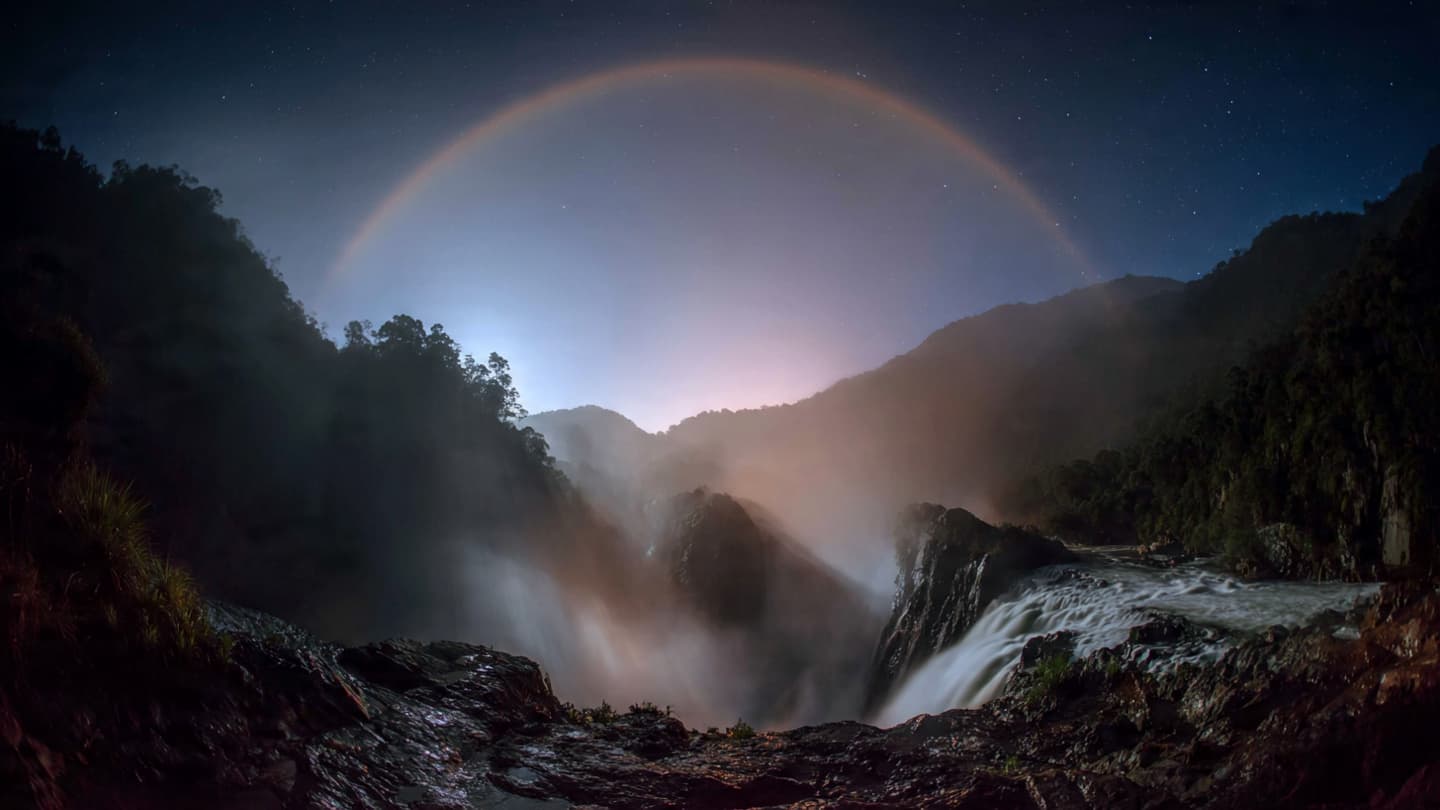
There are moments in nature when light seems to hesitate between worlds, neither fully present nor entirely absent. A moonbow over Victoria Falls belongs to that rare threshold, where night water and lunar glow meet in a quiet dialogue across the mist.
A moonbow, unlike a traditional rainbow, is formed when moonlight rather than sunlight is refracted, reflected, and dispersed through water droplets in the air. At Victoria Falls, the immense curtain of cascading water creates an ideal atmosphere for this phenomenon, where fine mist rises continuously into the night sky.
Victoria Falls, located on the border of Zambia and Zimbabwe, is among the largest waterfalls in the world by combined width and height of falling water. Its local name, “Mosi-oa-Tunya,” meaning “The Smoke That Thunders,” reflects the powerful spray that sustains the delicate optical conditions needed for a lunar rainbow to appear.
The phenomenon is most visible during a bright full moon when the sky is relatively clear and the surrounding air contains enough moisture. Unlike vivid daytime rainbows, moonbows often appear faint and pale, sometimes perceived as white or softly tinted arcs due to the limited sensitivity of human night vision.
Photographers and travelers who witness the event often describe it as both subtle and surreal, requiring patience and favorable timing. The interplay between darkness and reflected light transforms the familiar waterfall into something almost dreamlike, where boundaries between water, air, and sky blur.
Scientific explanations of moonbows remain consistent with basic optics, yet their emotional impact often extends beyond the technical explanation. They serve as a reminder of how natural laws can produce rare beauty when conditions align precisely, even in places already known for dramatic landscapes.
Victoria Falls continues to attract global attention not only for its scale but also for its capacity to produce such uncommon atmospheric effects. The moonbow remains one of its most elusive attractions, appearing only under specific and fleeting conditions.
As with many natural wonders, the moonbow over Victoria Falls is not a guaranteed sight, but a passing alignment of light, water, and time—brief, quiet, and unforgettable for those who witness it.
AI Image Disclaimer: Images associated with this phenomenon may be digitally generated or enhanced for illustrative purposes.
Sources: NASA, National Geographic, BBC Earth, Smithsonian Magazine
Published by Banx Network. This article is part of the Banx decentralized media programme, powered by the BXE token on the XRP Ledger.