From Earth, the Moon appears steadfast and subdued, a pale companion tracing its familiar path across our nights. It feels ancient in a way that suggests permanence, as though whatever forces shaped it have long since gone quiet. Yet in the crystalline memory of lunar rocks, scientists have uncovered evidence of a moment when our satellite was anything but subdued. For roughly 5,000 years, research suggests, the Moon hosted an unexpectedly strong magnetic field — a brief but mighty surge recorded in titanium-rich minerals.
For decades, samples returned by the NASA Apollo missions have offered glimpses into the Moon’s interior history. Many of these rocks, especially volcanic basalts formed billions of years ago, contain tiny magnetic grains. When molten rock cools in the presence of a magnetic field, these grains align like microscopic compass needles, preserving a snapshot of that field’s strength and direction.
Earlier studies indicated that the Moon once possessed a global magnetic field generated by a dynamo in its core, somewhat analogous to Earth’s. But the intensity and longevity of that field have remained subjects of debate. Some samples hinted at magnetism far stronger than models predicted for a small body with a rapidly cooling interior.
Recent analyses of certain titanium-rich lunar basalts suggest that at least part of this strong magnetism may have occurred during a relatively short-lived episode — a burst lasting perhaps 5,000 years. In planetary terms, that is a fleeting interval. Yet the magnetic imprint is pronounced, implying that the Moon’s field during that window rivaled or even exceeded the strength expected from its size.
The key lies in titanium-bearing minerals such as ilmenite. These minerals can enhance the ability of rock to record magnetic signatures faithfully. By carefully reheating and testing lunar samples in laboratory conditions, researchers can estimate the intensity of the ancient field that once surrounded them. The results point to a powerful but transient magnetic event — a “blip” rather than a prolonged era.
What could cause such a surge? Scientists propose several possibilities. One idea is that as the Moon’s molten core crystallized, changes in its internal structure briefly amplified convective motion, strengthening the dynamo. Another hypothesis suggests that large impacts may have mechanically stirred the core, temporarily boosting magnetic output. In either case, the emphasis is on instability and transition rather than steady endurance.
This finding reshapes how researchers think about small planetary bodies. A magnetic field is more than a curiosity; it can shield a world’s surface from solar wind, influence the behavior of charged particles, and affect the retention of tenuous atmospheres. If the Moon experienced intermittent bursts of magnetism, its surface environment may have fluctuated more than previously assumed.
At the same time, caution remains essential. The lunar record is fragmentary. Samples come from limited regions visited during the Apollo program, and each rock captures only its local conditions at the time of cooling. Distinguishing between a truly global magnetic field and localized magnetic effects requires careful comparison across many specimens.
Still, the broader implication is gently transformative. The Moon was not simply born active and then steadily faded. Its internal life may have pulsed, hesitated, and surged in episodes. A 5,000-year interval does not dominate lunar history, which spans more than 4.5 billion years. Yet brevity does not negate significance. In that narrow slice of time, the Moon’s core may have stirred with renewed vigor, leaving behind a magnetic signature strong enough to endure for billions of years.
Today, as new missions prepare to return humans and instruments to the lunar surface, these questions gain renewed relevance. Understanding the Moon’s interior evolution informs not only planetary science but also future exploration. The more we read its rocks, the more the Moon reveals itself as dynamic in ways subtle yet profound.
In the end, the story is not one of contradiction but of nuance. The Moon remains quiet in our sky. But within its ancient stones lies the memory of a brief magnetic heartbeat — a reminder that even worlds we consider settled can carry traces of sudden strength.
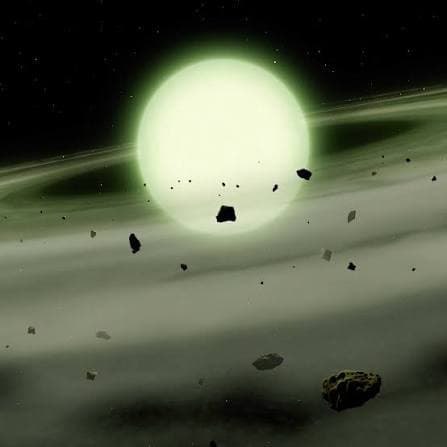
AI Image Disclaimer:
Visuals are created with AI tools and are not real photographs.
Sources:
Nature Science NASA National Geographic Smithsonian Magazine
Published by Banx Network. This article is part of the Banx decentralized media programme, powered by the BXE token on the XRP Ledger.