There is a particular electricity in the final hours of a close race, when the space between certainty and doubt narrows to a single evening. On Thursday night, that evening arrived for Toronto. CP24 hosted the last debate between Olivia Chow and Brad Bradford, four days before polls close, and the numbers leading into it suggested something rare: a race that had tightened to the edge of a statistical tie, with nearly a third of voters saying they were open to changing their minds based on what they heard .
The Nanos Research polling conducted exclusively for CP24 and CTV News Toronto painted a portrait of a contest in motion. Among decided voters, Chow held 49.8 percent to Bradford's 46.6 percent, a lead within the survey's margin of error of plus or minus 3.6 percentage points . Thirteen percent of respondents said they were open to changing their vote based on the debate performance, and another sixteen percent were somewhat open. That means roughly three in ten voters were, in effect, still deciding .
What made the debate potentially decisive was not only the undecided voters but the committed ones. Nik Nanos, CTV News' chief data scientist, noted that more than one in four supporters of both candidates said they might switch based on what they saw Thursday night. "This isn't just about undecided voters," he said. "This is about committed voters for Chow and committed voters for Bradford, saying they would be open to changing their vote" . The debate, in that sense, was less a persuasion exercise for the unaffiliated than a stress test for the already persuaded.
The issues that mattered to viewers were concrete and immediate. A plurality, nineteen percent, named the cost of living as their top concern. Congestion followed at sixteen percent, housing affordability at thirteen, homelessness at ten. Public safety and taxes each drew eight percent . The city's divisions were geographic as well as thematic: Scarborough voters were more likely to name congestion as their priority, while those in Etobicoke, North York, and downtown leaned toward cost of living. The candidates entered the evening with different coalitions to mobilize and different messages to refine.
Bradford, reacting to the poll before the debate, called the race "extremely tight" and urged supporters to turn out. "The only poll that matters is on election day," he said . Chow offered a similar framing, dismissing any suggestion of fading momentum. "It is the people that count, not the polls," she said . Both statements were standard campaign rhetoric, but in a race this close, they carried a weight beyond their familiarity.
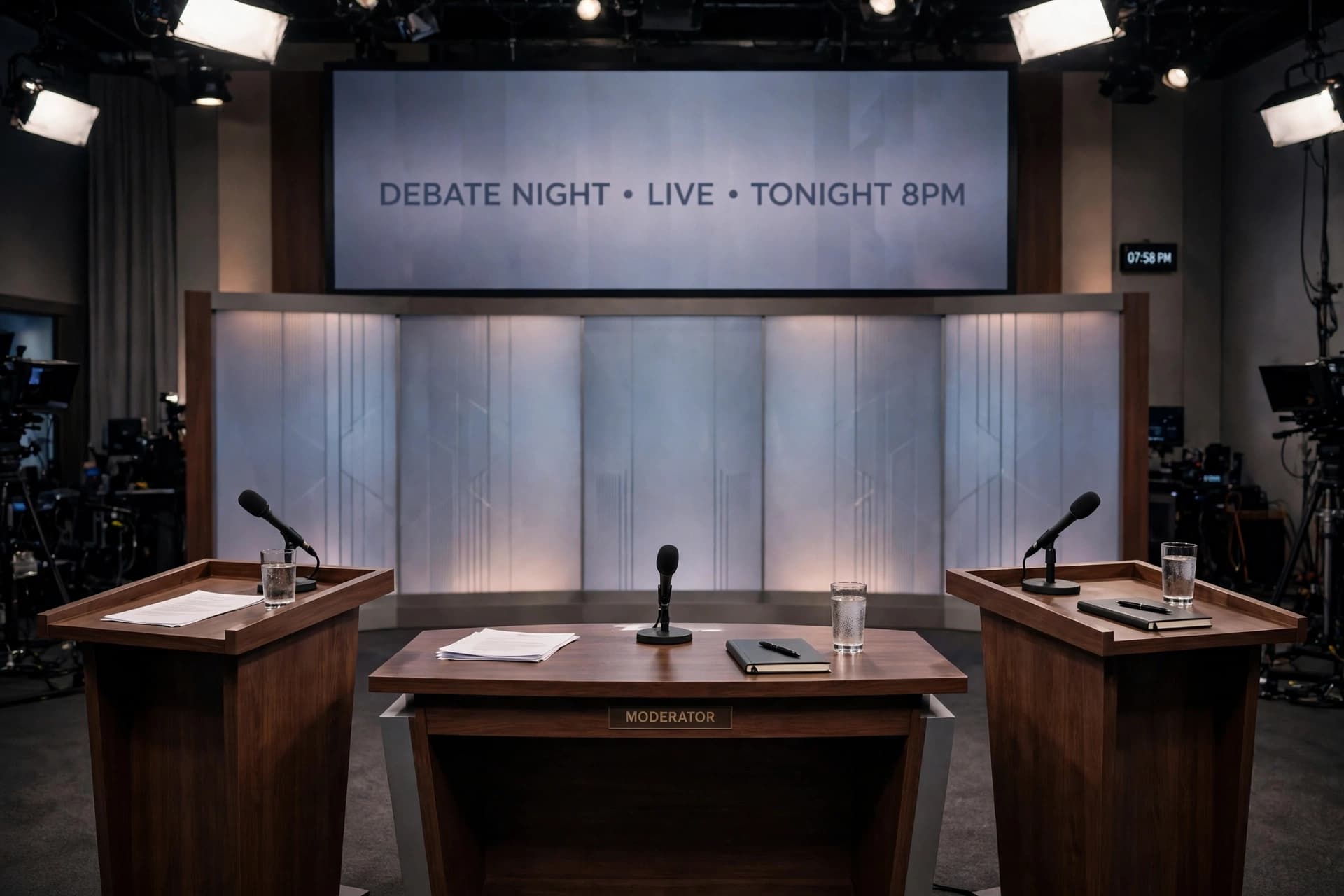
The debate itself was broadcast commercial-free at 7 p.m., moderated by CTV News Toronto anchor Michelle Dube, with Newstalk 1010 host John Moore bringing viewer questions . It was, by the assessment of Nanos and others, a moment that could define the campaign. Whether it did will be known on October 26, when Toronto voters make their final choice. For now, the evening stands as the last clear opportunity for both candidates to speak directly to a city that has not yet made up its mind.
---
Image Disclaimer: The visuals in this article are AI-generated and are not actual photographs of the debate or the candidates.
Sources: CP24, CTV News Toronto, Nanos Research
Published by Banx Network. This article is part of the Banx decentralized media programme, powered by the BXE token on the XRP Ledger.