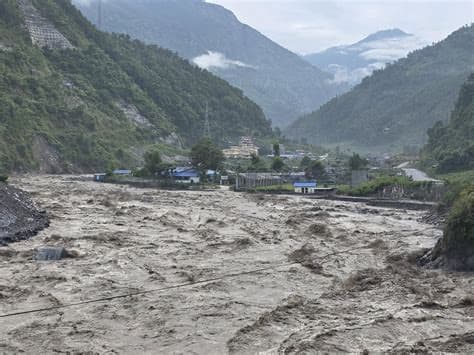
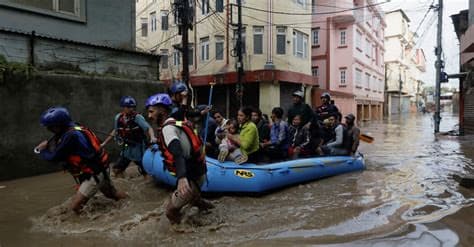
There are moments when the land no longer holds its shape as we remember it. Roads, once certain and continuous, begin to falter—not abruptly, but through a gradual surrender to water and gravity. Rain falls, not as a passing event, but as a sustained presence, soaking into soil, gathering in low places, loosening what once felt firm.
Across parts of New Zealand, that quiet transformation has taken hold. Heavy rain has settled over the landscape, and with it has come a series of disruptions that unfold not all at once, but in sequence—first the pooling of water, then the softening of ground, and finally the slow movement of earth itself.
Slips have begun to edge across roads, sometimes partially, sometimes with enough force to block entire routes. Hillsides, saturated beyond their limits, release sections of soil that drift downward, reshaping the margins of highways and rural roads alike. What was once a clear line of travel becomes uncertain, narrowed or entirely closed.
Flooding follows its own path. Water gathers in depressions, spills over drains, and stretches across roadways, turning surfaces into reflective planes where depth is difficult to judge. In these moments, movement becomes a calculation—drivers slowing, turning back, or waiting as conditions shift hour by hour.
Authorities have responded by closing multiple roads as conditions deteriorate. These closures are not always permanent; some are temporary pauses, held in place until water recedes or debris is cleared. Others remain uncertain, dependent on further rainfall and the stability of surrounding land.
Emergency services and transport agencies continue to monitor affected areas, assessing where it is safe to reopen and where further caution is required. In some regions, warnings have been issued for motorists to avoid unnecessary travel, particularly in areas prone to slips or sudden flooding.
The pattern reflects a broader rhythm seen during periods of intense rainfall. The land absorbs until it cannot, and then begins to move—not dramatically, but steadily, altering the routes that connect communities. Roads, often taken for granted, reveal their dependence on conditions beyond the surface.
Forecasts indicate that while some easing may occur, further showers remain possible in the coming days, particularly early in the week. This suggests that the landscape may continue to shift in small ways, even as immediate conditions improve.
Heavy rain has caused slips, flooding, and multiple road closures across affected regions in New Zealand. Authorities are advising caution, with ongoing monitoring and response efforts as weather conditions evolve.
AI Image Disclaimer
This imagery has been generated using artificial intelligence and is intended for illustrative purposes only.
Source Check:
NZ Herald RNZ Otago Daily Times Stuff
Published by Banx Network. This article is part of the Banx decentralized media programme, powered by the BXE token on the XRP Ledger.