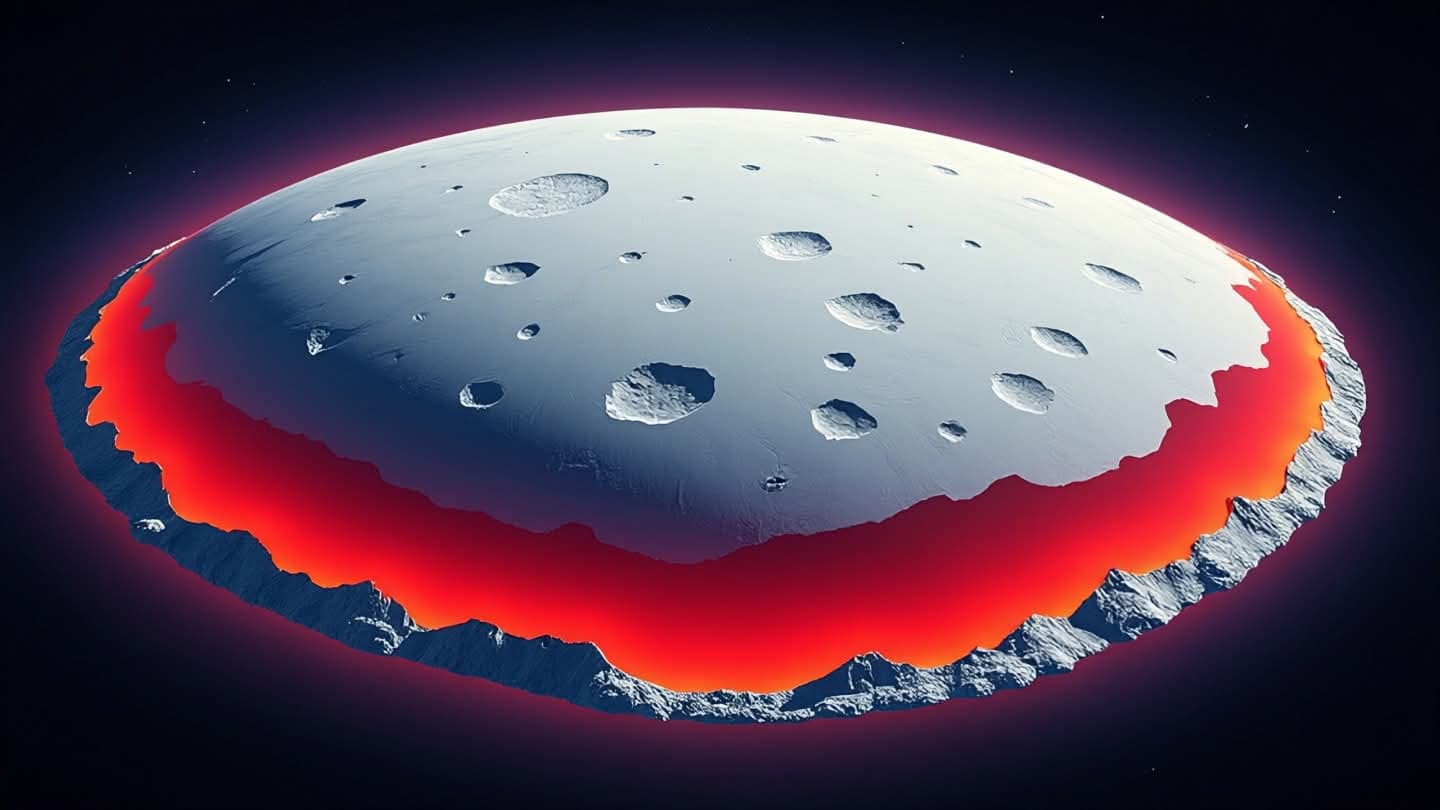
Not everything that shapes a galaxy announces itself with light. Some forces move without color or sound, passing through stars and dust as if they were little more than shadows. Dark matter belongs to this quiet category, present not by what it shows, but by what it subtly moves.
For decades, scientists have understood dark matter as an invisible framework holding galaxies together. It does not emit light, nor does it reflect it, yet its gravitational pull quietly guides the motion of stars and gas. Recently, researchers have begun to explore a more intricate question: what happens when dark matter itself interacts or collides within a galaxy?
The idea suggests that under certain conditions, dark matter particles could collide or interact in ways that leave indirect traces. These traces would not appear as bright flashes or visible debris, but as faint disturbances in galactic structure. Slight irregularities in star motion, unexpected density patterns, or subtle heating of surrounding matter could serve as clues that something unseen has passed through.
Such possibilities remain grounded in theory and careful simulation. Scientists rely on computer models and deep-space observations to compare expected galactic behavior with what telescopes actually record. When discrepancies appear—motions that seem slightly off balance or structures that resist simple explanation—dark matter interactions become one of several hypotheses considered.
What makes this research compelling is its restraint. No single observation is treated as final proof. Instead, evidence accumulates slowly, layered observation upon observation, much like mapping footprints long after the traveler has gone. The search is less about certainty and more about narrowing possibilities in a universe that rarely offers simple answers.
At present, studies continue through advanced simulations and next-generation telescopes designed to observe galaxies with greater precision. While direct confirmation remains elusive, scientists agree that exploring these interactions deepens understanding of how galaxies evolve. The question of whether dark matter collisions leave lasting galactic traces remains open, approached steadily through ongoing research rather than dramatic conclusion.
AI Image Disclaimer
Graphics are AI-generated and intended for representation, not reality
Sources identified (media names only):
1. NASA 2. Nature 3. Science Magazine 4. Space.com 5. European Space Agency
نُشر بواسطة Banx Network. هذا المقال جزء من برنامج الوسائط اللامركزية من Banx، مدعومًا برمز BXE على شبكة XRP Ledger.