
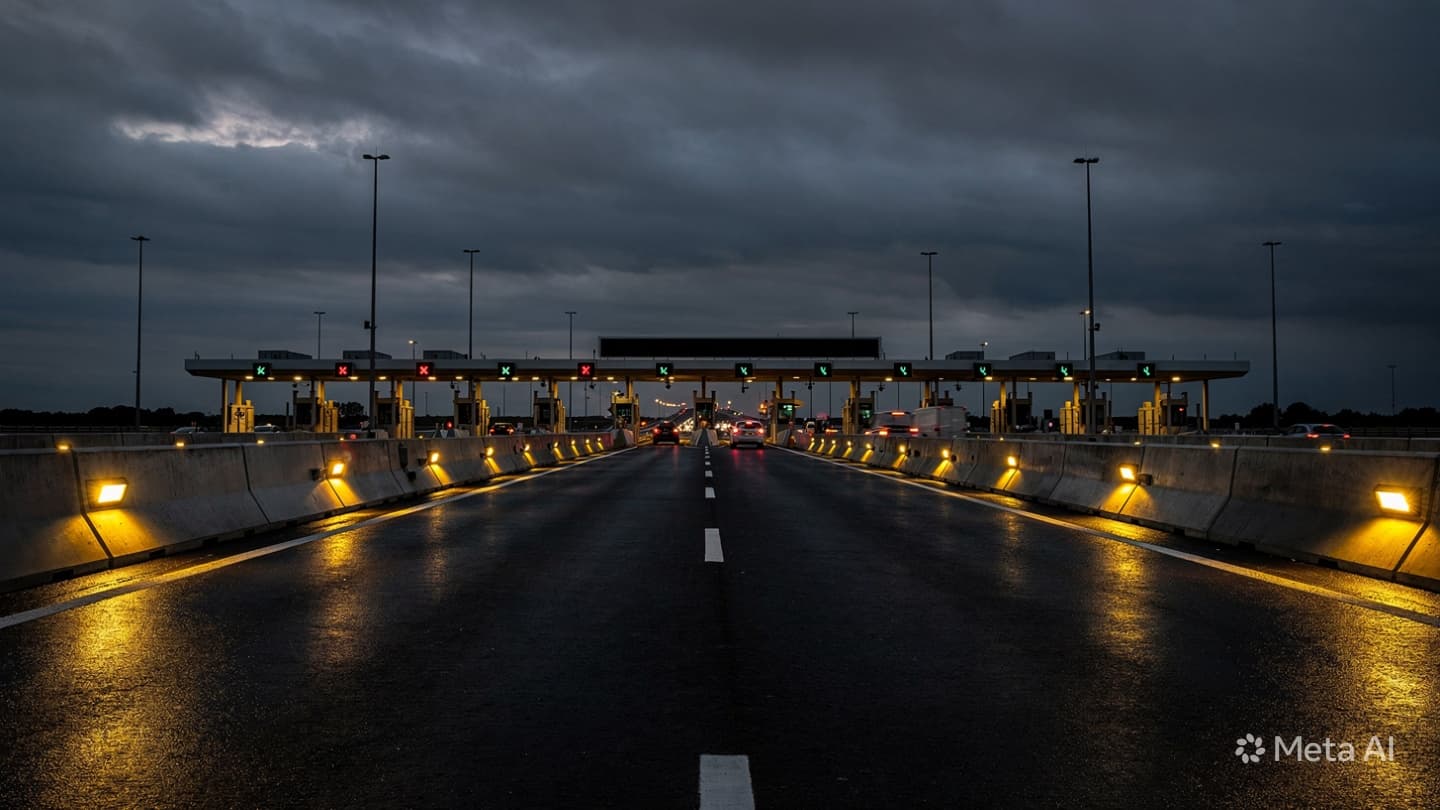
The long concrete approaches to a provincial toll plaza possess a stark, geometric regularity, where lanes converge into narrow channels designed to temporarily check the momentum of a moving world. Life within these concrete islands moves to a repetitive, transactional rhythm, governed by the flashing green signals, the sliding open of glass windows, and the brief exchange of transit slips. To an outside observer, the toll plaza appears as a bastion of absolute order, a controlled threshold where the vast velocity of the highway is systematically tamed and recorded. Yet, this entire network relies on a fragile assumption—that the massive machinery entering these lanes possesses the mechanical ability to slow down.
The heavy freight carriers that traverse the trans-provincial corridors carry a profound physical momentum, their enormous mass turning them into unstoppable vectors when mechanical systems fail. Down the long, steep gradients leading from the mountain passes, drivers must constant contend with the thermal limits of their brakes, balancing weight against gravity over miles of descending asphalt. When a catastrophic loss of control occurs, the vehicle separates itself from the rules of the road, becoming an unpredictable force moving toward a fixed point. In these brief sequences, the highway infrastructure transforms from a system of guidance into a landscape of extreme peril.
Inside the small, enclosed booth, the toll collector operated within a zone defined by service and routine, completely insulated from the heavy physics of the vehicles rolling past the glass. It is a space where the vast scale of regional logistics is reduced to a series of polite encounters with passing strangers. The sudden approach of an unbraked vehicle carries an unfamiliar, terrifying sound that shatters the plaza’s predictable cadence long before the impact occurs. In the confined interior of the workstation, the delicate balance of a normal shift dissolved in an instant under the weight of a mechanical failure that allowed no time for escape.
The collision, when it materialized, was a sudden and violent manifestation of momentum meeting stationary architecture, leaving a landscape of fractured steel and scattered glass across the plaza lanes. The sound of the impact traveled far along the concrete barriers, a sharp declaration that the orderly flow of the expressway had been tragically compromised. Within the debris of the destroyed structure, the true cost of the mechanical failure was revealed slowly, creating a painful contrast between the anonymous movement of freight and the irreplaceable loss of a life. The plaza grew still, its warning lights flashing in a rhythmic, somber sequence against the afternoon sky.
The loss of a worker within these transit sanctuaries brings a specific, lingering gravity to the highway network, reminding the commuter of the invisible vulnerabilities that accompany our modern infrastructure. The individual who perished was an anchor of the road’s daily operation, their life abruptly halted at the intersection of commerce and mechanical failure. It forces an unspoken reflection on how quickly our systems of convenience can transform into theaters of raw, unvarnished tragedy when the tools of transport escape our control. The surrounding lanes were quickly cordoned off, the traffic slowing to a cautious crawl as drivers looked on through their windows.
By dusk, the arrival of heavy recovery equipment and highway inspectors converted the plaza into a highly scrutinized zone of forensic analysis, their floodlights illuminating the twisted framework of the booth. The work of clearing the lanes and restoring the flow of transit is handled with a clinical, methodical focus, a necessary process to prevent regional gridlock. Yet, despite the speed with which the physical reminders are managed, the emotional residue of the event settles deep into the concrete foundation. For those who return to work the neighboring booths tomorrow, the environment will carry a quiet, persistent shadow that no amount of repair can entirely erase.
The investigations carried out by the highway authority are meticulous, tracing the truck’s mechanical history, brake temperature, and skid marks to understand exactly where the system dissolved. It is a necessary ritual of documentation, translating an hour of mechanical terror into a series of causal data points meant to reinforce future safety regulations. The structural integrity of the booths, the placement of safety barriers, and the length of runaway truck ramps will all be re-evaluated in the wake of the disaster. But for the family of the worker, the data offers no comfort against the sudden silence that reconfigured their evening.
Eventually, the plaza will be fully restored, a new booth will be anchored to the island, and the automated gates will resume their rhythmic lifting and lowering. The thousands of logistics trucks that pass through the gate next week will have little indication of what transpired, save perhaps for the unblemished grey of fresh concrete or a new protective pillar. The highway remains an institution that demands continuous motion, a space that must purge its own tragedies to keep the economic arteries of the province clear. But for a short while, the closed lane remains a monument to a quiet, collective sorrow, reminding the observer of the fragile human presence at the center of our massive networks.
The Shaanxi Highway Authority confirmed that a runaway freight truck suffered total brake failure and crashed into a toll plaza on the West Han Expressway on June 13, 2026, killing one toll collector. Official reports indicate the heavy vehicle descended a steep mountain gradient before losing control and striking the structure at high speed. Emergency medical personnel and structural rescue teams were dispatched to the site immediately, but the occupant of the booth sustained fatal injuries and was pronounced dead at the scene. The truck driver survived the impact with moderate injuries and is currently cooperating with law enforcement officials as a formal investigation into the vehicle's mechanical compliance is conducted.
Published by Banx Network. This article is part of the Banx decentralized media programme, powered by the BXE token on the XRP Ledger.


