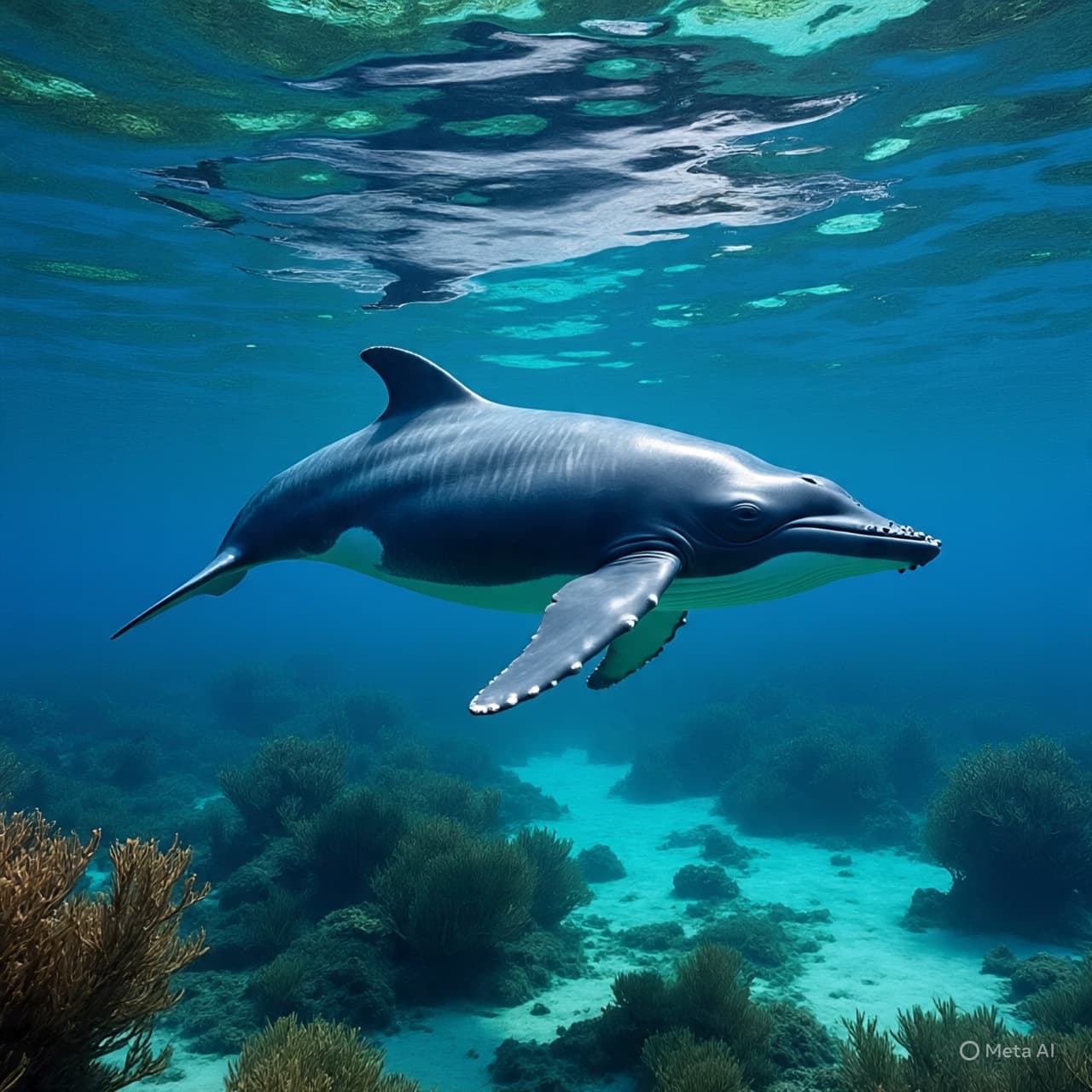
Far from the shore, where sunlight softens and the sea stretches into quiet blue distance, some of the ocean’s most secretive lives unfold unseen. Among them swims the pygmy sperm whale, a creature that rarely shows itself to human eyes. It moves through deep waters with quiet patience, leaving behind only fragments of its story for science to gather.
Because these whales are so rarely observed in the wild, much of what scientists know about them comes from unexpected encounters along coastlines—moments when the sea returns one of its travelers to shore. In these rare moments, researchers find not only the body of an elusive animal, but also a chance to listen to the quieter voices within it.
Recently, scientists studying stranded pygmy sperm whales uncovered something remarkable: previously unknown bacteria living deep inside the animals’ stomach tissues. The discovery emerged from long-term research led by scientists connected to Florida Atlantic University’s Harbor Branch Oceanographic Institute, drawing on more than two decades of samples and records.
Through careful genetic analysis, researchers identified three new genotypes of bacteria belonging to the Helicobacter group. These newly recognized forms have been provisionally named Kogia Helicobacter 1, 2, and 3. The findings represent the first confirmed identification of these specific bacterial types within pygmy sperm whales.
The pygmy sperm whale, known scientifically as Kogia breviceps, has long been considered one of the ocean’s more mysterious marine mammals. Unlike larger whale species that frequently breach or migrate close to coastlines, these animals spend most of their lives offshore. They travel quietly in small groups and dive deep to hunt squid and fish, making direct study extremely difficult for scientists.
As a result, the internal biology of these whales has remained largely unexplored. The newly discovered bacteria therefore open a small but meaningful window into the hidden microbial ecosystems that may exist within marine mammals.
Members of the Helicobacter group are already known to scientists in many contexts. Some species inhabit the stomachs of humans and animals, where they can influence digestion, health, or disease. Finding distinct Helicobacter variants in pygmy sperm whales suggests that these marine mammals may host specialized microbial communities adapted to life in deep-ocean species.
Yet the discovery is less about alarm and more about curiosity. Researchers emphasize that the presence of bacteria does not automatically imply illness. In many organisms—including humans—microbes form complex and sometimes beneficial relationships with their hosts. The whale’s microbiome may therefore represent an ordinary part of its biology, quietly assisting digestion or interacting with the animal’s immune system.
What makes the discovery especially significant is the way it broadens the map of life in the ocean. Marine mammals, like whales and dolphins, occupy unique ecological positions. Their bodies can host microorganisms that reflect the chemical environment of the deep sea, the prey they consume, and the long evolutionary paths that shaped their species.
By examining stranded whales collected over decades, scientists were able to detect patterns that might otherwise remain invisible. Each genetic sequence, each bacterial strain, becomes a small piece in a much larger puzzle: how life adapts and diversifies in the vast marine world.
For researchers studying ocean ecosystems, these findings hint at how much remains unseen beneath the waves. If an elusive whale—already difficult to observe—carries microorganisms that science has never recorded before, it suggests that entire microbial landscapes may still wait quietly inside other marine species.
The discovery does not close a mystery; instead, it gently opens a new set of questions. How widespread are these bacteria among whales? Do they play a role in digestion or health? Are they unique to pygmy sperm whales, or shared among other deep-diving cetaceans?
For now, scientists regard the findings as a starting point for further exploration. As genetic tools grow more precise and long-term marine research continues, the invisible companions of ocean life may slowly become easier to understand.
In the end, the story is less about bacteria than about perspective. Even within one of the ocean’s most elusive whales, entire communities of microscopic life may be quietly thriving—reminding us that the sea still holds countless layers of discovery.
The research, published in the Journal of Wildlife Diseases, provides one of the most detailed glimpses yet into the microbiological world associated with pygmy sperm whales and encourages continued study of marine mammal health and ecology.
AI Image Disclaimer Illustrations were produced with AI and serve as conceptual depictions.
Sources Phys.org ScienceDaily SciTechDaily Journal of Wildlife Diseases Florida Atlantic University Harbor Branch Oceanographic Institute
Published by Banx Network. This article is part of the Banx decentralized media programme, powered by the BXE token on the XRP Ledger.