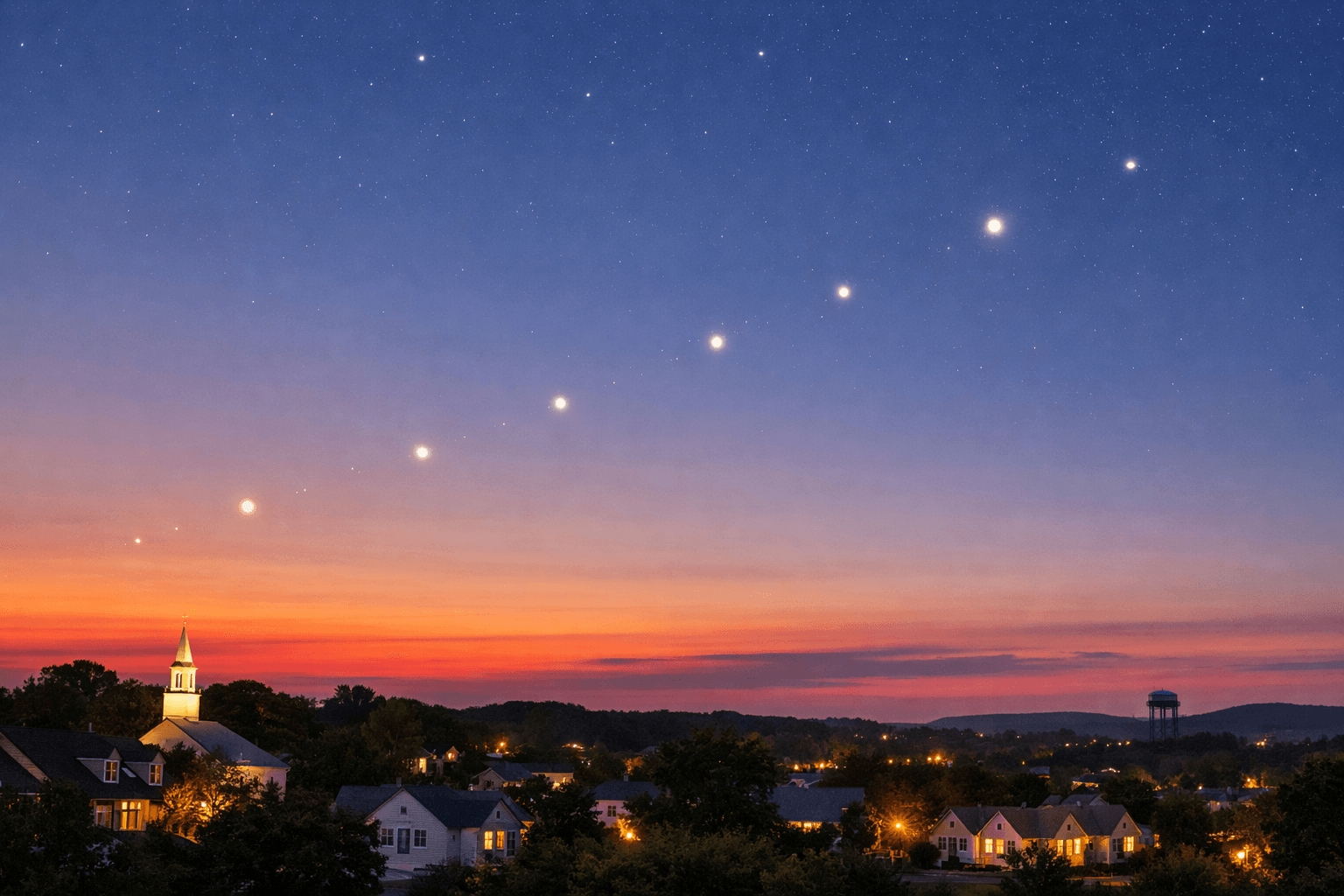
There are evenings when the sky feels closer than usual, as if the vastness above has decided, gently, to lean toward us. On such nights, people step outside not because they must, but because something quiet and ancient seems to be calling them. Tonight in Connecticut, that invitation arrives in the form of a rare alignment — a “planetary parade,” as described by NASA — where several planets appear to line up across the dark canvas of the sky. The phrase itself carries a certain poetry. A parade suggests procession, order, a shared direction. Yet in truth, the planets are not marching in formation. They remain millions — even billions — of miles apart, each following its own gravitational path around the Sun. What changes is our vantage point here on Earth. From where we stand, looking outward, their positions align in such a way that they seem to trace a gentle arc across the horizon. According to NASA, this evening’s display offers viewers in Connecticut an opportunity to spot multiple planets shortly after sunset, depending on local weather and light conditions. Typically, alignments like this may include bright, easily visible planets such as Venus or Jupiter, with others requiring binoculars or a small telescope. Clear skies and a low western horizon can make the difference between a fleeting glimpse and a lingering memory. Events described as planetary parades occur from time to time, though each carries its own configuration. They are not once-in-a-lifetime phenomena, but neither are they routine. The rarity lies less in the mathematics of orbital mechanics and more in the simple fact of attention. Many alignments pass unnoticed, hidden behind clouds or city lights, or overlooked in the pace of everyday life. Astronomers often note that alignments are visual coincidences rather than physical gatherings. The planets do not cluster together in space; instead, they line up along the ecliptic — the apparent path the Sun takes across our sky — because the solar system itself formed from a flattened disk. As a result, most planets orbit in roughly the same plane, creating the possibility for these graceful visual arrangements. For observers in Connecticut, timing will be important. Shortly after sunset, when the sky is dim enough for planets to emerge but not yet fully dark, the brightest among them may become visible to the naked eye. As twilight deepens, additional points of light may appear, steady and unwavering compared to the twinkle of distant stars. Those with optical aids might discern subtle color differences — the creamy glow of Venus, the steady brilliance of Jupiter, or the faint reddish hue of Mars, if it is part of the lineup. NASA encourages skywatchers to check local forecasts and viewing charts before heading outdoors. Light pollution can soften the spectacle, so suburban or rural areas may offer clearer views than brightly lit city centers. Still, even in towns and neighborhoods, a brief upward glance may be enough to feel the quiet symmetry of the moment. In a time when much of life unfolds on screens, a planetary parade asks for something simpler: a pause, a patch of open sky, and a willingness to look up. The alignment does not alter the orbits of worlds, nor does it signal any cosmic upheaval. It is, instead, a reminder of scale and continuity — that our planet shares a disciplined dance with others, each moving according to laws written long before human history began. Tonight’s alignment will eventually dissolve as the planets continue along their separate paths. The arc will stretch, shift, and fade into ordinary spacing. But for a few hours, at least, the sky over Connecticut will hold a pattern that invites reflection. NASA describes the event as an accessible opportunity for public engagement with astronomy. With clear conditions and modest preparation, residents may witness several planets sharing the same stretch of sky. And when the evening grows darker and the chill settles in, the procession will continue silently overhead, whether observed or not — a calm reminder that even in their distance, the planets remain part of our shared horizon.
AI Image Disclaimer Visuals are created with AI tools and are not real photographs.
Published by Banx Network. This article is part of the Banx decentralized media programme, powered by the BXE token on the XRP Ledger.