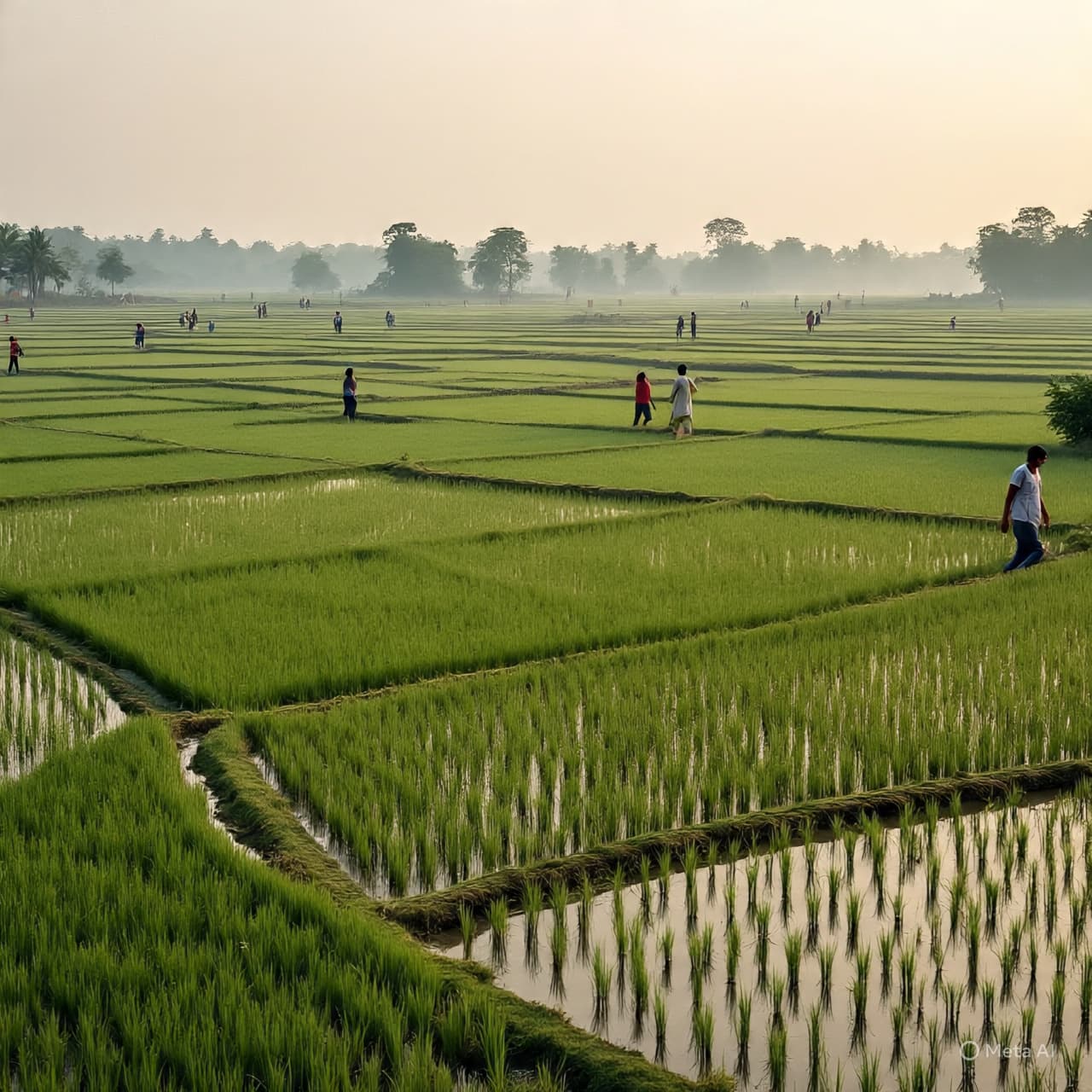
Morning in the paddy fields begins with repetition. Water settles, seedlings align, and the work moves forward at a pace set by seasons rather than headlines. Yet sometimes, the cumulative effect of those small, steady motions becomes visible far beyond the fields themselves. Such a moment has arrived as India moves past China to become the world’s largest producer of rice.
The shift reflects years of incremental change rather than a single dramatic harvest. India’s output has continued to rise, supported by expanded acreage, improved seed varieties, and sustained government support for farmers. Favorable monsoon patterns in recent seasons have added to that momentum, allowing production to edge higher even as global conditions remain uneven.
China, long the dominant producer, has seen its own output stabilize rather than collapse. Urbanization, water constraints, and policy priorities have gradually limited expansion in key growing regions. The result is not a sharp reversal, but a quiet recalibration, where leadership changes hands through accumulation rather than disruption.
Rice occupies a particular place in India’s economy and culture, linking rural livelihoods with national food security. As production has grown, exports have also played a larger role, positioning the country as a central supplier to global markets, especially for nations sensitive to price and availability. This dual role, feeding both domestic demand and international trade, has amplified the significance of India’s production gains.
For global markets, the shift carries practical implications. Supply stability, pricing dynamics, and policy decisions in New Delhi now resonate more widely. Restrictions or incentives introduced by India can ripple through importing countries, shaping access and affordability for millions who rely on rice as a staple.
The transition also highlights broader patterns in Asian agriculture. Climate variability, water management, and demographic change are increasingly decisive factors. Leadership in production is no longer assured by tradition alone, but by adaptation to these pressures.
As the latest figures settle, the change in ranking stands as a marker rather than a finale. Production levels will continue to fluctuate with weather and policy. Yet for now, the balance has shifted. India’s fields, shaped by monsoon rains and human labor, have collectively placed the country at the forefront of the world’s rice supply.
Published by Banx Network. This article is part of the Banx decentralized media programme, powered by the BXE token on the XRP Ledger.