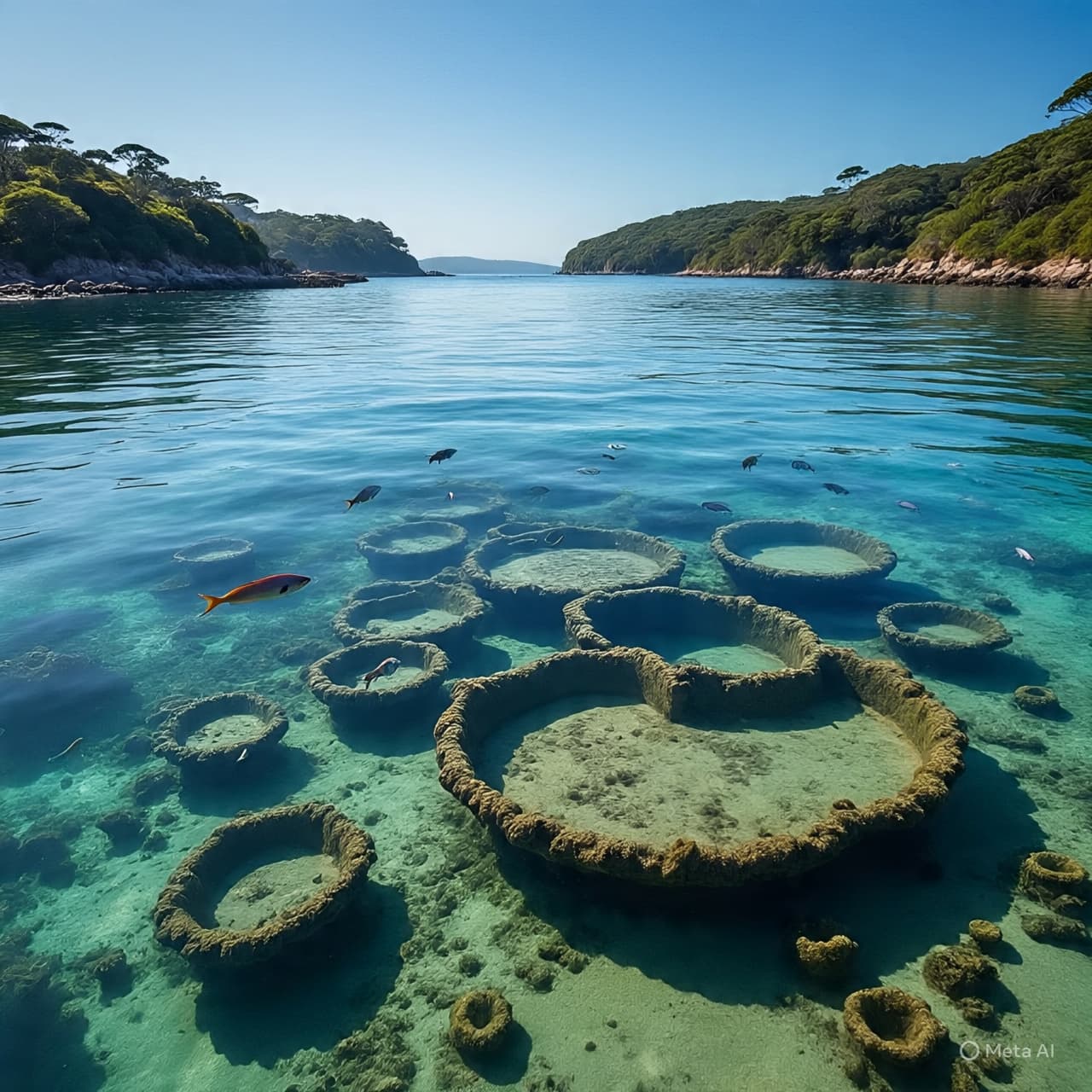
There are cities that grow upward, and there are cities that grow outward. Sydney, cradled by its luminous harbor, did both — stretching its skyline toward the clouds while quietly reshaping the waters below. Long before ferries traced white lines across the blue, before seawalls squared off the shoreline, the harbor held cathedrals of shell. Oyster reefs once formed intricate cities of their own, rising layer upon layer, filtering the tides, softening the waves, and giving shelter to countless small lives.
In the earliest years of colonization, these reefs were seen less as architecture and more as resource. Oysters were harvested for food; their shells were burned for lime to build the colony’s first stone structures. Over time, dredging and shoreline development swept away what had taken centuries to form. By the late nineteenth century, Sydney’s natural oyster reefs — once vast and thriving — had largely vanished. The harbor remained beautiful, but something foundational had been removed, as if a library had lost its shelves.
For generations, the disappearance lingered as a historical footnote. Yet science, patient and persistent, has returned to the question of what was lost — and what might be rebuilt.
Marine ecologists now understand oyster reefs not merely as clusters of shellfish but as living infrastructure. Each oyster filters water, removing excess nutrients and suspended particles. Together, reefs act as natural purification systems, clarifying the harbor and improving conditions for seagrass and fish. Their rough, layered surfaces create habitat for crabs, small fish, and invertebrates, increasing biodiversity in ways seawalls and concrete cannot replicate. And as climate change intensifies storms and sea-level rise, oyster reefs serve as quiet breakwaters, absorbing wave energy and protecting shorelines.
In recent years, restoration projects across New South Wales have begun translating this knowledge into practice. Scientists have experimented with different reef designs — varying the size and arrangement of shell substrate, adjusting elevation to account for tidal patterns, and selecting oyster species suited to local conditions. Monitoring has revealed that placement matters: reefs positioned at optimal tidal heights show higher survival and faster growth. Structural complexity — the careful stacking of shell and rock — improves habitat value and resilience.
What emerges from this research is not simply a blueprint, but a reminder. Restoration is less about imposing something new and more about listening to the rhythms that once guided the harbor. By studying historical records and sediment cores, researchers have mapped where reefs once flourished. By observing water flow and salinity, they have learned how to give oysters the conditions they need to anchor and thrive again.
The work is gradual. Oysters grow in seasons, not headlines. But early results are encouraging: increased marine life around pilot reefs, improved water clarity in localized areas, and a growing public awareness that the harbor’s health is intertwined with its past. Community volunteers now help lay shell, school groups visit restoration sites, and policymakers are beginning to view reefs as allies in coastal management rather than relics of another era.
Sydney’s skyline still gleams in the sun. Ferries still cut across Circular Quay. Yet beneath the surface, in carefully chosen pockets, a quieter reconstruction is underway. The reefs will not return overnight, nor exactly as they were. Time alters all landscapes. But science has illuminated a path forward — one that blends memory with method.
In restoring oyster reefs, Sydney is not turning back the clock. It is acknowledging that progress can include repair. The harbor, shaped by both ambition and oversight, now hosts an experiment in balance. And as small shells begin to knit themselves into structure once more, they suggest that even what was dredged away can, with patience and knowledge, find its way home.
AI Image Disclaimer Illustrations were produced with AI and serve as conceptual depictions.
Sources
The Guardian ABC News Australia The Sydney Morning Herald Australian Geographic Nature Communications
Published by Banx Network. This article is part of the Banx decentralized media programme, powered by the BXE token on the XRP Ledger.