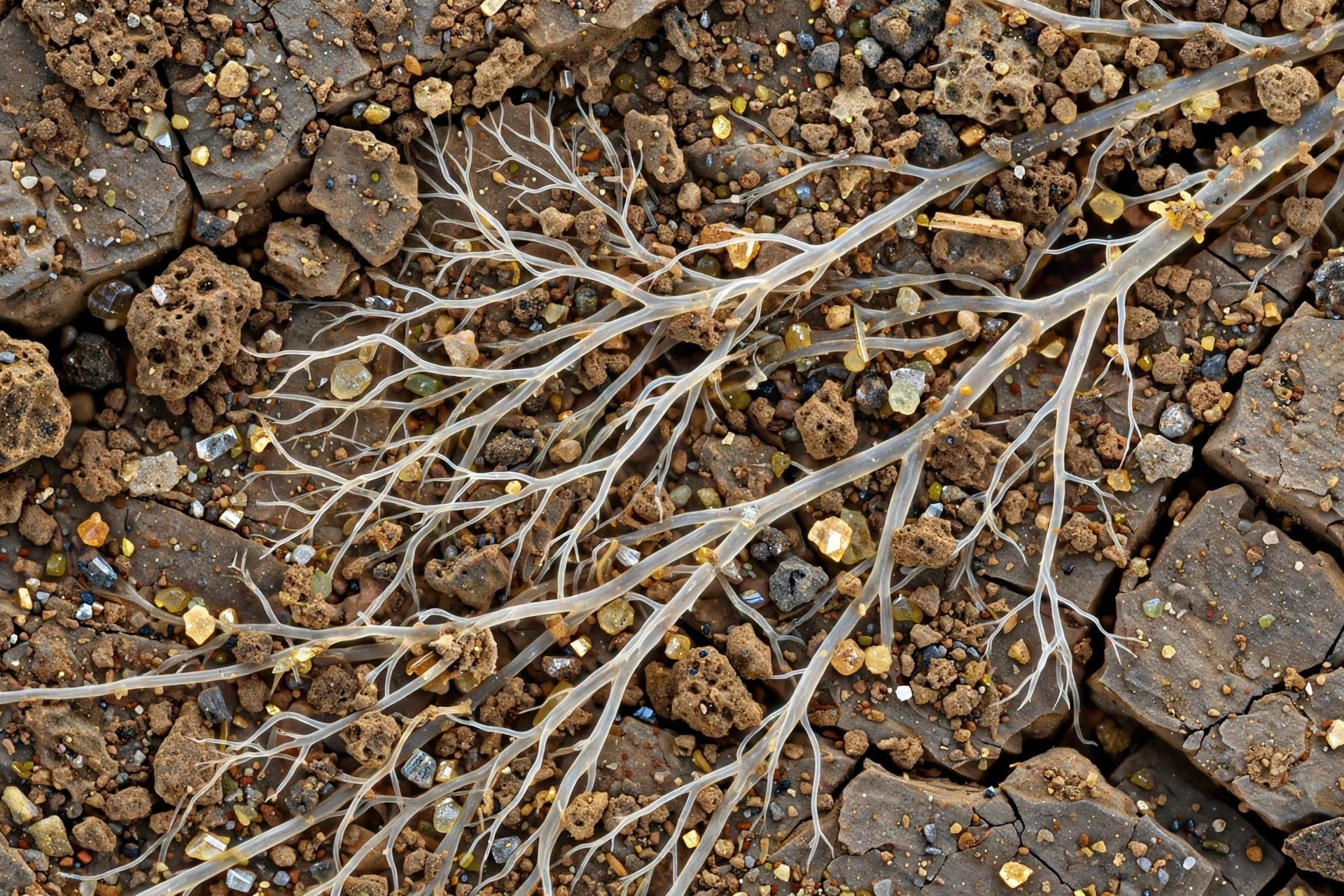
There is a kingdom beneath our feet that we rarely see and almost never thank. It threads through soil and rock, through roots and decaying wood, a vast network of microscopic filaments that has been shaping the surface of the Earth for longer than plants have had leaves. We call it mycelium, the vegetative body of fungi, and its story is older and stranger than most of us have been taught.
How old? The question is harder to answer than it might seem. Fungi are soft-bodied, and soft bodies do not fossilize well. The oldest confirmed mushroom fossils date to about 460 million years ago, but that is almost certainly not when fungi began. Molecular clocks and rare fossil traces push the origin of the fungal kingdom back much further, into the shadows of the Proterozoic . A study published in Science Advances described mycelium-like fossils in rocks between 715 and 810 million years old from the Democratic Republic of the Congo, identified through chemical traces of chitin and evidence that the organisms were eukaryotes . Other researchers have reported filamentous fossils in 2.4-billion-year-old basalt from South Africa that resemble mycelial structures, though whether they represent true fungi or an unknown fungus-like branch remains debated .
What is clear is that mycelia were present long before the first plants colonized land. When early terrestrial plants began to spread across bare rock and thin soil, fungi were already there, their hyphae penetrating cracks and releasing enzymes that dissolved minerals, slowly building the first soils . Many of those early plants depended on fungal partners to supply water and nutrients, a partnership that persists today in the mycorrhizal networks that connect forests underground.
The scale of mycelial networks is difficult to imagine. A single teaspoon of forest soil can contain hundreds of meters of fungal filaments. Some mycelial networks span hectares, linking trees and transferring nutrients and chemical signals between them. The largest known organism on Earth, by some measures, is a mycelial network of Armillaria in Oregon, spreading across nearly four square miles. These networks are not sentient, but they are communicative, responsive, and ancient in ways that unsettle our usual categories of individual and community.
There is a particular humility that comes from considering this timeline. One billion years is a number that resists intuition. It encompasses the assembly and breakup of supercontinents, the rise and fall of entire phyla, the slow oxygenation of the atmosphere. Through all of it, mycelia have persisted, adapting to conditions we can only reconstruct from isotopes and sediment. They have survived mass extinctions that erased most of the species we know from the fossil record. They are, in a sense, the quiet constant in a story of constant change.
The study of mycelial origins is not merely an exercise in deep time. Understanding how fungi weathered past climate shifts and how they partnered with plants during the colonization of land may inform how we think about ecosystems under stress today. Mycorrhizal networks are increasingly recognized as critical to forest health, carbon storage, and soil stability. The kingdom beneath our feet is not a curiosity. It is infrastructure.
So the next time you walk through a forest, consider what lies below. The mushrooms you see are only the fruiting bodies, the brief reproductive gestures of something far larger and far older. The real organism is the network, silent and spreading, a billion years in the making.
Image note: The accompanying visual is an AI-generated illustration and does not represent actual fossil or microscopic imagery.
Sources: Science Advances, GFZ German Research Centre for Geosciences, Europe PMC, Nature, De Gruyter
Published by Banx Network. This article is part of the Banx decentralized media programme, powered by the BXE token on the XRP Ledger.