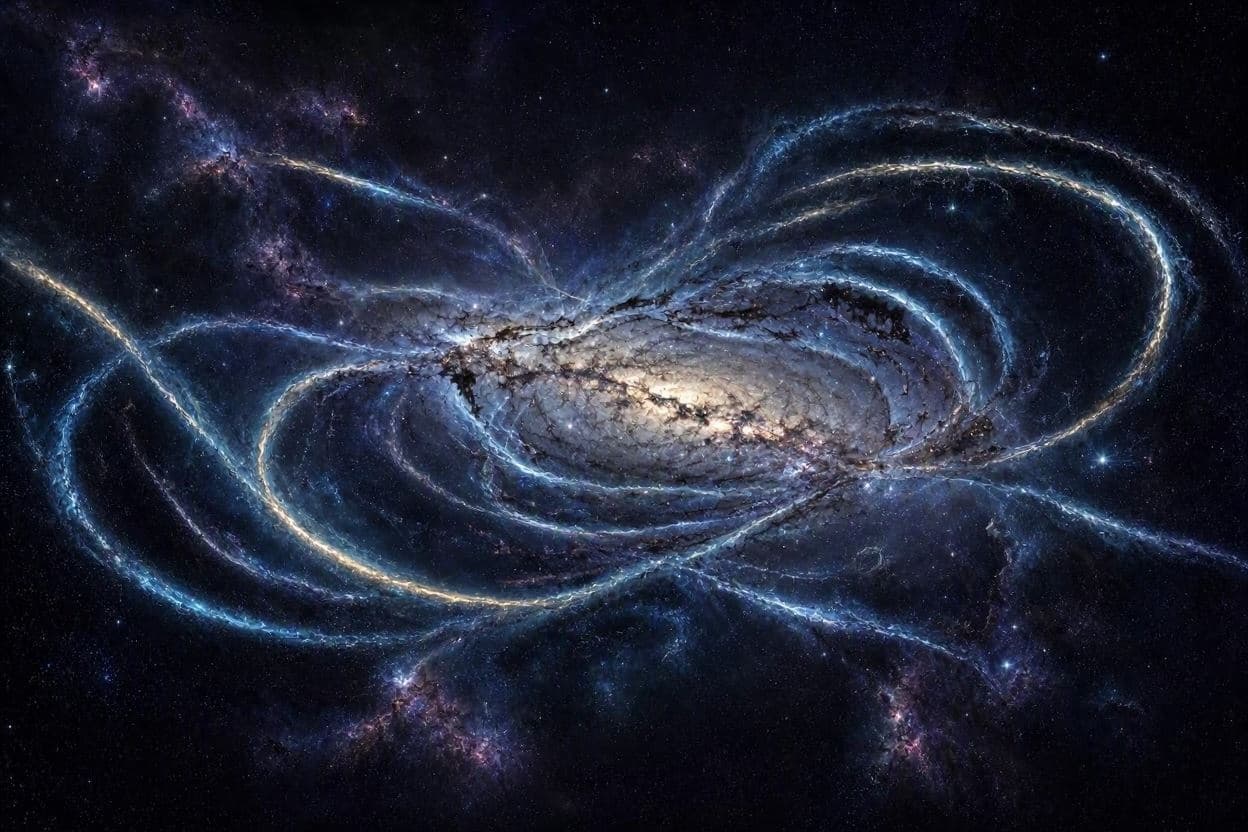
In the quest to understand the invisible scaffolding of the universe, astronomers often look for subtle disturbances in the motion of stars. These ripples, known as stellar streams, are thought to be caused by the gravitational pull of dark matter subhalos. However, new simulations suggest that the Milky Way’s own complex structure may be creating similar patterns, complicating the search for dark matter and urging a reevaluation of existing models.
Stellar streams are long trails of stars torn from dwarf galaxies or globular clusters as they orbit the Milky Way. They act like sensitive detectors, responding to gravitational tugs from unseen mass. For years, gaps and wiggles in these streams have been interpreted as evidence of dark matter clumps passing through them. But recent high-resolution simulations indicate that the bar and spiral arms of the Milky Way itself can produce similar distortions.
The Milky Way is not a static disk; it is a dynamic system with a rotating central bar and swirling spiral arms. As stars move through these structures, their orbits are perturbed, creating density variations and gaps that mimic the signatures of dark matter interactions. This "noise" from the galaxy’s own gravity makes it difficult to distinguish between internal dynamics and external dark matter influences.
Researchers used advanced computational models to simulate the evolution of stellar streams within a realistic Milky Way potential. By including the effects of the bar and spirals, they found that many of the observed anomalies could be explained without invoking dark matter subhalos. This finding does not disprove the existence of dark matter, but it suggests that some previously attributed signals may be false positives.
The implications for dark matter detection are significant. If standard models overestimate the number of dark matter clumps based on stream disturbances, then the properties of dark matter particles may need to be reconsidered. It highlights the importance of accurately modeling the baryonic (normal) matter distribution in our galaxy before drawing conclusions about the invisible component.
This study underscores the complexity of galactic dynamics. The Milky Way is a chaotic environment where multiple forces interact in non-linear ways. Untangling these effects requires precise observations and sophisticated simulations, pushing the boundaries of both astronomy and computer science.
Future missions, such as the European Space Agency’s Gaia, are providing increasingly precise data on star positions and velocities. This data will allow astronomers to refine their models and better separate the signal from the noise. The goal is to create a comprehensive map of the galaxy’s gravitational field, accounting for all visible and invisible masses.
The findings have been published in a leading astrophysical journal, prompting a renewed focus on modeling the Milky Way’s internal structure. Astronomers remain confident in the existence of dark matter, but acknowledge that identifying its specific signatures requires greater caution and precision.
AI Image Disclaimer: Please be aware that any images accompanying this article are AI-generated illustrations designed to evoke the themes of galactic dynamics and stellar streams.
Sources: The Astrophysical Journal Nature Astronomy Space.com Scientific American ESA Gaia Mission
Published by Banx Network. This article is part of the Banx decentralized media programme, powered by the BXE token on the XRP Ledger.