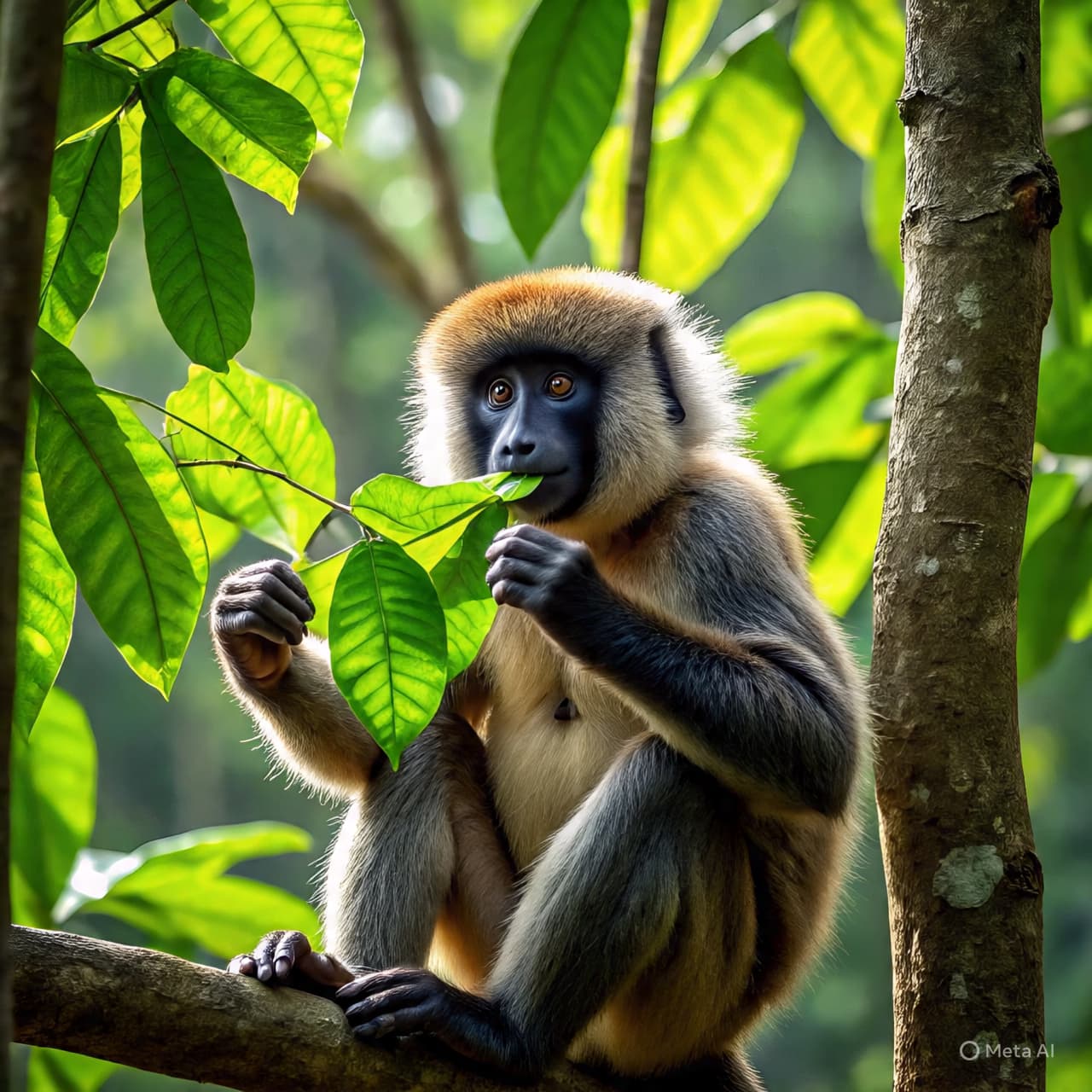
There are moments in evolution when a quiet shift in behavior becomes a turning point for an entire lineage. In the forests of South America, where sunlight filters through layers of green and the air hums with life, one such shift may have occurred millions of years ago. It was not a dramatic transformation, nor a sudden leap in anatomy. Instead, it began with a change in diet—a new willingness to eat what the forest offered most abundantly: leaves.
For the ancestors of today’s howler monkeys, that decision may have altered the path of primate history across the continent.
Recent research suggests that howler monkeys, members of the genus Alouatta, began incorporating significant amounts of leaves into their diet roughly 13 million years ago. This transition toward folivory, or leaf-eating, may have reshaped their ecological role and influenced how primates spread and diversified throughout South America.
Howler monkeys are already well known for their distinctive voices. Their deep, resonant calls—amplified by a specialized throat bone called the hyoid—can echo across forests for miles. Yet beyond their famous roar, howlers possess another notable trait: a digestive system adapted to processing large quantities of leaves.
Leaves, while plentiful, present a nutritional challenge. Compared with fruits, they contain less readily accessible energy and often include tough fibers and chemical compounds that can deter herbivores. To thrive on such a diet, animals must develop specialized digestive strategies.
Researchers studying fossil records and primate evolution now believe that the ancestors of howler monkeys began adapting to these challenges millions of years earlier than previously thought. Evidence suggests that by the middle Miocene epoch, roughly 13 million years ago, these primates had already begun shifting toward a diet where leaves played a significant role.
This dietary adaptation may have provided an important ecological advantage.
In tropical forests, fruit availability can fluctuate seasonally, sometimes becoming scarce. Leaves, however, are almost always present. By evolving the ability to digest foliage efficiently, howler monkeys may have gained access to a more stable food supply than many other primates that depend primarily on fruit.
That stability could have allowed them to occupy habitats that might otherwise have been difficult for fruit-specialist primates to survive in. Over time, this adaptability may have helped howler monkeys expand their range across much of South and Central America.
The evolutionary consequences of this shift reach beyond a single species group. When one primate lineage adopts a different ecological strategy, it can reshape how other species share the forest.
If howler monkeys relied more heavily on leaves, they may have competed less directly with fruit-eating primates such as spider monkeys or capuchins. This separation of dietary niches could have allowed multiple primate species to coexist within the same ecosystems, each relying on different parts of the forest’s resources.
Scientists often describe such shifts as ecological partitioning, a process that helps maintain biodiversity by reducing direct competition for food.
Fossil evidence and evolutionary modeling suggest that the emergence of folivory in howler monkeys may have played a role in structuring primate communities throughout South America during the Miocene.
The discovery also highlights how evolutionary change often unfolds gradually. A shift toward eating more leaves would not have happened overnight. Instead, it likely emerged through incremental changes in behavior, digestion, and anatomy across many generations.
Over millions of years, these small adjustments accumulated, shaping the modern howler monkey—a primate uniquely adapted to a leafy diet and known for its powerful voice echoing across forest canopies.
Today, howler monkeys remain among the most widespread primates in the Americas, inhabiting forests from southern Mexico to northern Argentina. Their presence is often first announced not by sight but by sound, as their calls roll through the trees like distant thunder.
Yet behind those famous vocalizations lies a deeper evolutionary story—one that began millions of years ago with a simple adaptation to the forest’s most common food.
Researchers continue to examine fossil clues and genetic evidence to better understand how early dietary shifts influenced primate evolution in the Americas. Each new finding helps illuminate how species adapt to their environments and how small changes in survival strategies can ripple across ecosystems over vast spans of time.
In the quiet record preserved within ancient bones and modern genomes, the story of the howler monkey reminds us that even the simplest decisions in nature—such as what to eat—can shape the course of evolution for millions of years.
AI Image Disclaimer Illustrations were produced with AI and serve as conceptual depictions.
Sources Reuters Phys.org ScienceDaily New Scientist National Geographic
Published by Banx Network. This article is part of the Banx decentralized media programme, powered by the BXE token on the XRP Ledger.