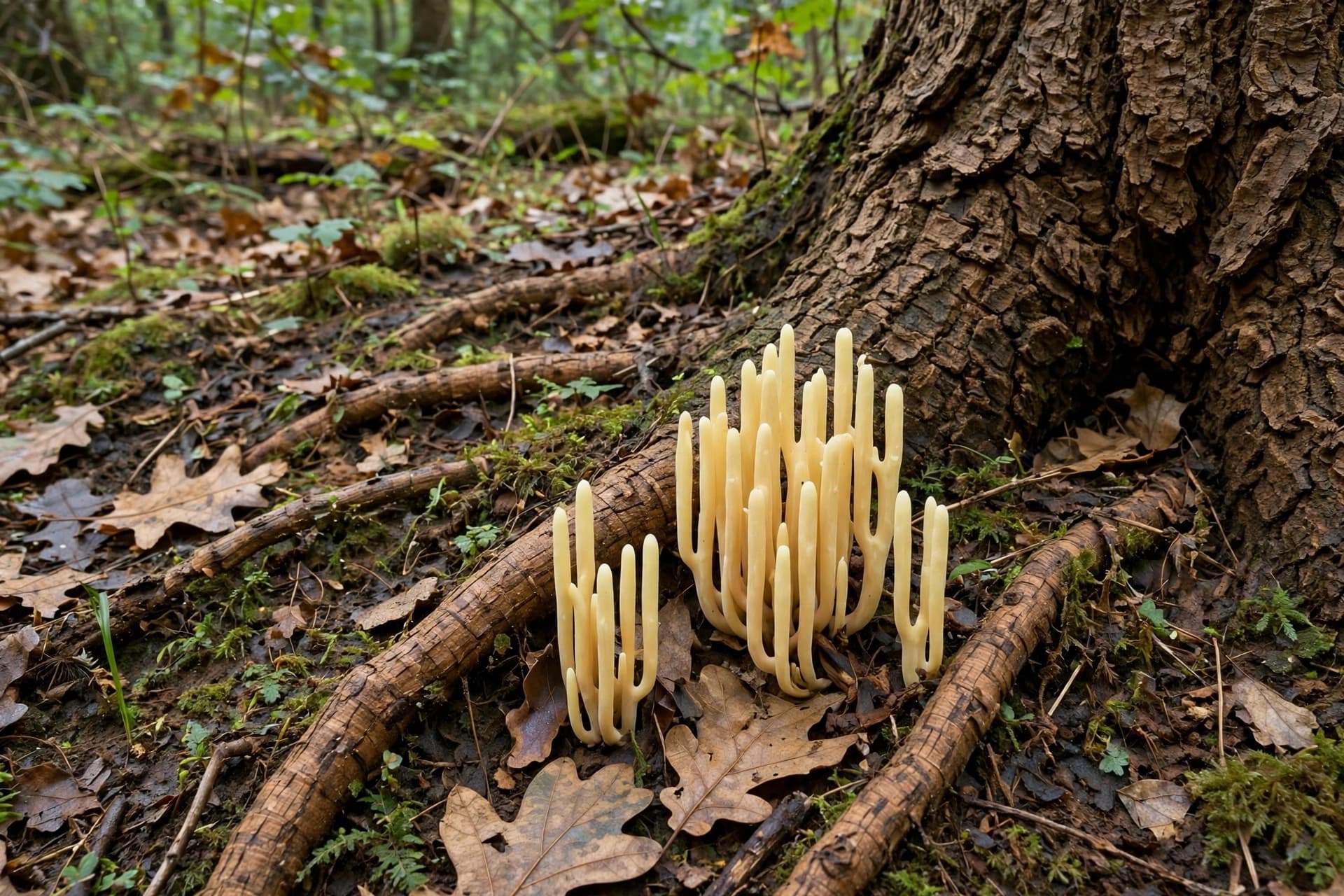
In the forests of Yunnan, where the air is damp and the leaf litter deep, a fungus has been quietly growing to a size that seems almost disproportionate to the modest kingdom it belongs to. It does not announce itself with a cap and stem like the mushrooms of storybooks. Instead, it rises in pale, fleshy columns from the roots of oak trees, a structure tall enough to catch the wind and heavy enough to weigh as much as a small book.
Scientists have named it Dianjunus rex—the specific epithet a nod to Tyrannosaurus rex, the king of dinosaurs—and the nickname “D-rex” has stuck . The fungus can grow up to 20 inches tall and weigh nearly five pounds, making it the largest known fruiting body among the ascomycetes, a vast group that includes truffles, morels, and yeasts . Its discovery, published in Frontiers in Fungal Biology, required not only a new species name but an entirely new family, Dianjunaceae .
What makes D-rex remarkable is not only its size but its lineage. Genetic analysis suggests that its family emerged roughly 65 million years ago, around the time of the asteroid impact that ended the age of non-avian dinosaurs . The researchers are careful to note that this timing is an estimate, with a possible range of 50 to 80 million years. But the coincidence is intriguing. After the mass extinction, forests across the planet experienced a sudden abundance of dead plant material—a banquet for fungi that decompose wood .
D-rex, however, does not fit neatly into the category of a simple decomposer. Its genome carries unusually few genes for the enzymes that break down plant tissue, a pattern shared with some fungi that live inside plants without causing harm . Researchers suspect it may spend part of its life hidden within the living roots of trees, waiting for the tree to die before switching to a different mode of survival. This hypothesis remains unconfirmed, one of many open questions about a fungus that has been seen only a handful of times.
The visible structure, the part that rises above the soil, is only a fraction of the whole. A long black stalk remains buried underground, anchoring the fruiting body and accounting for much of its reported height . The pale columns at the surface begin white and turn yellow with age, eventually splitting into narrow finger-like branches dotted with tiny pores that release spores . Why the fungus invests so much energy in such a large structure remains a mystery. One theory is that height allows spores to catch air currents above the dense forest floor, improving dispersal .
The discovery adds to a growing recognition of how much remains unknown about fungal diversity, particularly in East Asian forests. Yunnan alone is estimated to host more than 100,000 fungal species, of which only a fraction have been formally described . D-rex was not found by a targeted expedition but came to attention after a local person sent photographs to researchers—a reminder that scientific discovery sometimes begins with someone noticing something unusual and deciding it is worth sharing .
For now, the giant fungus remains a creature of questions. Its range is unmapped, its life cycle uncertain, its role in the forest ecosystem only beginning to be glimpsed. What is clear is that it exists, quietly and improbably, a reminder that even in a world mapped and measured, there are still things that grow beyond expectation.
Image note: This article’s visual is an AI-generated representation and does not depict the actual fungus in its natural habitat.
Sources: Frontiers in Fungal Biology, Yahoo News, CNN via ABC17News, NDTV, GreekReporter, EcoTicias
Published by Banx Network. This article is part of the Banx decentralized media programme, powered by the BXE token on the XRP Ledger.