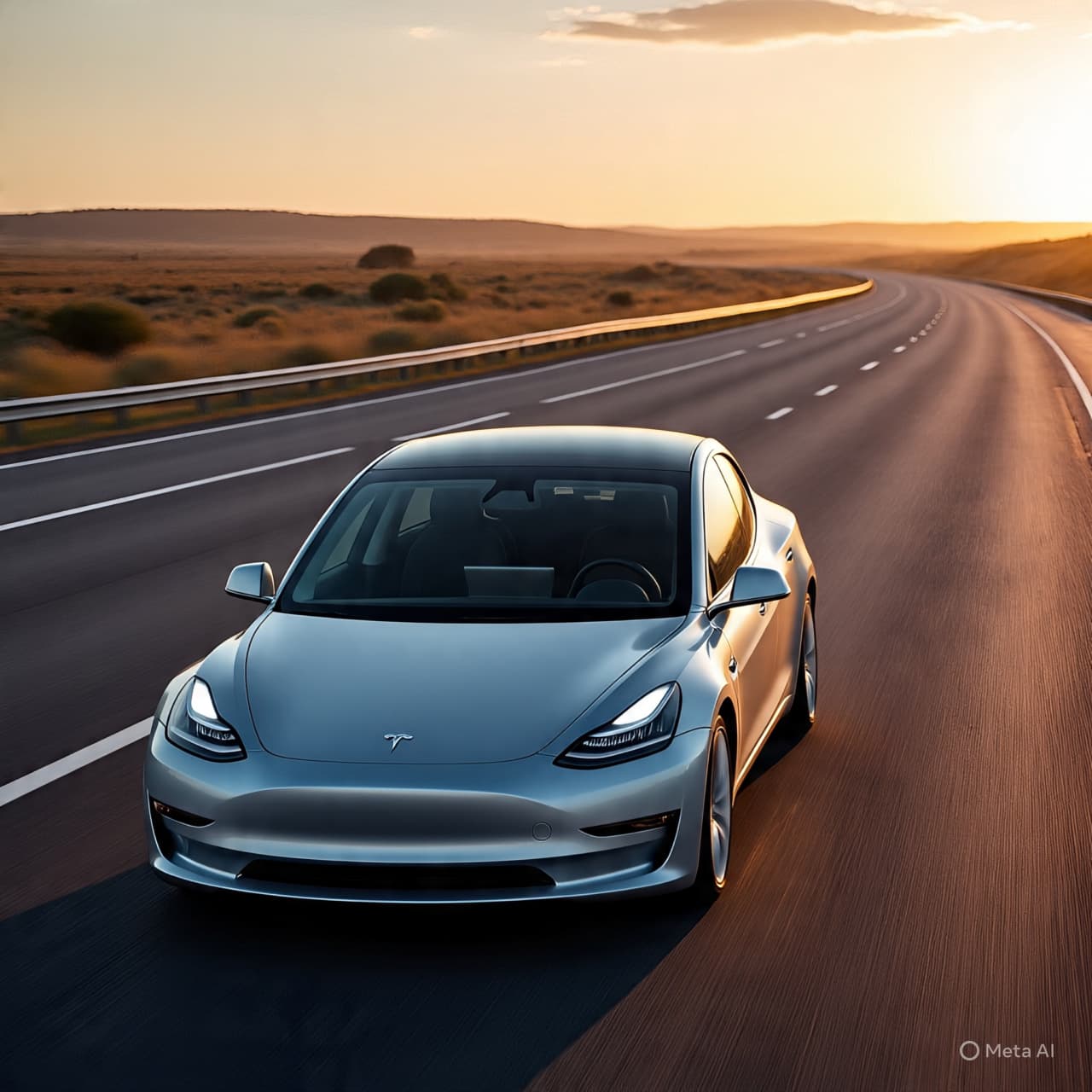
At dawn, the highways still hum with the familiar language of motion — tires whispering against asphalt, dashboards glowing softly as cities wake. For years, some of those lights carried a quiet promise: that the future of driving would arrive not with a roar, but with a near-silent glide. The vehicles that carried that promise once felt unmistakable, their silhouettes instantly recognizable in traffic and memory alike.
Lately, those shapes have begun to fade.
Tesla’s decision to step back from the Model S and Model X — its longest-running and most emblematic vehicles — has landed less like an announcement and more like a quiet closing of a door. These were the cars that introduced the company to the world not as a disruptor-in-waiting, but as a manufacturer with tangible ambition. They were proof that electric vehicles could be aspirational, fast, and unafraid of luxury.
Their retreat signals something larger than a product cycle ending. It reflects how Tesla itself has changed. Once a carmaker fighting for relevance, the company now occupies a broader, less defined space — part technology firm, part energy company, part cultural symbol. In recent years, its focus has increasingly shifted toward software, autonomous driving systems, robotics, and artificial intelligence, with vehicle sales becoming only one thread in a widening portfolio.
The Model S and X were never mass-market machines. Their price points, design philosophy, and early-mover status placed them in a category closer to statements than commodities. Over time, newer models — cheaper to build, easier to scale — became the backbone of Tesla’s sales strategy. Efficiency replaced experimentation; volume overtook spectacle.
Industry analysts have noted that maintaining low-volume luxury models carries growing costs, particularly as global competition in electric vehicles intensifies. Chinese manufacturers, European legacy automakers, and new startups now crowd the space Tesla once navigated almost alone. In that landscape, resources are finite, and focus becomes a form of survival.
Yet the departure of these vehicles carries emotional weight beyond spreadsheets. The Model S, in particular, reshaped expectations, not just for electric cars but for what a startup could challenge. It blurred lines between Silicon Valley and Detroit, between software updates and horsepower. It made the improbable feel routine.
As Tesla recalibrates, its identity becomes less tethered to the idea of being a traditional automaker. Car sales may continue, but no longer as the singular story. The road ahead appears oriented toward platforms rather than models, ecosystems rather than showrooms.
For drivers who remember when seeing a Model S felt like spotting the future a few years early, the shift may feel bittersweet. For Tesla, it is another evolution — quieter than a launch event, less dramatic than a recall, but profound in its implication.
Sometimes, the clearest sign of change is not acceleration, but the gentle easing off the pedal.
AI Image Disclaimer Illustrations were created using AI tools and are not real photographs.
Sources Reuters Bloomberg The Wall Street Journal Financial Times Tesla investor communications
Published by Banx Network. This article is part of the Banx decentralized media programme, powered by the BXE token on the XRP Ledger.