
Key Highlights
- Discovery:Dwarf galaxies were key to clearing the early universe's fog.
- Observations:Findings based on data from the James Webb Space Telescope and Hubble.
- Impact:This research reshapes our understanding of cosmic evolution.
The early universe was a realm shrouded in darkness, where light struggled to penetrate a thick fog of neutral hydrogen. This primordial state, characterized by a vast expanse of charged particles, marked a significant chapter in cosmic history. For decades, astronomers have sought to understand what ultimately lifted this veil, allowing light to traverse the universe. The quest was not merely about identifying when the lights turned on, but also about uncovering the celestial bodies responsible for this monumental transformation.
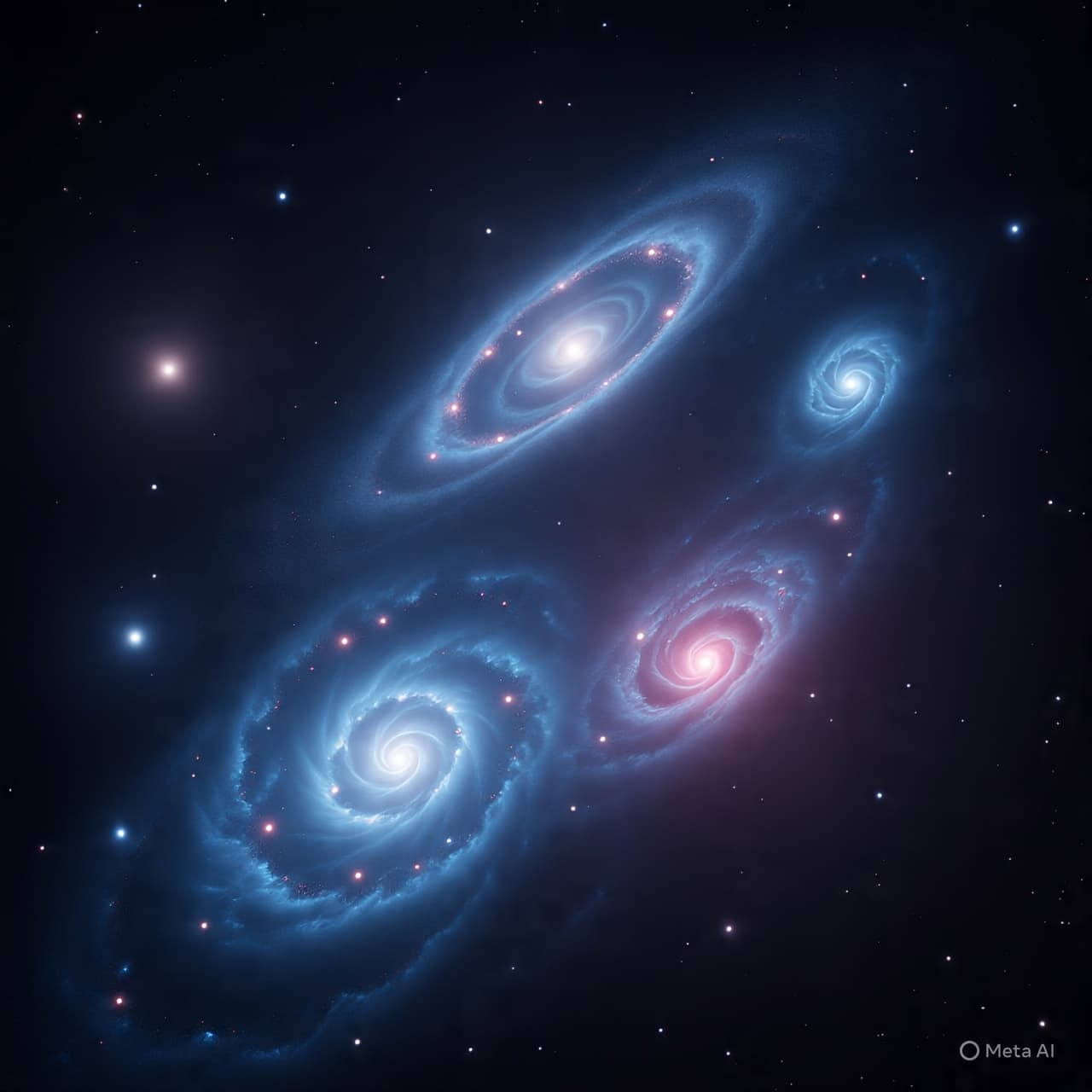
Recent observations from the James Webb Space Telescope (JWST) and Hubble have unveiled a surprising answer: it was not the massive black holes or grand early galaxies that played the leading roles, but rather the smallest galaxies—dim dwarf systems scattered throughout the young universe. These ultra-faint galaxies, magnified by the galaxy cluster Abell 2744, emitted sufficient energetic ultraviolet radiation to strip electrons from hydrogen atoms, effectively ending the cosmic fog during a period known as reionization.
This revelation paints a poetic picture of the early universe. Instead of a few colossal beacons illuminating the darkness, it was countless tiny fires—each modest in size but overwhelming in number—that collectively transformed the cosmos. Research indicates that these dwarf galaxies likely outnumbered their larger counterparts by a staggering ratio of 100 to 1, producing far more ionizing radiation than previously thought. Thus, the dawn of the universe may be likened to a field of innumerable distant lanterns rather than a singular sunrise.
The implications of this finding extend beyond astrophysics, challenging the notion that significant cosmic events are solely the result of the largest forces. Instead, the evidence suggests that the smallest structures, when multiplied across vast distances, can have a profound impact on the state of the universe. The transition from darkness to light was not merely a spectacle but a testament to persistence and abundance.
This era, roughly the first billion years following the Big Bang, has long been one of the most elusive frontiers in astronomy. The new data provides compelling evidence that dwarf galaxies were central to the Epoch of Reionization, the time when the first stars and galaxies transformed the universe from opaque to transparent. While further observations across additional regions of the sky are necessary, these findings significantly narrow one of cosmology's oldest mysteries.
Astronomers now assert that the best evidence points to small dwarf galaxies as the primary source of the radiation that illuminated the early universe, clearing the hydrogen fog and allowing light to travel freely during this cosmic dawn. The findings were published in the journal Nature and are based on JWST-supported observations of some of the faintest early galaxies detected to date.
As we continue to explore the cosmos, these insights into the role of dwarf galaxies not only enhance our understanding of the universe's evolution but also inspire further inquiry into the intricate tapestry of cosmic history.
Published by Banx Network. This article is part of the Banx decentralized media programme, powered by the BXE token on the XRP Ledger.



