There are times when a landscape seems to remember something it has long held in reserve. In the heart of Australia, where red earth usually stretches unbroken beneath an open sky, the ground has shifted in tone—subtly at first, then unmistakably. What is often defined by dust and distance has, for a moment, softened into color.
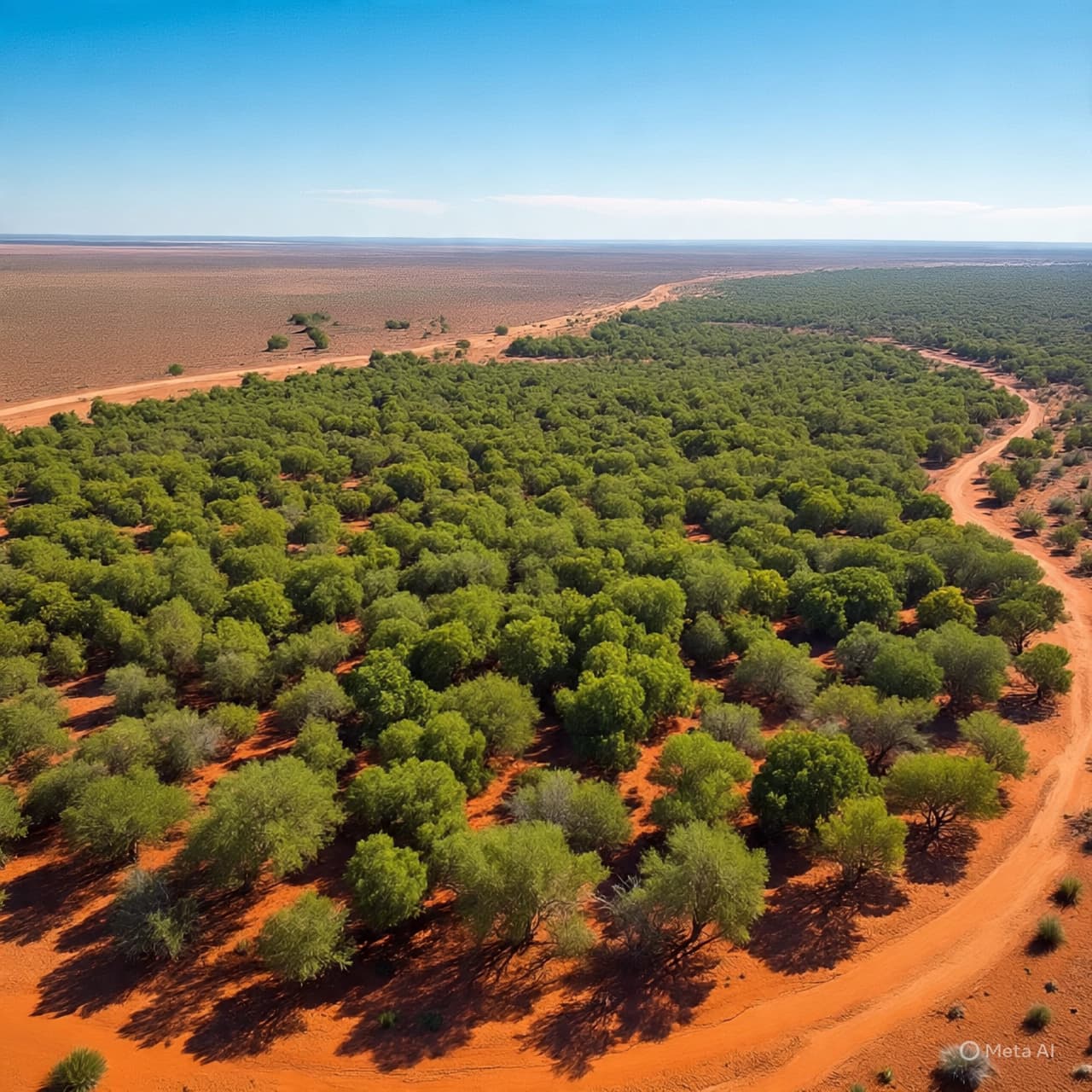
Across the Red Centre, an expanse known for its arid stillness, February and March of 2026 brought an uncommon abundance of rain. Storm systems moved through with a persistence that the region does not often see, delivering water to soils that typically hold only traces of it. The response was immediate, though quiet: seeds long dormant began to stir, grasses emerged, and wide stretches of desert shifted toward green.
From above, the transformation appears almost improbable. Areas once marked by muted reds and browns now carry a patchwork of vegetation, as if the land itself has briefly rewritten its palette. Rivers and creeks, many of them dry for extended periods, have flowed again, tracing familiar paths that are not always visible in drier years. The change is not uniform, but it is widespread enough to alter the character of the region, if only temporarily.
Such events are part of a longer ecological rhythm. The deserts of central Australia are not empty in the way they sometimes appear; they are responsive, holding life in suspension until conditions allow it to return. Rainfall acts as a kind of signal, unlocking cycles that can remain dormant for years. When it arrives in sufficient volume, the response can feel sudden—flowers emerging, insects multiplying, wildlife adjusting to the brief abundance.
For local communities, the shift carries both opportunity and complexity. Pastoral lands benefit from renewed growth, offering improved grazing conditions after periods of dryness. Water sources replenish, easing some of the pressures that define life in remote regions. Yet heavy rainfall can also bring challenges—roads becoming impassable, infrastructure tested by flooding, and the need to navigate a landscape that has changed quickly.
Scientists and environmental observers note that while such greening events are not unprecedented, their timing and intensity often reflect broader climate patterns. Variability in rainfall, influenced by large-scale atmospheric systems, continues to shape the interior of the continent in ways that are difficult to predict with precision. Each event becomes part of a larger record, offering insight into how arid environments respond to changing conditions.
There is also a sense of impermanence in the transformation. The green that now spreads across the Red Centre is unlikely to remain indefinitely. As temperatures rise and the rains recede, much of the vegetation will fade, returning the landscape to its more familiar hues. Yet the memory of the shift lingers—in the soil, in the seed bank, and in the cycles that will respond again when conditions allow.
For now, the change is visible, tangible. Travelers moving through central Australia encounter a different version of the desert, one that feels briefly expansive rather than sparse. The air carries a different scent, the ground a different texture. It is not a replacement of the landscape, but a variation—a reminder that even the most enduring environments hold the capacity for renewal.
The latest observations confirm that above-average rainfall during February and March 2026 has led to widespread greening across central Australia, with vegetation growth, flowing waterways, and improved conditions for pastoral activity. The shift is expected to be temporary, shaped by the return of drier weather in the months ahead.
And so the Red Centre, for a time, is not only red. It is layered, changing, and quietly alive in ways that are easy to forget—until the rain arrives again.
Published by Banx Network. This article is part of the Banx decentralized media programme, powered by the BXE token on the XRP Ledger.