Time, as we perceive it, is often considered a constant, unyielding river flowing steadily forward. Yet, the instrument we use to measure this flow—the Earth itself—is not as consistent as we might assume. Recent observations indicate that our planet is spinning slightly faster than it has in decades, a subtle shift that challenges the precise synchronization of our global clocks. This phenomenon raises intriguing questions about how we define and maintain time in an increasingly connected world.
The length of a day, traditionally defined as 24 hours, is based on the Earth’s rotation relative to the Sun. However, this rotation is influenced by various factors, including the distribution of mass within the planet, atmospheric changes, and even the melting of polar ice caps. Recently, scientists have recorded days that are fractions of a millisecond shorter than the standard 86,400 seconds, a trend that has accelerated since 2020.
For most people, these minuscule differences are imperceptible. However, for systems that rely on ultra-precise timing, such as GPS satellites, financial networks, and telecommunications, even a millisecond matters. To keep our atomic clocks in sync with the Earth’s rotation, international timekeepers occasionally add a "leap second" to Coordinated Universal Time (UTC). But with the Earth speeding up, the possibility of a "negative leap second"—removing a second—has emerged for the first time.
This potential adjustment poses technical challenges. Many computer systems and software protocols are not designed to handle a missing second, which could lead to errors or crashes. Tech companies and timekeeping organizations are currently debating the best approach to manage this transition, weighing the need for astronomical accuracy against digital stability.
Some experts argue that we should decouple civil time from the Earth’s rotation entirely, allowing atomic time to drift naturally. This would eliminate the need for leap seconds altogether, simplifying timekeeping for modern technology. Others contend that maintaining the link between clock time and solar time is essential for human orientation and tradition.
The debate highlights the tension between natural rhythms and technological precision. As our reliance on digital infrastructure grows, the definition of time becomes less about the sun’s position and more about the consistency of atomic oscillations. Finding a balance that serves both scientific accuracy and practical utility is the current challenge for metrologists.
As the Earth continues its variable spin, the conversation about time measurement evolves. It reminds us that even the most fundamental aspects of our daily lives are subject to the dynamic forces of our planet. Adapting to these changes requires collaboration, innovation, and a willingness to rethink established norms.
The Earth’s accelerating rotation presents a unique challenge for global timekeeping. As scientists and technologists navigate the possibility of a negative leap second, the discussion underscores the complex relationship between natural phenomena and the precise demands of modern society.
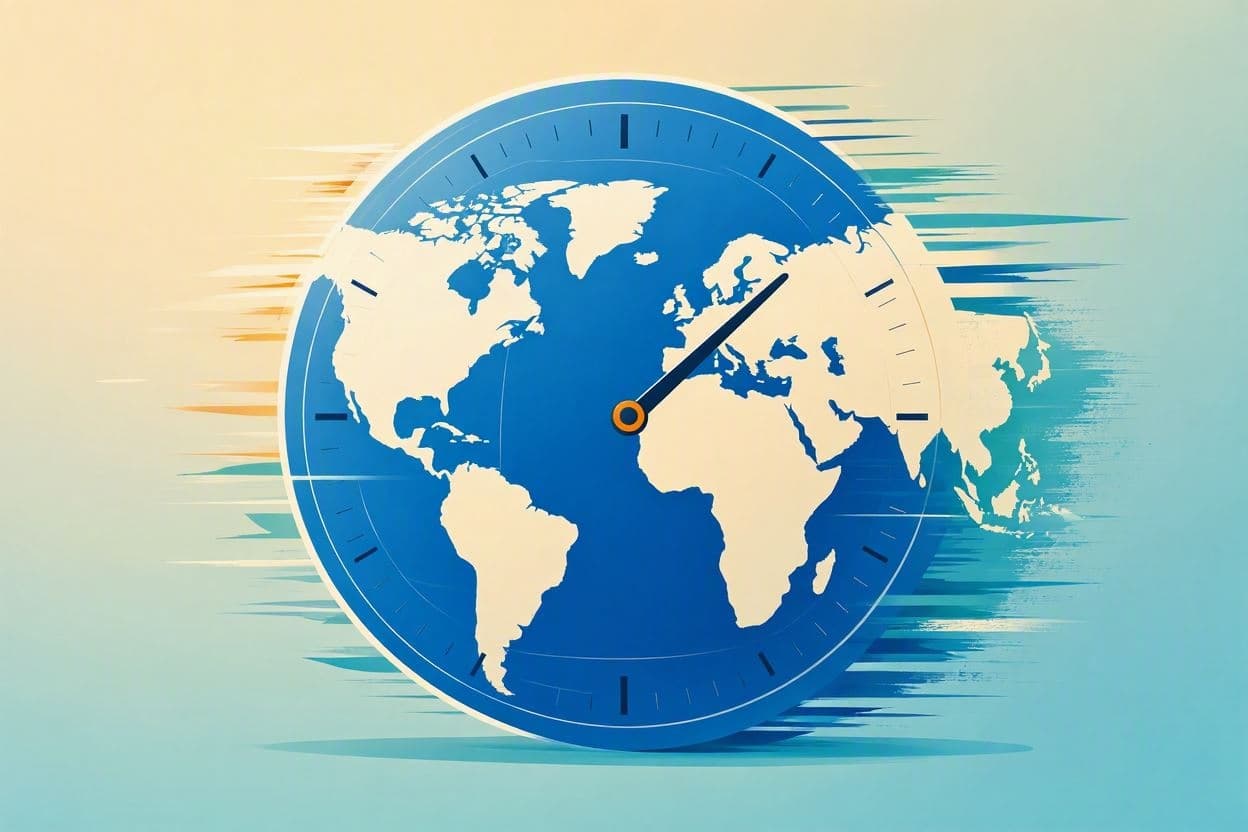
AI Image Disclaimer: Images used to depict this scientific concept are AI-generated for illustrative purposes.
Sources: National Institute of Standards and Technology (NIST) BBC Future The Guardian
Published by Banx Network. This article is part of the Banx decentralized media programme, powered by the BXE token on the XRP Ledger.