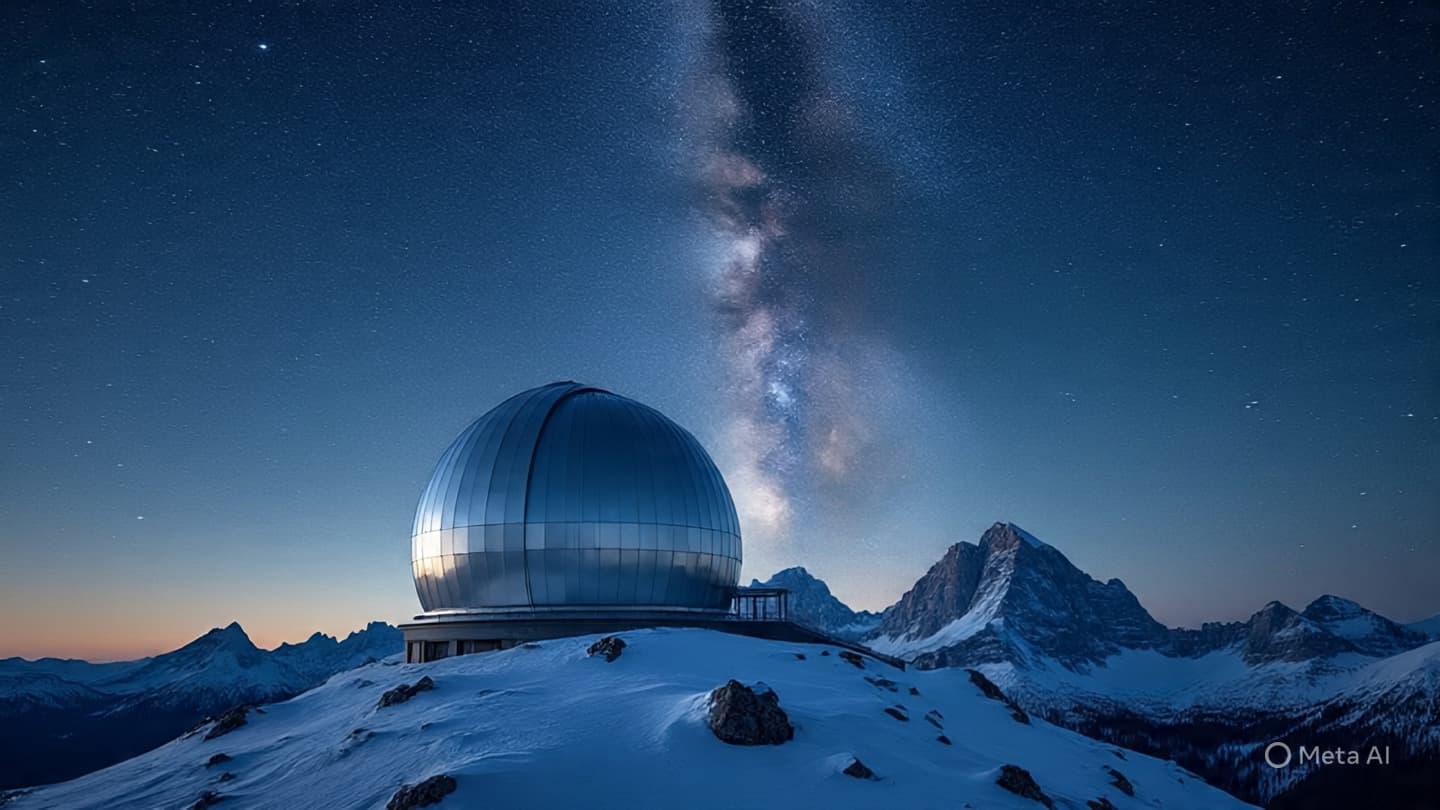
The high peaks of the Andes stand as silent sentinels above the clouds, reaching into a cold and rarified air where the atmosphere is thin enough to offer a clear window into the infinite. At these altitudes, the darkness is not merely the absence of light, but a profound and velvety presence that allows the stars to burn with a brilliance that is seldom seen by human eyes. It is here, in the stillness of the mountain night, that a new eye has been opened—a vessel of glass and steel designed to capture the faint whispers of light that have traveled across the cosmos for eons.
To observe the commencement of operations at the new observatory is to witness the quiet intersection of human curiosity and the vastness of the universe. There is a certain humility in this endeavor, a recognition that our understanding of the heavens is a journey that requires both precision and a deep sense of wonder. The atmosphere within the control room is one of hushed focus, a narrative of discovery that moves with the slow and majestic rotation of the earth itself. It is a study in clarity, where the focus remains on the subtle patterns of distant galaxies and the silent secrets they hold.
The start of the deep space mapping project serves as a resonant opening chapter in this scientific story, signaling Argentina’s growing role as a guardian of the southern skies. It is a movement born of a desire to look beyond the immediate and the tangible, seeking instead the fundamental truths that govern the motion of the stars. The air at the summit remains crisp and observational, detached from the noise of the world below and centered on the quiet, steady accumulation of data from the depths of the void.
As the telescope swivels with a nearly imperceptible hum, tracking the movement of a distant nebula, one reflects on the long history of celestial observation in this part of the world. The narrative of the Andes is one of elevation—not just of the land, but of the spirit of inquiry that seeks to bridge the gap between the terrestrial and the divine. It is a calm and contemplative process, where the focus remains on the integrity of the observations and the collaborative spirit of the international scientific community.
There is no sense of rush in this exploration, only the methodical mapping of the heavens to ensure that every photon is accounted for. The dialogue between the astronomers and the instruments is a subtle one, a constant refinement of focus and technique to capture the most elusive phenomena of the deep sky. It is a narrative of light, where the ancient past of the universe is brought into the present through the steady and undeniable power of the lens.
Within this context of cosmic inquiry, the participation of local researchers alongside global partners appears as a natural result of a shared passion for the unknown. The path from the mountain peak to the published paper is a journey of translation, a physical manifestation of the choice to seek knowledge that transcends borders and languages. It is a study in perspective, a narrative of humanity looking outward to find its place in a reality that is far larger than it could have ever imagined.
The atmosphere in the mountain research stations is one of quiet dedication, a sense that the work being done is a contribution to a collective legacy of human understanding. There is a lyrical quality to the way the data is processed and the images are formed, a choreographed dance of light and silicon that remains respectful of the immense mystery it seeks to unravel. It is a narrative of vision, where the darkness of the night is transformed into a source of enlightenment for all.
The LLAMA (Long Latin American Millimeter Array) observatory in Salta province has officially begun its primary mission of deep space mapping, following a successful calibration period. Situated at over 4,800 meters above sea level, the facility utilizes cutting-edge radio telescope technology to observe star formation and the composition of distant interstellar clouds. Argentine scientists, in collaboration with regional partners, expect the data collected over the next 48 months to provide unprecedented insights into the evolution of our galaxy and the physics of the early universe.
Published by Banx Network. This article is part of the Banx decentralized media programme, powered by the BXE token on the XRP Ledger.