Cities rarely sleep in perfect silence. Even in the quietest hours of the night, distant engines hum, streetlights glow like scattered constellations, and somewhere in the darkness people continue moving—working, returning home, or simply chasing a different rhythm of life. In some corners of the urban landscape, the night has long been associated with a particular kind of motion: the informal world of street racing.
For years, street racing has existed in the shadows of many cities, including those around Jakarta. Young drivers, drawn by adrenaline and speed, sometimes turn empty roads into improvised circuits once traffic fades. Authorities have often responded with patrols and enforcement, seeking to keep public roads safe while discouraging illegal competition.
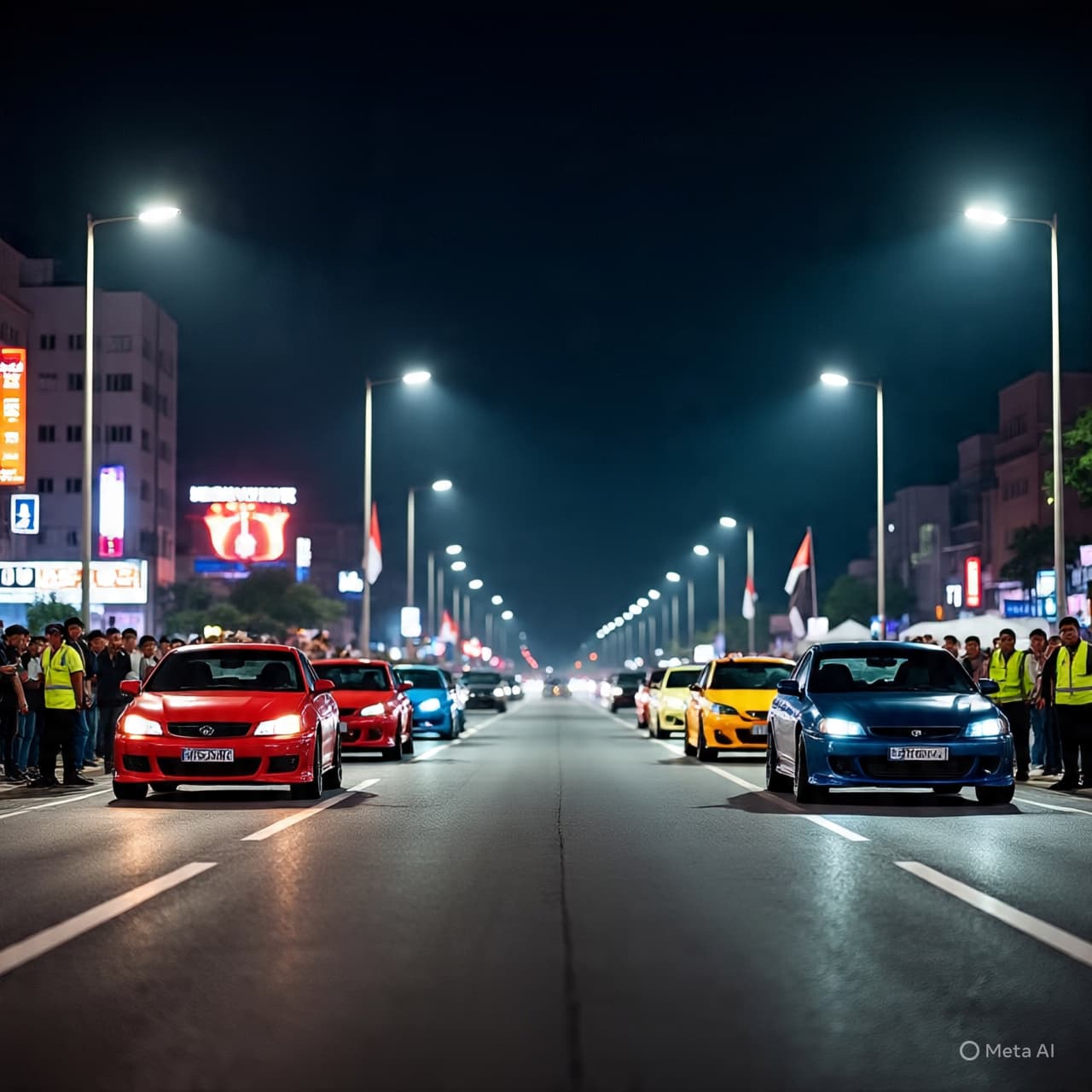
Yet in South Tangerang, a different approach briefly illuminated the night. Instead of chasing the phenomenon away, local authorities and organizers experimented with a structured alternative: a legal nighttime street racing event. On that evening, the roar of engines remained, but it unfolded under supervision rather than secrecy.
The event brought together 64 participants who gathered to compete in a controlled street race along a designated road. The arrangement was intended to transform a practice that often takes place outside the law into something more organized and safer for participants and spectators alike.
Organizers and local officials explained that the idea behind the event was partly preventive. By creating a legal space for racing, they hoped to reduce the number of informal and potentially dangerous street races that sometimes occur late at night. The concept reflects a broader strategy seen in several cities: channeling youthful enthusiasm into regulated environments rather than attempting to eliminate it entirely.
For the participants, the atmosphere carried a mixture of excitement and curiosity. Drivers who might otherwise have raced quietly in hidden corners of the city now found themselves on a monitored route, surrounded by officials, spectators, and fellow competitors. The familiar thrill of acceleration remained, yet the setting offered a different kind of legitimacy.
Such initiatives often walk a delicate line. Authorities must balance public safety, traffic regulations, and community concerns, while still recognizing that enthusiasm for automotive culture runs deep among many young drivers. Legal racing events can provide a platform where speed is experienced within clearer boundaries.
Observers also note that regulated events allow for greater safety measures. Roads can be temporarily secured, emergency personnel can be present, and participants can follow specific rules designed to minimize risks. While no form of racing is entirely without danger, structured events can reduce the unpredictability often associated with spontaneous street competitions.
The presence of dozens of racers on a single night suggests that interest in such opportunities is considerable. Many drivers who once operated outside official frameworks may welcome the chance to participate openly, especially when it comes with the approval of local authorities.
For residents and communities, the initiative also offers a glimpse of how cities experiment with new approaches to familiar challenges. Rather than viewing street racing solely as a problem to suppress, policymakers sometimes explore ways to reshape it into safer forms of expression.
Whether such programs become a regular feature remains an open question. Each city must consider its own traffic patterns, public safety priorities, and community feedback before expanding similar initiatives.
For now, the night in South Tangerang briefly carried a different story. Instead of scattered engines racing through hidden streets, a group of drivers gathered under watchful supervision, their headlights tracing temporary lines of competition across the asphalt.
And as the engines quieted and the city slowly returned to its ordinary rhythm, the experiment left behind a small but intriguing possibility: that even in the fast and restless world of street racing, structure and safety might one day travel side by side.
AI Image Disclaimer Visuals are created with AI tools and are not real photographs.
Sources Kompas Detik CNN Indonesia Tempo Antara News
Published by Banx Network. This article is part of the Banx decentralized media programme, powered by the BXE token on the XRP Ledger.