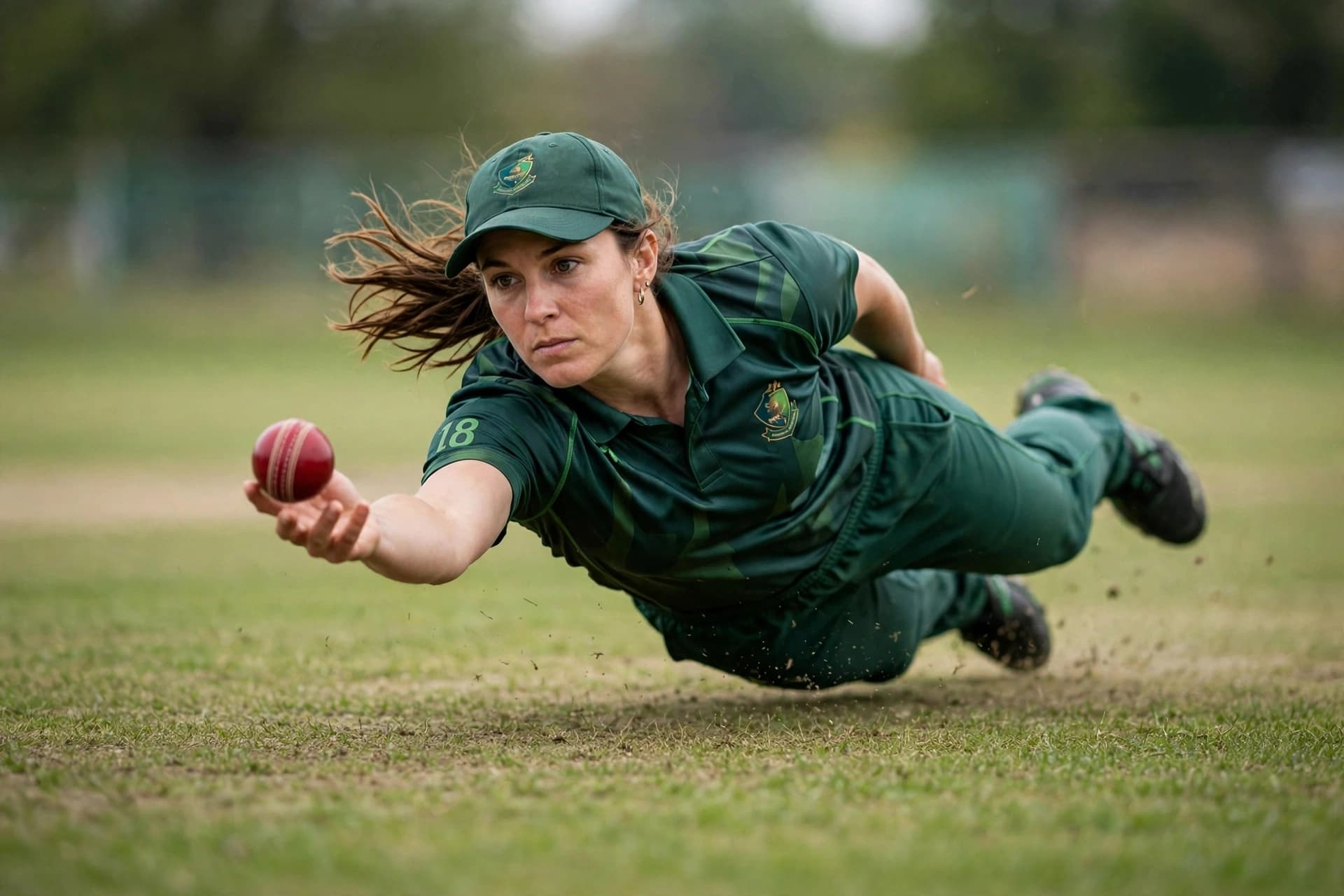
There are moments in sport when the ordinary boundaries of what is possible seem to bend, when a player does something so unexpected that the commentary box falls silent and then erupts. On Monday, in a Women’s National Cricket League match between Western Australia and Tasmania, Lauren Smith produced one of those moments—not once, not twice, but three times, each catch more improbable than the last, each one drawing the same disbelieving cry from the commentary box: “Oh my god, Smudge!”
Smith, a 29-year-old off-spinner for Tasmania, was bowling to Western Australia’s batters when the first of her three extraordinary catches arrived. The details of the deliveries vary—an off-break outside off, a fuller ball driven to cover, a length ball played off the back foot—but the result was the same. Time and again, Smith reacted with a speed and anticipation that seemed to defy the normal limits of human reflexes, plucking the ball from the air in positions that should not have been possible.
The first catch set the tone. A ball played toward cover, seemingly destined for a single or perhaps a boundary, disappeared into Smith’s hands before the batter had completed her follow-through. The second was perhaps even more remarkable: a drive that Smith intercepted at close range, her hands moving faster than the eye could track. The third, late in the innings, was the kind that gets replayed for years—a full-blooded shot that Smith somehow reached, diving to her right, the ball sticking in her outstretched palm.
By the end of the innings, Smith had claimed three catches and two wickets, dismantling Western Australia’s middle order in a display of fielding that commentators struggled to describe without lapsing into superlatives. The phrase “freak catches” appeared in the match report, and it was not hyperbole. The catches were not merely good; they were anomalous, the kind of interventions that change the momentum of a game and leave the opposition wondering what, exactly, they had just witnessed.
For Tasmania, Smith’s performance was the difference in a match that had been finely balanced. Western Australia, buoyed by a partnership that seemed to be building toward a competitive total, found itself repeatedly checked by a fielder who refused to let the ball pass. The wickets that followed were as much a product of Smith’s fielding as her bowling—batters, aware of her presence in the ring, began to second-guess their shots, to hesitate, to look for gaps that did not exist.
Smith has been a fixture in Australian domestic cricket for years, a reliable off-spinner and lower-order batter who has represented Australia in limited-overs formats. But this performance, on a warm October afternoon in Perth, was something else entirely. It was the kind of day that a player remembers for the rest of her career, and that opposition batters try to forget.
The WNCL season is long, and records are made to be broken. But some performances transcend the scorecard. On Monday, Lauren Smith produced three catches that will be watched, shared, and rewatched—a reminder that even in a sport defined by statistics, there are moments that resist measurement.
AI Image Disclaimer: The imagery accompanying this article was generated using artificial intelligence and is intended for illustrative purposes only, not as a photographic record of the match.
Sources: cricket.com.au, Western Australia Women vs Tasmanian Tigers Women WNCL scorecard
Published by Banx Network. This article is part of the Banx decentralized media programme, powered by the BXE token on the XRP Ledger.