In the quiet currents of the ocean, where sunlight fades into blue uncertainty, life often unfolds in forms that feel both familiar and strangely distant. The natural world beneath the waves carries stories of adaptation that challenge human expectations, reminding us that survival can take many unexpected paths.
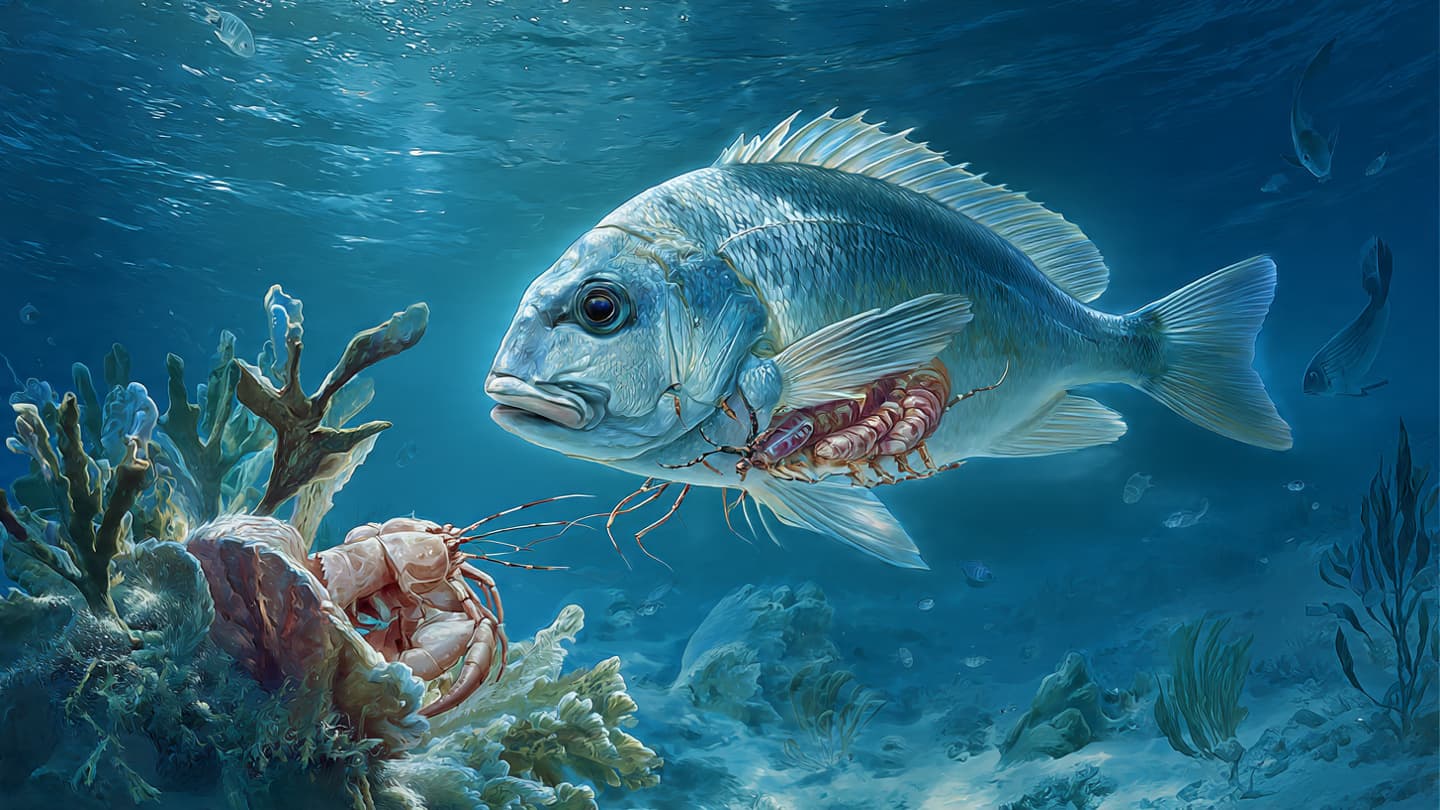
One such example is the parasitic organism known as Cymothoa exigua, a marine isopod that interacts with fish in a highly unusual biological relationship. Scientists have documented its life cycle as one of the more remarkable cases of parasitism in marine ecosystems.
The process begins when the organism enters a fish through the gills, where it attaches itself to the tongue. Over time, it feeds on the blood supply of the tongue, gradually weakening the tissue until it deteriorates.
As the tongue shrinks and eventually disappears, the parasite remains attached in its place. What makes this relationship particularly notable is that the organism effectively becomes a physical substitute for the lost organ.
In a functional sense, the fish is able to continue eating, using the parasite as a structural replacement. While this may seem extraordinary from a human perspective, it reflects a broader pattern in nature where organisms adapt in unexpected and efficient ways to survive.
Marine biologists study such interactions to better understand ecological balance and evolutionary strategies. Parasitism, while often viewed negatively, plays a role in regulating populations and shaping biological diversity within ecosystems.
The presence of Cymothoa exigua highlights how complex and interconnected marine life can be, where even relationships that appear harmful can result in long-term survival for both host and parasite in a shared system.
Research into such species continues to deepen scientific understanding of adaptation, evolution, and the intricate balance of ocean ecosystems.
AI Image Disclaimer: Images used in this article are AI-generated and intended for scientific illustration purposes only.
Source Verification Check: National Geographic, Smithsonian Magazine, BBC Earth, Marine Biology Journals
Published by Banx Network. This article is part of the Banx decentralized media programme, powered by the BXE token on the XRP Ledger.