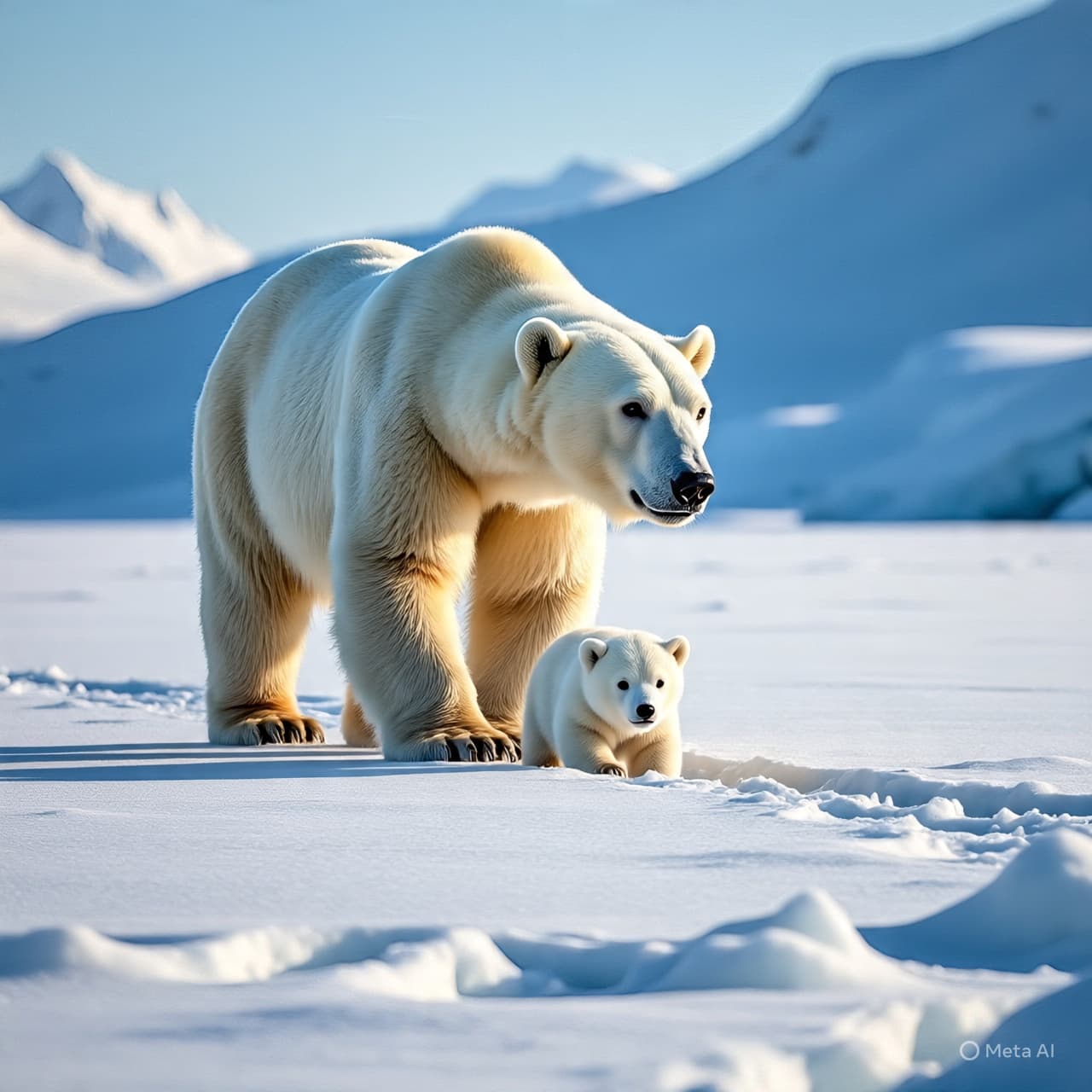
On the vast white canvas of the Canadian Arctic, where survival is often reduced to instinct and endurance, researchers witnessed something that unsettled long-held assumptions. A wild adult polar bear appeared to take in a lone cub—an interaction so rare that it paused the observers themselves.
Polar bears are not known for communal care. Outside the bond between a mother and her offspring, adults are typically solitary, and encounters between unrelated bears can be tense or dangerous. Cubs without mothers face grim odds. Yet in this case, the adult bear remained with the cub, allowing it to stay close, travel alongside, and feed in its presence.
The moment was captured by Canadian researchers conducting routine monitoring work. At first, the pairing raised questions rather than wonder. Was the adult the cub’s mother? Had the researchers simply missed earlier context? Over time, however, behavior told a different story. The size difference, lack of maternal cues, and the adult’s physical condition suggested the two were not related.
What unfolded instead was something closer to tolerance than textbook adoption, but no less remarkable for that reason. The adult bear did not chase the cub away. It did not display aggression. In an environment where energy is precious and competition fierce, that restraint alone was extraordinary.
Scientists are cautious in their interpretations. Anthropomorphic language has no place in serious wildlife research. Still, the interaction challenges rigid ideas about animal behavior. It suggests that even among species shaped by scarcity, responses can be flexible, situational, and influenced by factors we do not yet fully understand.
The broader context matters. Polar bears are under increasing pressure from climate change, with shrinking sea ice altering hunting patterns and survival rates. Cubs are especially vulnerable in this shifting environment. Whether the adult bear’s behavior was driven by environmental stress, individual temperament, or coincidence remains unknown.
What researchers emphasize is rarity. Such interactions have been documented only a handful of times, often briefly, and rarely observed long enough to confirm sustained tolerance. That this moment was recorded at all speaks to both the patience of field researchers and the unpredictability of the natural world.
In the end, the significance lies not in assigning human emotion, but in recognizing complexity. Nature is often described as ruthless, efficient, and unforgiving. Yet every so often, it reveals edges that are softer, less easily categorized.
On the ice, far from human presence, a cub survived another day—not because the Arctic became kinder, but because one adult bear chose not to turn away. Sometimes, that difference is everything.
Published by Banx Network. This article is part of the Banx decentralized media programme, powered by the BXE token on the XRP Ledger.