
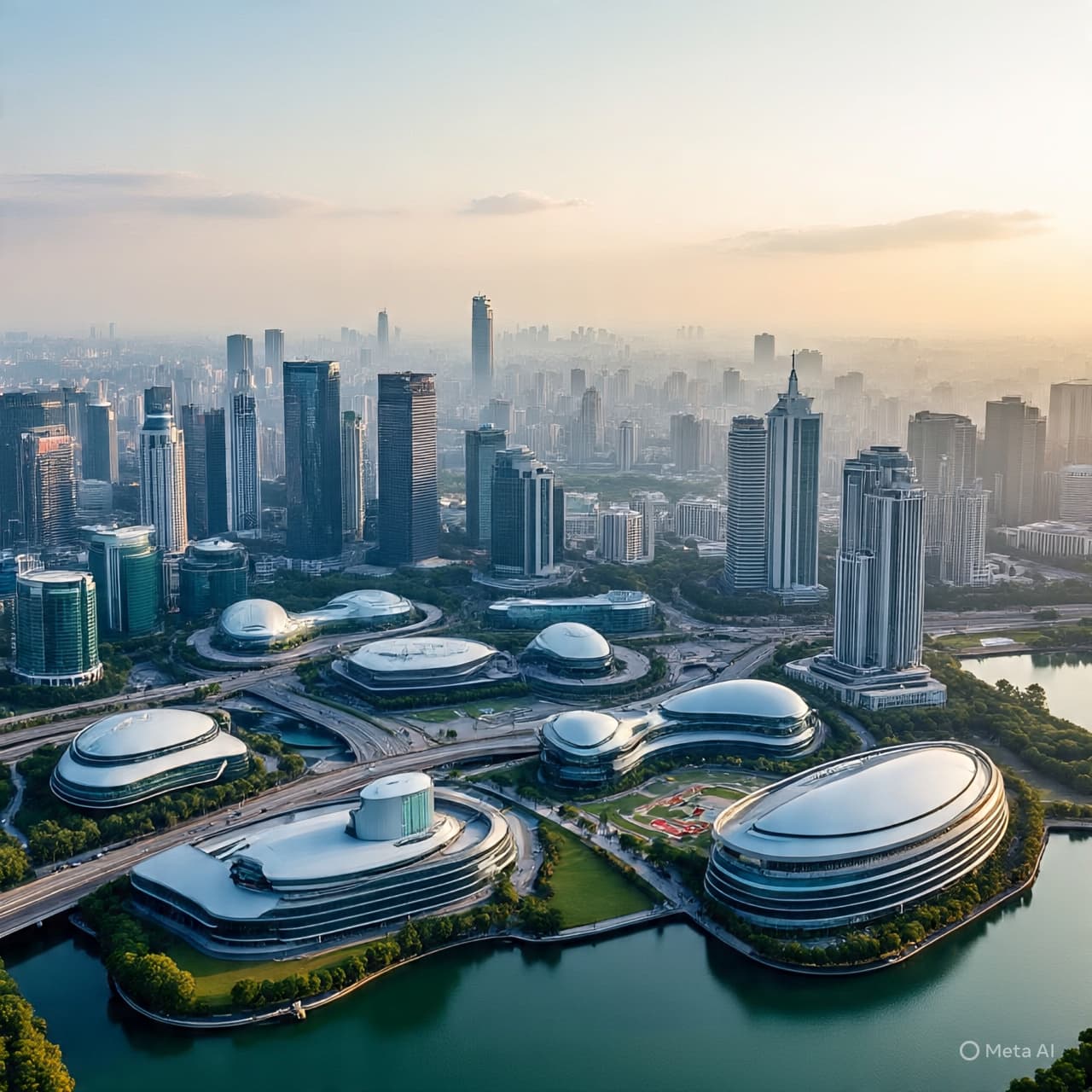
The first light of morning across China’s southern plains touches factories and ports alike, a gentle glow that somehow marks both age‑old industry and something newly stirring. In the province of Guangdong, where the cadence of production once defined much of the world’s supply of phones, appliances, and cars, there now echoes a different sort of rhythm—not the measured beat of assembly lines but the pulse of data and algorithms promising to reshape that work itself.
Guangdong has long been an economic colossus, its output rivaling entire nations, and for more than thirty years it has proudly held its rank as China’s largest provincial economy. Last year its gross domestic product reached an estimated 14.6 trillion yuan, an expanse of economic activity that stretches from the Pearl River Delta to the heart of Shenzhen’s skyscrapers. Officials have now cast their gaze beyond sheer scale, toward a future in which artificial intelligence underpins the province’s evolution as much as finished goods ever did.
At recent government forums outlining a multi‑year roadmap, leaders affirmed that AI‑driven industrial upgrading will occupy a central place in Guangdong’s economic strategy. The language of the gatherings was both practical and ambitious: deepen the application of “AI plus” across sectors, accelerate commercialization of advanced technologies, and build out computing infrastructure for generative models, robotics, and intelligent manufacturing.
In Shenzhen—the region’s high‑tech heart, where companies have already woven digital innovation into local identity—officials pointed to double‑digit growth in advanced sectors last year as evidence that the shift toward an AI‑infused economy was underway. Robotics, semiconductors, and smart appliances are no longer distinct curiosities but pieces of an industrial mosaic in which data flows and sensors layer atop the physical.
Yet the pledge to embed AI deeply into daily economic life also bears witness to pressures from beyond Guangdong’s borders. With global supply chains recalibrating amid geopolitical tension, how China’s key manufacturing hubs adapt to digital disruption could affect not just regional fortunes but how other economies rethink their own dependence. The new strategy calls for domestic self‑sufficiency in chips, software tools, and computing networks, areas where past reliance on foreign technology has invited scrutiny.
Behind the technical vocabulary one hears an echo of something more elemental: the restlessness of an economy that once rode the wave of globalization’s material output, now reaching for the intangible but potent force of artificial intelligence. State capital will be steered toward sectors from autonomous vehicles to drones, while calls for stronger central support underscore a desire to build a self‑sufficient ecosystem that can sustain innovation even in challenging geopolitical climates.
As Guangdong commits itself to this transformation, its leaders stress a gradual but firm turning of the industrial compass: from hardware alone to hardware married with smart computing; from simple assembly to adaptive systems; from exporting goods to scaling ideas. In its vast weaving of policy and enterprise, the province aims not merely to keep pace with technological change but to help define it.
Officials and business leaders in Guangdong have pledged to expand the application of artificial intelligence across the province’s nearly $2 trillion economy, making AI‑driven industrial modernization central to growth. They emphasize building infrastructure, deepening commercialization, and strengthening domestic capabilities in areas such as semiconductors and smart vehicles, a strategy aligned with national priorities and global competitive pressures.
AI Image Disclaimer Illustrations were created using AI tools and are not real photographs.
Sources (Media Names Only) Reuters The Economic Times MarketScreener South China Morning Post
Published by Banx Network. This article is part of the Banx decentralized media programme, powered by the BXE token on the XRP Ledger.



