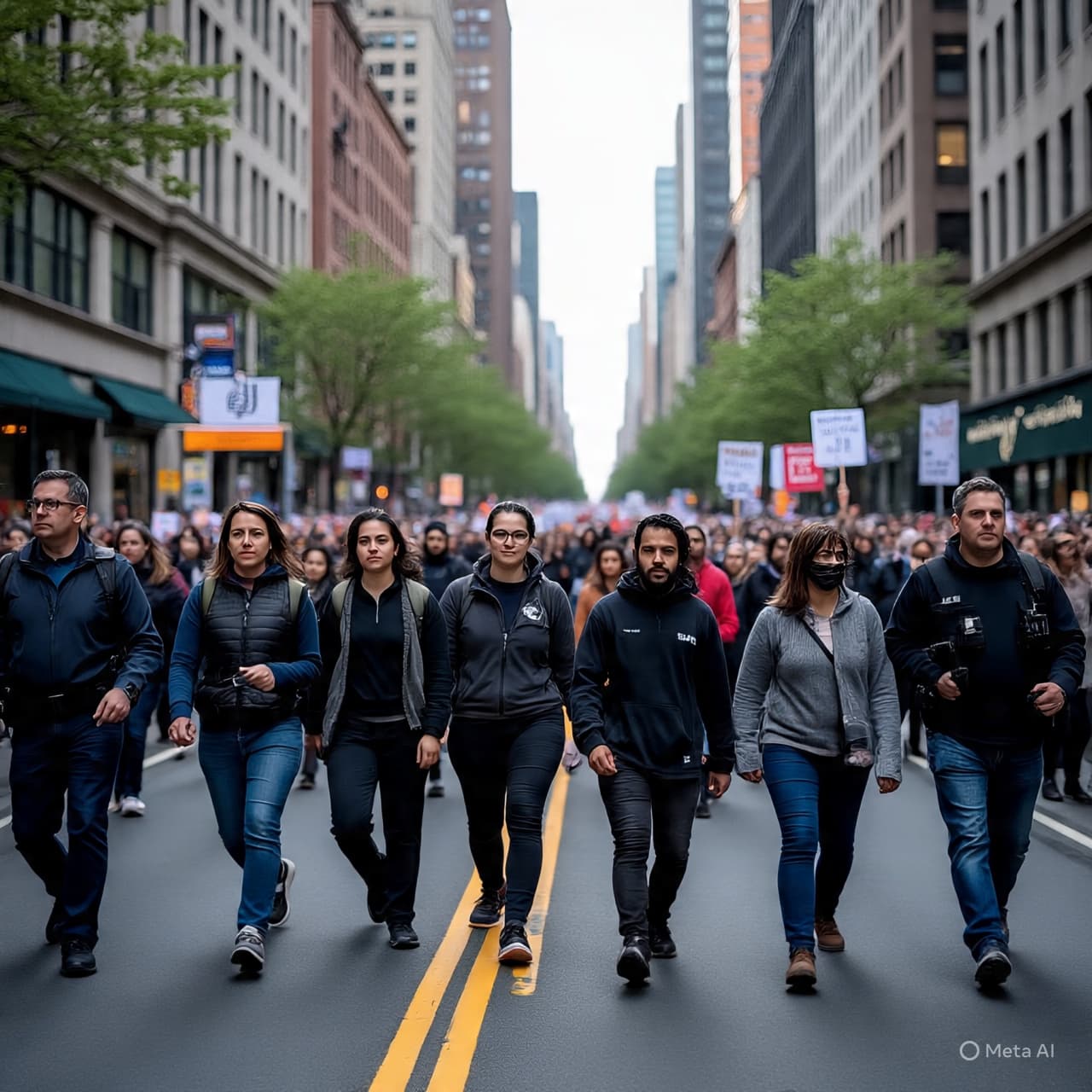
There are moments when a nation seems to pause—not in silence, but in a collective inhale, as if listening to its own heartbeat. Streets that usually carry the rhythm of daily life begin to echo with something deeper: voices layered with memory, conviction, and unease. In cities across the United States, the phrase “No Kings” has surfaced not merely as a slogan, but as a quiet reminder of an old principle—that power, no matter how large, is meant to be held in balance, not above it.
From the wide avenues of Washington to the dense grids of New York and the sunlit boulevards of Los Angeles, demonstrations have unfolded with a tone that is at once urgent and reflective. Protesters gather not only in opposition to former President Donald Trump’s political presence but also in response to what they perceive as a broader question about leadership, authority, and the boundaries of democratic norms. Their signs, often simple yet evocative, carry words that feel less like declarations and more like echoes of long-standing civic ideals.
The phrase “No Kings” itself carries historical weight, rooted in the early identity of the United States—a country shaped by its rejection of monarchy. Yet in this modern moment, it has been repurposed as a lens through which many Americans view contemporary political tensions. Demonstrators speak not only about individuals, but about systems—about the resilience of institutions, the tone of public discourse, and the invisible lines that define accountability.
In several cities, the protests have remained largely peaceful, marked by organized marches, speeches, and the steady cadence of chants. There is a noticeable blend of generations: older participants who recall past movements walking alongside younger voices encountering their first major civic action. Together, they form a kind of living timeline, where past and present overlap in shared concern.
At the same time, authorities have maintained a visible presence, aiming to ensure that gatherings remain orderly. Local officials have urged calm and respect, acknowledging the right to protest while emphasizing the importance of public safety. In this delicate balance, the streets become more than physical spaces—they transform into arenas where expression and restraint coexist.
What stands out is not only the scale of these demonstrations, but their tone. While there is frustration, there is also a noticeable undercurrent of introspection. Many participants frame their involvement not as an act of defiance alone, but as a form of civic participation—an attempt to engage with the evolving story of their country. It is less about a single moment and more about an ongoing dialogue, one that stretches beyond election cycles and into the deeper fabric of national identity.
As the protests continue, the broader implications remain open-ended. Public response varies, reflecting the diversity of perspectives that define the United States itself. Some view the demonstrations as a necessary expression of democratic engagement, while others see them as part of a more polarized landscape.
Yet, as the crowds slowly disperse at the end of each day, the echoes linger. Not as a final word, but as a question still unfolding—about leadership, about limits, and about the enduring idea that no voice, however powerful, stands alone above the rest.
AI Image Disclaimer
Visuals are created with AI tools and are not real photographs.
Source Check (Credible Media Outlets):
CNN
The New York Times
Reuters
BBC News
The Washington Post
Published by Banx Network. This article is part of the Banx decentralized media programme, powered by the BXE token on the XRP Ledger.