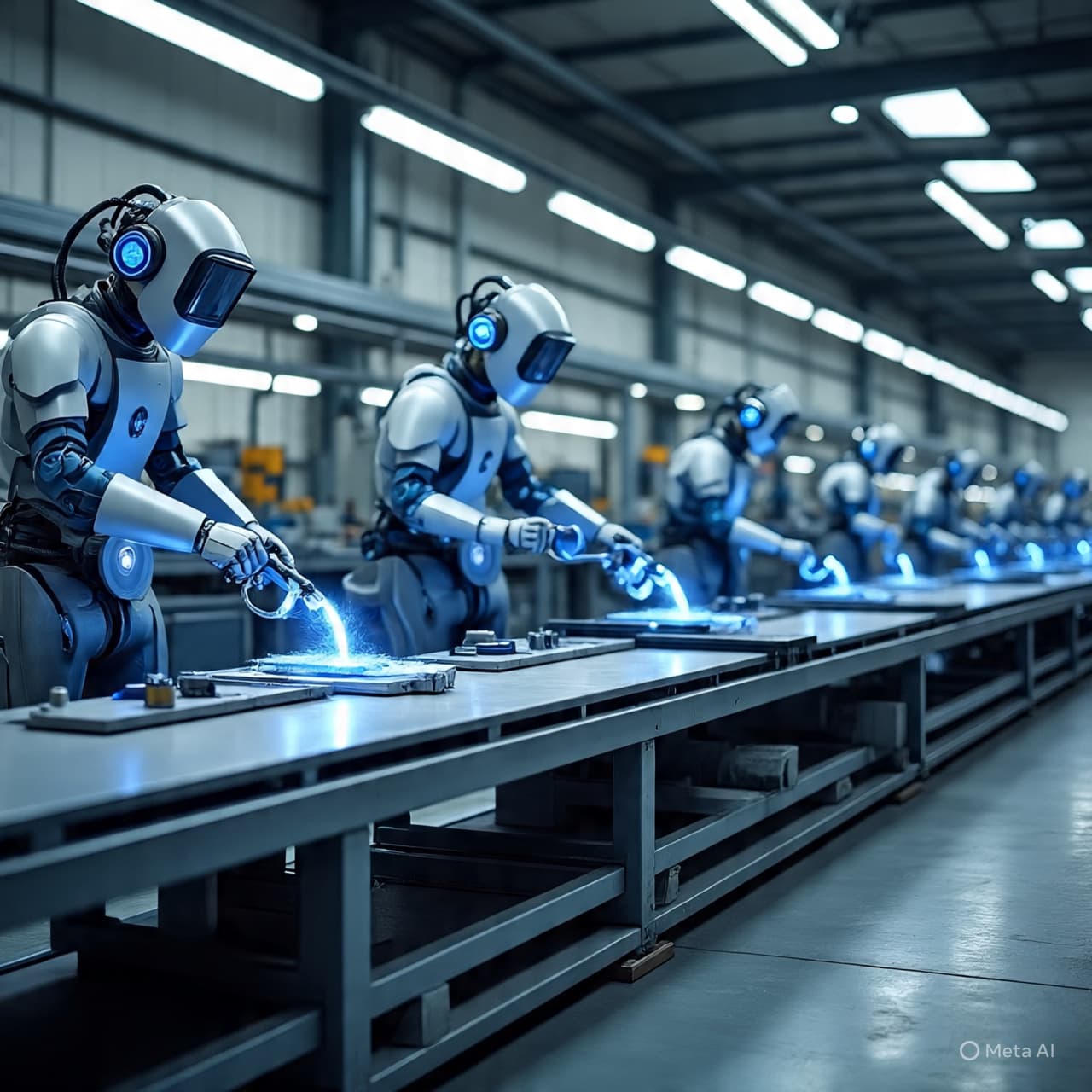
In Canada’s vast mosaic of boreal forests, quiet towns, and shimmering lakes, there is a sense of careful progression — a deliberate cadence that shapes how ideas and technologies take root. Just as the migrating geese transverse the skies in thoughtful symmetry, guided by instinct and long memory, nations, too, follow paths shaped by history, opportunity, and collective temperament. In this reflective moment, as artificial intelligence grows arms and legs in the form of robotics and physical automation, many are pausing to ask whether Canada is embracing this new era with urgency and depth, or if it stands at the shore watching the tide roll in.
Across the global economy, robots infused with AI — once the stuff of science fiction — are entering factories, warehouses, and even our streets. These machines are no longer mere tools; they sense, adapt, and act in ways that stretch the boundary between software and physical labor. Where advanced economies clamor to embed these systems into manufacturing, logistics, and service sectors, Canada’s experience appears more tempered. According to national statistics, only a small fraction of Canadian enterprises have adopted robotics technologies at all, with most reporting that such systems are not applicable to their operations. This contrasts with much broader industrial deployment across many peer nations.
Such figures invite a broader reflection on Canada’s industrial rhythm. Historically, the nation has prized foundational research and thought leadership in AI — evident in world-class institutions and ranks high on indices measuring AI talent and innovation. Yet the journey from conceptual leadership to widespread practical deployment has proven less swift. In business environments where exploration and proof-of-concepts are appreciated, the next steps of scaling and embedding robotics technologies into everyday workflows require not just imagination, but capital, confidence, and strategic coordination.
Part of this narrative may be connected to Canadians’ attitudes toward AI and automated systems. Recent studies suggest that training, literacy, and trust in AI are comparatively low, which may shape how firms and communities approach physical automation. Without robust comfort in the underlying technologies, it can be challenging for businesses to move beyond tentative experiments toward comprehensive adoption. This dynamic plays out not just in manufacturing floors but in service sectors where robotics could augment human effort in logistics, health care, and infrastructure maintenance.
Moreover, Canada’s overall investment in capital equipment, including the modern machinery that serves as the backbone for robotic automation, lags behind many comparator countries. This underinvestment not only affects productivity growth but also narrows the space for firms to modernize their operations with robotics and advanced AI systems. When robots are sparse on the grounds where goods are produced and tasks are performed, the country’s broader industrial base finds itself trailing others that have embraced automation with greater intensity.
Yet it would be incomplete to describe Canada’s story as one of absence. There are vibrant pockets of robotics innovation emerging, with Canadian firms exporting systems and insights globally. These examples hint at a more nuanced future, one where domestic barriers — from knowledge networks to incentives — may give way to broader adoption as understanding deepens and success stories accumulate.
Just as the seasons in the North shift slowly, transforming forests and waterways over months and years, so too does the evolution of technology require time, reflection, and intentional nurture. Canada’s journey into the physical realm of AI and robotics is still unfolding, shaped by economic choices, cultural attitudes, and the persistent question of where opportunities lie.
In recent data, Statistics Canada reported that only around 2% of enterprises had adopted robotics technologies in 2022, with only a small increase in planned adoption over the next few years. Meanwhile, national reports note that Canada’s usage of robotics remains lower than that of many peer nations, positioning the country in the lower tier of global robot deployment intensity. These figures underscore that while innovation and research thrive, practical uptake in the physical domain is comparatively modest at present.
AI Image Disclaimer “Graphics are AI-generated and intended for representation, not reality.”
Source Check Conference Board of Canada report ITIF analysis o KPMG/University of Melbourne study RBC thought leadership Statistics Canada robotics adoption data
Published by Banx Network. This article is part of the Banx decentralized media programme, powered by the BXE token on the XRP Ledger.