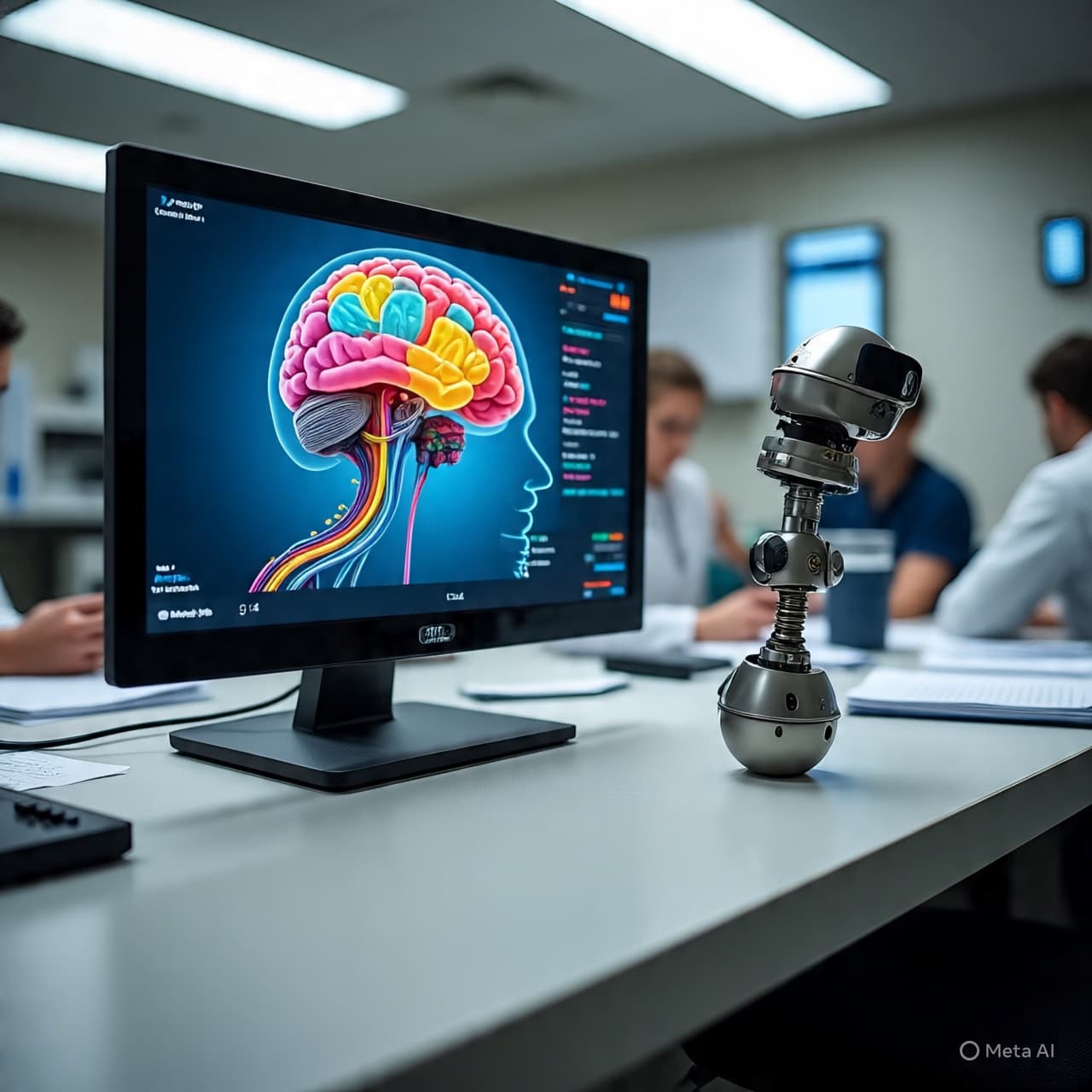
There is a quiet moment that follows movement—the fraction of a second when the body recognizes itself. A hand reaches, a foot steps forward, and somewhere between nerve and thought, the mind whispers: this is me. For most of us, that recognition feels effortless, almost invisible. But for those who rely on robotic prosthetics, that simple certainty can become something far more intricate—a dialogue between biology and machine.
Recent research into advanced robotic prosthetics is reshaping not only how people move, but how they perceive their own bodies. Engineers and neuroscientists are exploring how artificial limbs can do more than replicate mechanical function. They are asking a deeper question: can a prosthetic become part of the body’s internal map?
The human brain maintains what scientists call a “body schema”—a constantly updated mental representation of where our limbs are and how they move. It is why we can close our eyes and still touch our nose. Traditional prosthetics, while functional, often exist outside that internal map. They respond to muscle signals or external controls, yet they may not fully integrate into the user’s sense of self.
The new generation of robotic prosthetics is attempting to bridge that divide. Through embedded sensors, responsive motors, and sometimes direct neural interfaces, these devices provide feedback—pressure, vibration, even temperature cues. When a prosthetic hand grips an object, signals can travel back to the user’s nervous system, offering a sensation that approximates touch.
What researchers are discovering is subtle but profound. When sensory feedback becomes more natural and immediate, users begin to report changes in perception. The prosthetic feels less like a tool and more like an extension. Movements become smoother. Reaction times improve. Some participants describe a shift in awareness, as if the artificial limb has been quietly adopted into the body’s internal blueprint.
This shift does not happen overnight. The brain adapts gradually, rewiring neural pathways in response to repeated use. Scientists observe measurable changes in brain activity, suggesting that the boundary between biological limb and robotic device can soften over time. The process reflects the brain’s remarkable plasticity—its ability to reshape itself in response to experience.
There are emotional dimensions as well. For many amputees, prosthetics have long symbolized both loss and resilience. As devices become more integrated with perception, the psychological landscape evolves. The technology no longer simply compensates; it collaborates. Users report increased confidence, improved balance, and in some cases, a renewed sense of bodily wholeness.
Researchers remain measured in their conclusions. Robotic prosthetics do not perfectly replicate the complexity of natural limbs. Sensory feedback systems are still developing, and accessibility remains uneven. Yet the trajectory is clear: innovation is moving beyond mechanics into perception itself.
The implications extend beyond mobility. Understanding how the brain incorporates artificial components could inform treatments for neurological conditions, rehabilitation therapies, and even future human-machine interfaces. The boundary between person and device is not vanishing, but it is becoming more conversational.
For now, the research continues in laboratories and clinical trials around the world. Scientists are refining feedback systems, improving neural integration, and studying long-term outcomes. What began as an effort to restore movement is gradually transforming into a study of identity and embodiment.
As advancements progress, experts emphasize the importance of accessibility, affordability, and ethical oversight. Robotic prosthetics are becoming more intuitive and responsive, offering new possibilities for users. In that evolving partnership between nerve and circuit, the understanding of what it means to move—and to feel that movement as one’s own—continues to unfold.
AI Image Disclaimer
Illustrations were produced with AI and serve as conceptual depictions.
SOURCE CHECK
Credible coverage found in:
BBC The Guardian CNN Scientific American MIT Technology Review
Published by Banx Network. This article is part of the Banx decentralized media programme, powered by the BXE token on the XRP Ledger.