Morning in Milan often begins with a metallic whisper—the hum of tram lines tracing their patient arcs through narrow streets, the gentle chime of approaching cars as cafés lift their shutters to the pale Italian light. It is a city accustomed to rhythm: fashion seasons, cathedral bells, the unhurried glide of public transport threading between centuries-old façades. But on a recent day, that rhythm faltered.
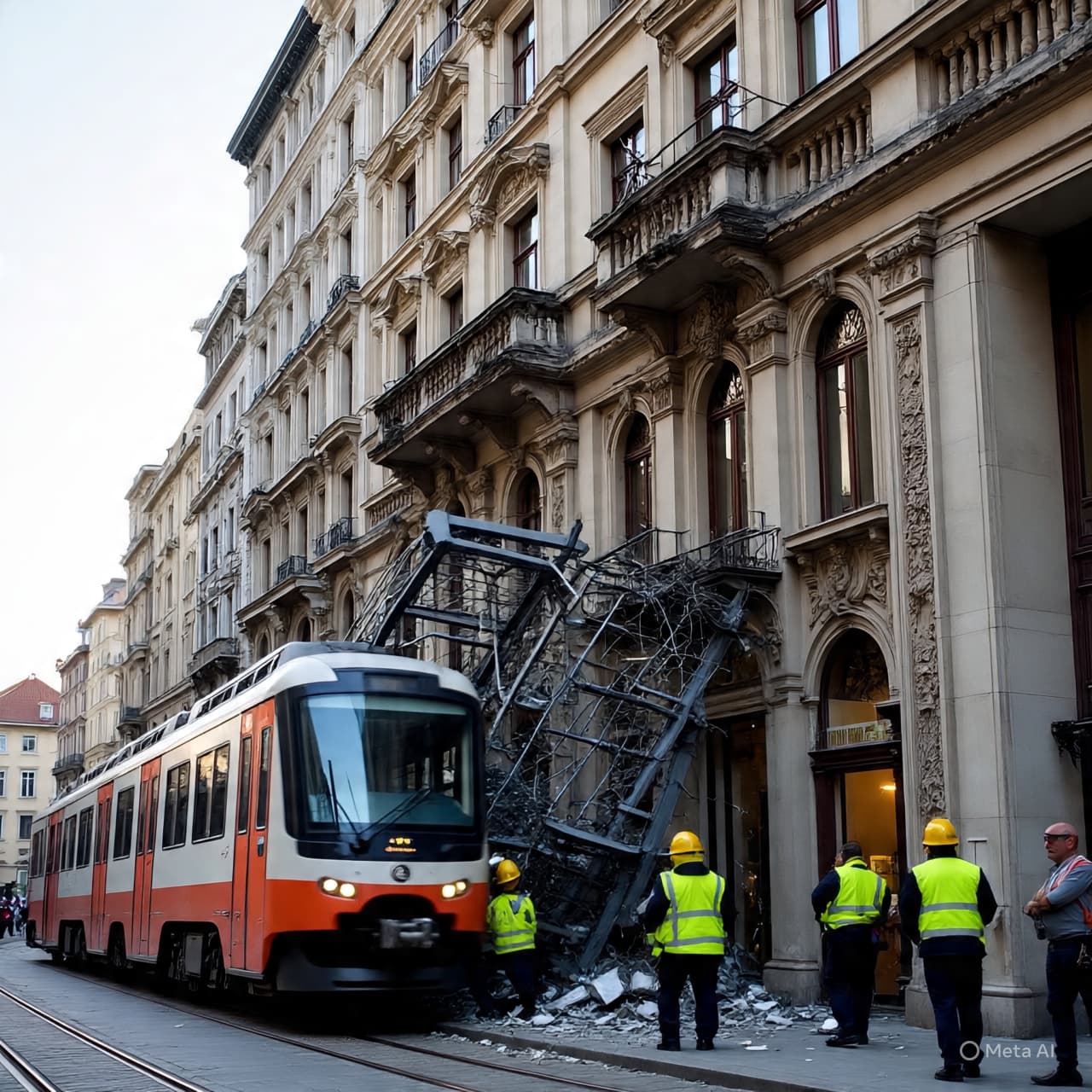
A tram, part of the city’s familiar transit tapestry, left its rails and veered from its intended course. In the sudden, jarring departure from steel and symmetry, it slammed into a nearby building. The impact was not only physical but temporal, as if the morning itself had been split into before and after. Two people lost their lives. Others were injured. A routine commute became a moment suspended in shock.
Witnesses described the screech of metal against stone, a sound that seemed to echo far beyond the intersection where it occurred. Emergency crews arrived quickly, their vehicles folding into the tight geometry of the street. Paramedics moved with practiced urgency. Police cordoned off the area, redirecting the steady pulse of pedestrians and cyclists that defines daily life in the city. Residents leaned from windows, their expressions caught between disbelief and quiet grief.
Initial reports indicated that the tram derailed before striking the building, though the precise cause remains under investigation. Transport authorities began reviewing track conditions, mechanical systems, and operational protocols. Public transit in Milan, known for its extensive network and vintage orange cars that have become urban icons, carries millions each year. Accidents are rare, and the infrastructure—some of it modern, some of it echoing the city’s industrial past—generally performs its duties with understated reliability.
Yet even the most familiar systems can falter. The tram lines that curve through historic districts and newer neighborhoods alike are both functional and symbolic: they bind together commerce, culture, and community. On this day, those lines bore witness to a rupture.
The building that absorbed the force of the crash now stands marked by it, its façade damaged, windows shattered. City engineers have begun assessing structural stability, while cleanup crews clear debris from the street. For nearby shop owners, the disruption is immediate and practical—closed doors, paused deliveries, unanswered questions. For families of the victims, the impact is immeasurable, rippling outward into private spaces far from the site of collision.
Officials have pledged a thorough inquiry, examining whether technical failure, human error, or external factors played a role. Transport services in the affected area were temporarily suspended, with alternative routes arranged to maintain continuity across the network. Statements of condolence have been issued by city leaders, acknowledging both the loss of life and the broader sense of unease that follows such an event.
As evening settled over Milan, the city’s lights returned one by one, reflecting off tram tracks that now lie quiet in a cordoned stretch of road. In time, repairs will be made. Rails will be realigned. The hum will resume. But for now, there is a stillness—a pause in the choreography of movement—that invites reflection.
Urban life depends on trust: in structures, in systems, in the unseen calibrations that carry us from one place to another. When that trust is shaken, even briefly, it leaves a fine crack in the day’s surface. Milan will continue, as cities do, balancing remembrance with resilience. Yet the morning when the tram left its rails will linger, a sober reminder of how swiftly the ordinary can tilt into the irreversible.
AI Image Disclaimer Illustrations were created using AI tools and are not real photographs.
Sources Reuters Associated Press ANSA BBC News La Repubblica
Published by Banx Network. This article is part of the Banx decentralized media programme, powered by the BXE token on the XRP Ledger.