There are places in the universe that cannot be seen, yet shape everything around them. At the center of our galaxy lies such a presence—an object so powerful that stars orbit it at extraordinary speeds, yet so elusive that it remains hidden from direct view. Astronomers often speak of it with a mixture of certainty and wonder: an invisible giant quietly anchoring the Milky Way.
Though it cannot be photographed in the traditional sense, scientists have learned to reveal its presence through the movements of stars and the glow of surrounding gas. From these clues emerges the portrait of Sagittarius A*, the supermassive black hole residing at the heart of our galaxy.
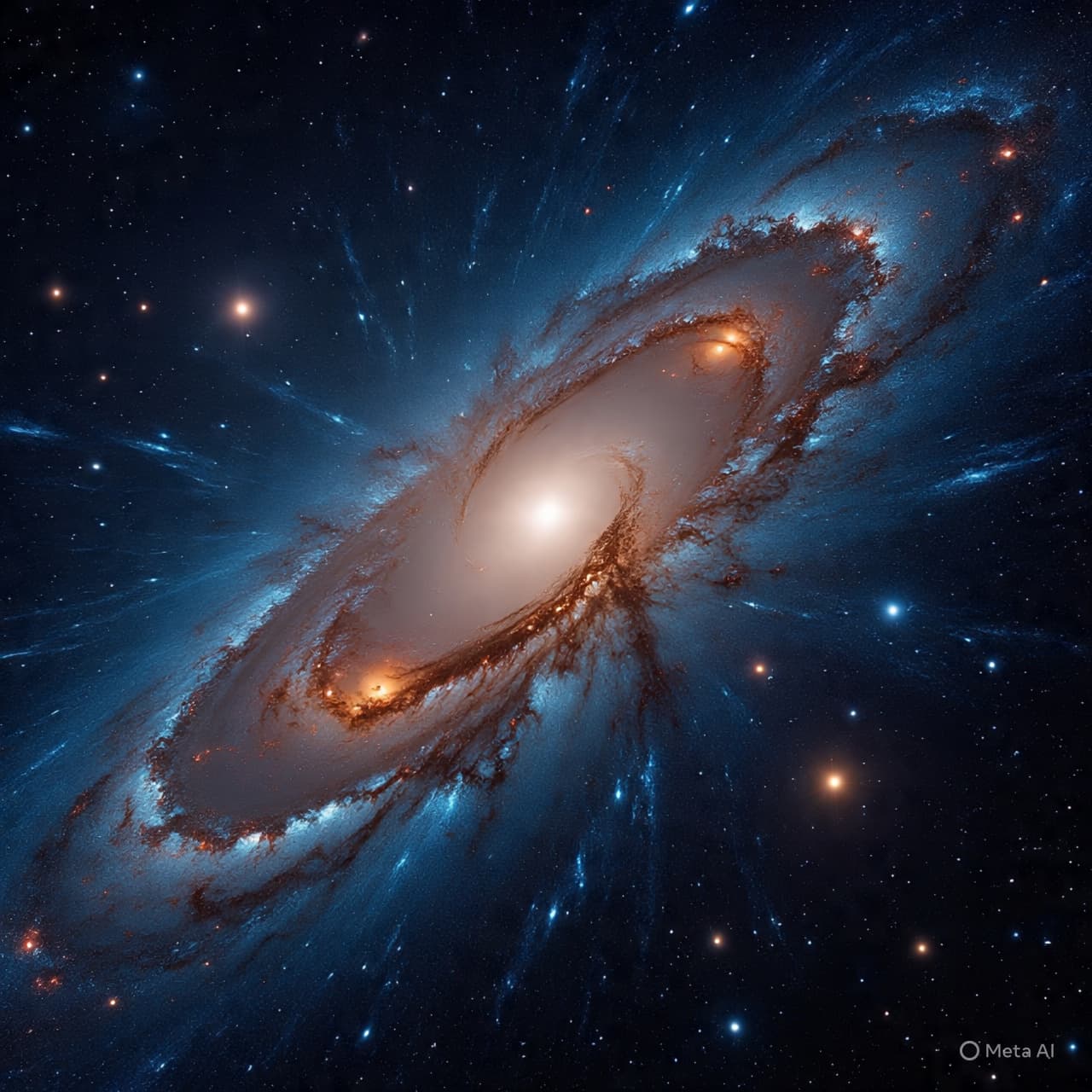
A recently highlighted Space Photo of the Day for March 11, 2026, draws attention to this cosmic centerpiece. The image—assembled from powerful observatories—offers a dramatic look into the crowded and energetic region surrounding Sagittarius A*, where swirling clouds of gas, clusters of stars, and intense radiation hint at the enormous gravitational force hidden within.
Sagittarius A* sits roughly 26,000 light-years from Earth in the direction of the constellation Sagittarius. While distant on a human scale, it remains relatively close in galactic terms, making it one of the most studied supermassive black holes in astronomy.
Scientists estimate that this black hole contains a mass about four million times greater than our Sun. Yet despite that tremendous mass, the object itself occupies a surprisingly small region of space. If placed where the Sun is today, its event horizon would extend only a fraction of the distance to Mercury’s orbit.
The image highlighted in the feature captures the chaotic environment surrounding the black hole rather than the object itself. Bright streaks and clouds represent energetic gas heated to extreme temperatures as it moves through the galactic center. Nearby stars race along tight orbits, their paths shaped by the immense gravity concentrated at the core.
Observations of these stellar motions have provided some of the strongest evidence for the existence of Sagittarius A*. Over decades, astronomers tracked individual stars whipping around an unseen focal point, sometimes completing an orbit in just a few years. These precise measurements revealed that only a supermassive black hole could produce such gravitational effects.
Advances in telescope technology have gradually sharpened humanity’s view of this region. Instruments operating in radio, infrared, and X-ray wavelengths help astronomers peer through the thick dust clouds that obscure the galactic center when viewed with ordinary visible light.
One of the most dramatic milestones came when the Event Horizon Telescope collaboration produced the first image of Sagittarius A* in 2022, revealing the glowing ring of matter surrounding the black hole’s shadow. The new image highlighted in the Space Photo of the Day continues that exploration, illustrating the turbulent surroundings where gravity, magnetism, and hot plasma interact.
For researchers, studying Sagittarius A* offers more than just a glimpse of an exotic object. Supermassive black holes appear to exist at the centers of most galaxies, influencing the growth of stars and the evolution of galactic structures over billions of years.
Understanding how these black holes behave helps scientists piece together the broader story of how galaxies form and change across cosmic time. Even relatively quiet black holes like Sagittarius A* can occasionally flare, releasing bursts of energy as gas spirals inward.
Despite the remarkable progress of recent years, much about the Milky Way’s central giant remains mysterious. Astronomers continue to monitor the region, hoping to observe new flares, track additional stars, and refine models of how matter behaves in extreme gravitational environments.
The photograph featured in the March 11 edition of Space Photo of the Day serves as a reminder that sometimes the most powerful forces in the universe are not directly visible. Instead, they reveal themselves through motion, energy, and the subtle choreography of the cosmos.
At the center of our galaxy, an unseen presence continues its quiet influence—holding stars in orbit and shaping the Milky Way’s heart from behind a veil of darkness.
For now, astronomers will keep watching that hidden center, collecting light that began its journey tens of thousands of years ago. Each observation brings the invisible giant a little closer to understanding, even if its true nature remains wrapped in shadow.
AI Image Disclaimer Visuals are created with AI tools and are not real photographs.
Sources Space.com NASA European Southern Observatory (ESO) Phys.org Sky & Telescope
Published by Banx Network. This article is part of the Banx decentralized media programme, powered by the BXE token on the XRP Ledger.