In the quiet hours before dawn, when sky and mind both soften into gentle hues, there lies a reflection of distant realms — a tapestry woven not with thread but with light itself. It is a reminder that the universe’s vastness is not empty but richly textured, and that even the most distant shapes can converse with us through color and form.
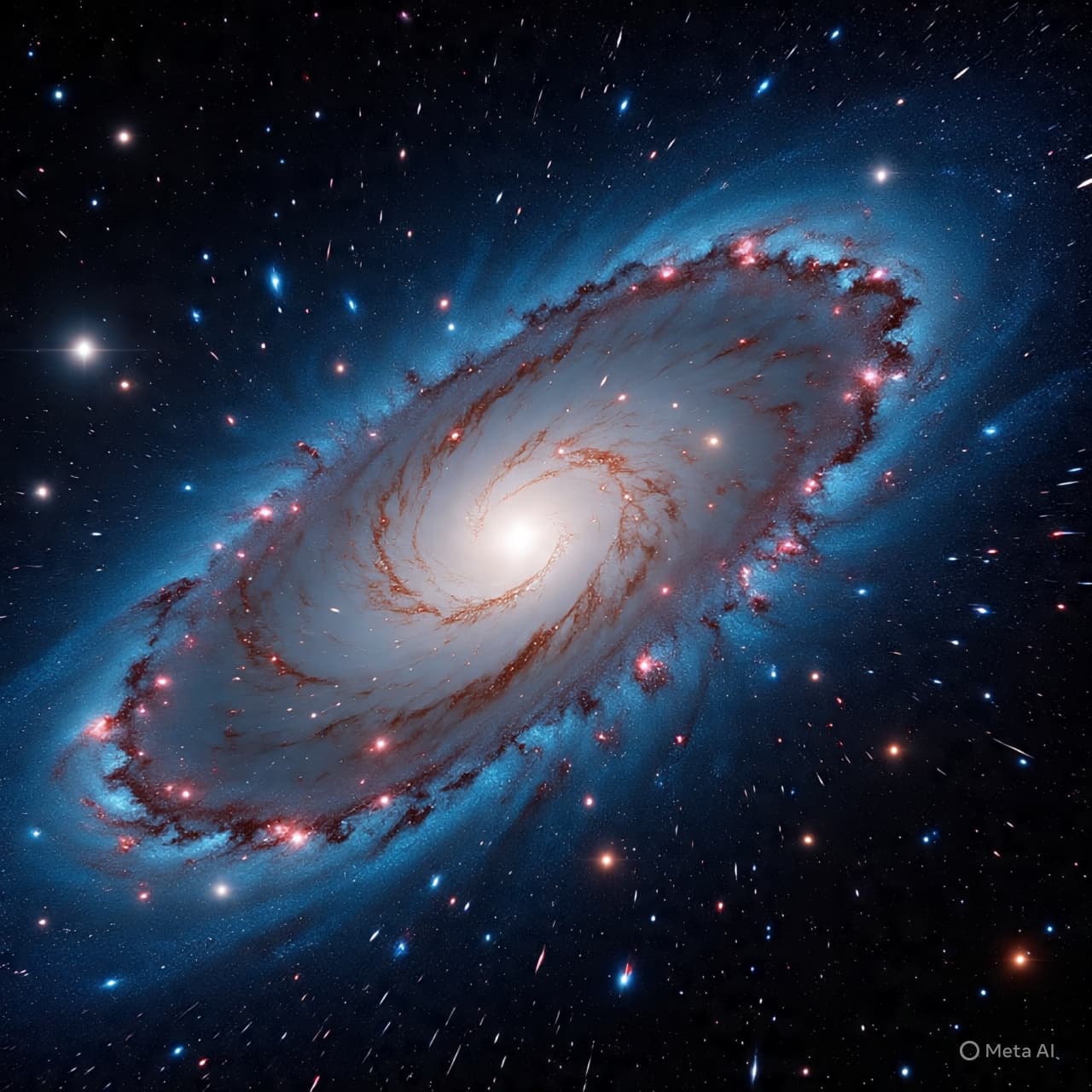
Among these distant whispers is the Triangulum Galaxy, a graceful spiral that dwells some three million light‑years from Earth in the constellation that bears its name. On a still day, humans might see its glow faintly without magnification, like a ghostly sigh in the night sky. Yet through the lens of powerful observatories, its arms unfurl in a spectacle both vibrant and delicate, revealing patterns of stars and gas that speak of creation across cosmic time.
On March 23, 2026, astronomers unveiled a new portrait of this galactic neighbor that seems to shimmer with “psychedelic” color, captured by the Very Large Telescope in Chile. In this image, clouds of interstellar gas — stirred by the ceaseless birth of stars — glow in an array of hues that stretch across the spiral’s graceful curves. The result is less a static picture and more a dynamic landscape, one in which the interplay of stars, dust, and elemental gases paints a scene of serene intensity.
This dance of light and matter is not arbitrary; it traces the life of stars and the reservoirs of cosmic material that feed their formation. Young, hot stars emit energetic light that excites surrounding gas, causing it to radiate in vivid color. In turn, cooler stars and interstellar dust reflect and absorb light in ways that accentuate the spiral structure, lending a depth and texture that invites contemplation from afar. In the Triangulum Galaxy — catalogued as Messier 33 — this interplay is readily apparent, a quiet testament to the processes that shape galaxies across the cosmos.
Seen through such instruments, the galaxy becomes more than a distant object; it becomes a mirror to our own curiosity, a reminder that light carries memory and meaning across unimaginable distances. Each filament of glowing gas, each knot of brilliant stars, holds a record of motion and change that has unfolded over millions of years. It is in these gentle billions of cycles that galaxies like Triangulum trace their evolution, visible to us only because of the patience and precision of modern astronomy.
In straightforward observational terms, the image released as the Space Photo of the Day for March 23, 2026 showcases the Triangulum Galaxy’s spiral arms and interstellar clouds in vivid, varied color. These hues result from different emissions linked to star‑forming regions, gas densities, and stellar populations, and are revealed by the telescope’s ability to capture light across multiple wavelengths. Astronomers use such images to study the structure and evolution of nearby galaxies within the Local Group, offering insights into how stars and nebulae coalesce and disperse over time.
AI Image Disclaimer: Illustrations were created using AI tools and are not real photographs.
Sources: Space.com Space Photo of the Day, encyclopedia astronomy summaries.
Published by Banx Network. This article is part of the Banx decentralized media programme, powered by the BXE token on the XRP Ledger.