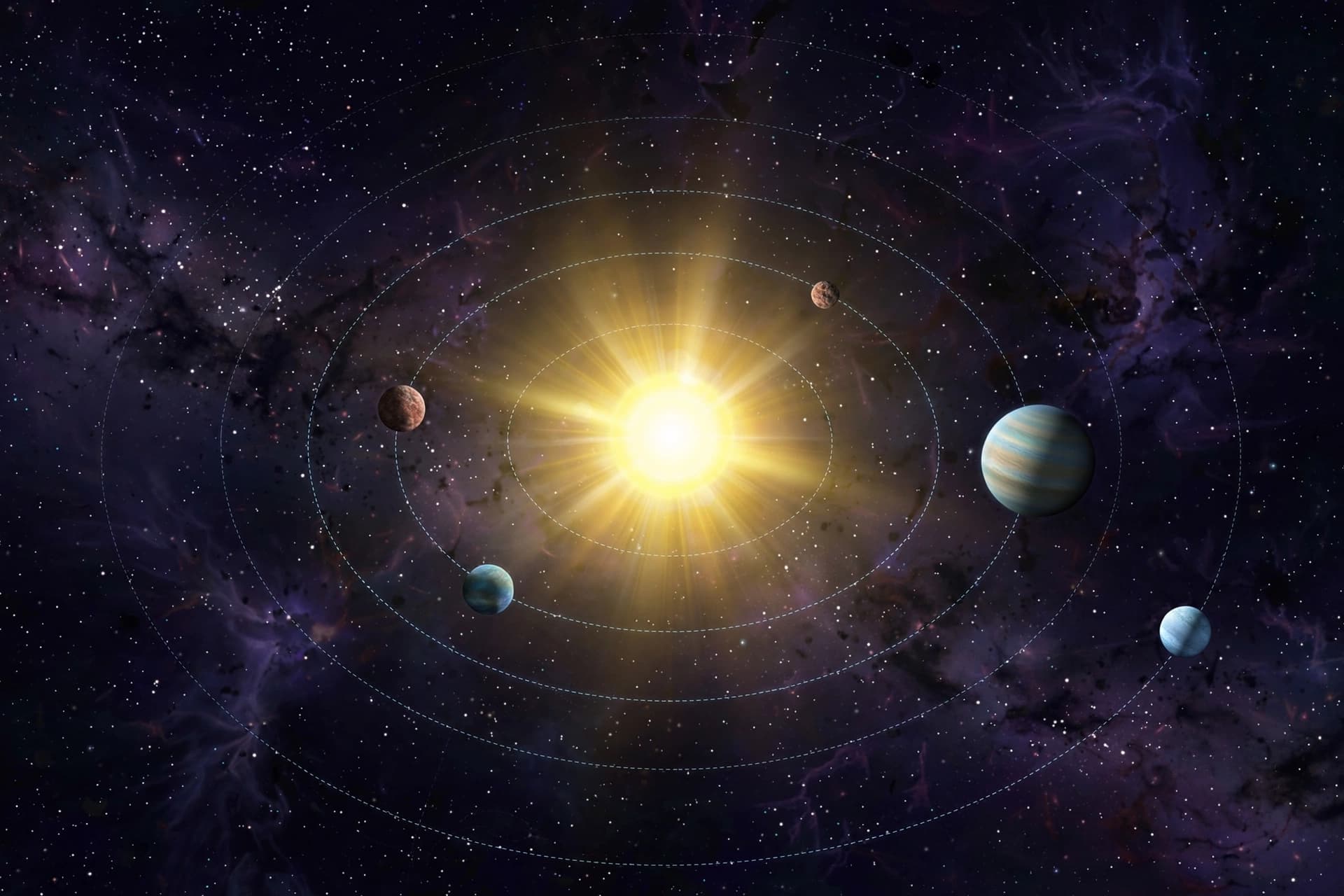
Far from Earth, where sunlight travels quietly across millions of miles of empty space, the planets orbit in a delicate rhythm. Most days, the journey of sunlight is gentle—warmth, light, and the faint breath of solar wind drifting outward. But sometimes the Sun raises its voice.
In May 2024, the Sun did just that.
A powerful solar superstorm surged through the solar system, strong enough to light Earth’s skies with rare auroras stretching far from the poles. Yet Earth was not the only world touched by that storm. Farther out, near the rust-colored deserts of Mars, two spacecraft happened to be watching at exactly the right moment.
Their timing, scientists would later say, was remarkably lucky.
High above the Martian surface, the European Space Agency’s Mars Express and ExoMars Trace Gas Orbiter were quietly circling the planet when the storm arrived. The event itself was part of a broader wave of solar activity that sent radiation, energetic particles, and plasma racing outward from the Sun.
When this surge reached Mars, it struck a planet very different from Earth.
Our world is shielded by a global magnetic field—a protective bubble known as the magnetosphere that deflects many charged particles from solar storms. Mars, by contrast, lost most of its global magnetic shield billions of years ago. The Red Planet’s atmosphere stands more exposed to the Sun’s temper.
So when the storm arrived, its effects were dramatic.
Sensors aboard the orbiters recorded a surge of radiation equivalent to roughly 200 days of normal exposure compressed into just 64 hours. The upper layers of the Martian atmosphere reacted quickly. Electrons flooded into the region, creating the most intense atmospheric response scientists have ever measured during a solar storm at Mars.
At altitudes around 110 kilometers above the planet, electron density increased by about 45 percent, while another layer around 130 kilometers experienced a remarkable 278 percent surge.
For researchers studying planetary atmospheres, the event became an unexpected window into how solar energy interacts with Mars.
The orbiters also experienced the storm firsthand. High-energy particles triggered small computer glitches aboard both spacecraft—an example of the technological hazards that space weather can create far from Earth. Fortunately, the probes were designed with radiation-resistant systems capable of detecting and correcting such faults, and operations quickly returned to normal.
What made the observations particularly valuable was not only the storm itself, but the rare opportunity to measure it in detail.
Scientists used an experimental technique known as radio occultation, in which one spacecraft sends a radio signal through the planet’s atmosphere toward another spacecraft. As the signal passes through layers of charged particles, it bends slightly, revealing information about atmospheric structure and density.
In this case, the timing was extraordinary. The measurement began only about ten minutes after a large solar flare struck Mars, allowing researchers to capture the atmosphere’s immediate reaction. Normally, such observations occur only twice a week, making the alignment of events particularly fortunate.
Beyond the scientific curiosity, the findings also illuminate a deeper story about Mars itself.
The Red Planet was once warmer and wetter, with rivers and lakes shaping its ancient landscape. Over billions of years, however, much of its atmosphere escaped into space. Continuous bombardment from solar particles is believed to have played a significant role in that gradual loss.
Solar storms like the one observed in 2024 offer researchers a glimpse of that long process in action—a reminder of how powerful the Sun’s influence can be across the solar system.
For now, the event also offers a practical lesson. Charged particles and electron-rich atmospheres can interfere with radio signals used by spacecraft to study planets and communicate with rovers on the surface. Understanding these conditions may help scientists design future missions more effectively.
The observations were recently published in the journal Nature Communications, providing one of the clearest looks yet at how Mars responds when the Sun unleashes its strongest outbursts.
And thanks to two orbiters circling quietly in the right place at the right time, a moment of solar fury became an unexpected opportunity for discovery.
AI Image Disclaimer Illustrations were produced with AI and serve as conceptual depictions.
Sources Space.com European Space Agency Phys.org EurekAlert Mirage News
Published by Banx Network. This article is part of the Banx decentralized media programme, powered by the BXE token on the XRP Ledger.