On a distant sphere of roiling color and whispering winds, storms gather with a patience unfathomable in the rhythmic skies of Earth. Jupiter’s belts and zones swirl in slow motion — great atmospheric rivers pulling and folding upon themselves like ocean tides frozen in time. In those immense folds, where ammonia and water mingle beyond our common experience, lightning sleeps, waiting for the thunderbolt that only giants can release.
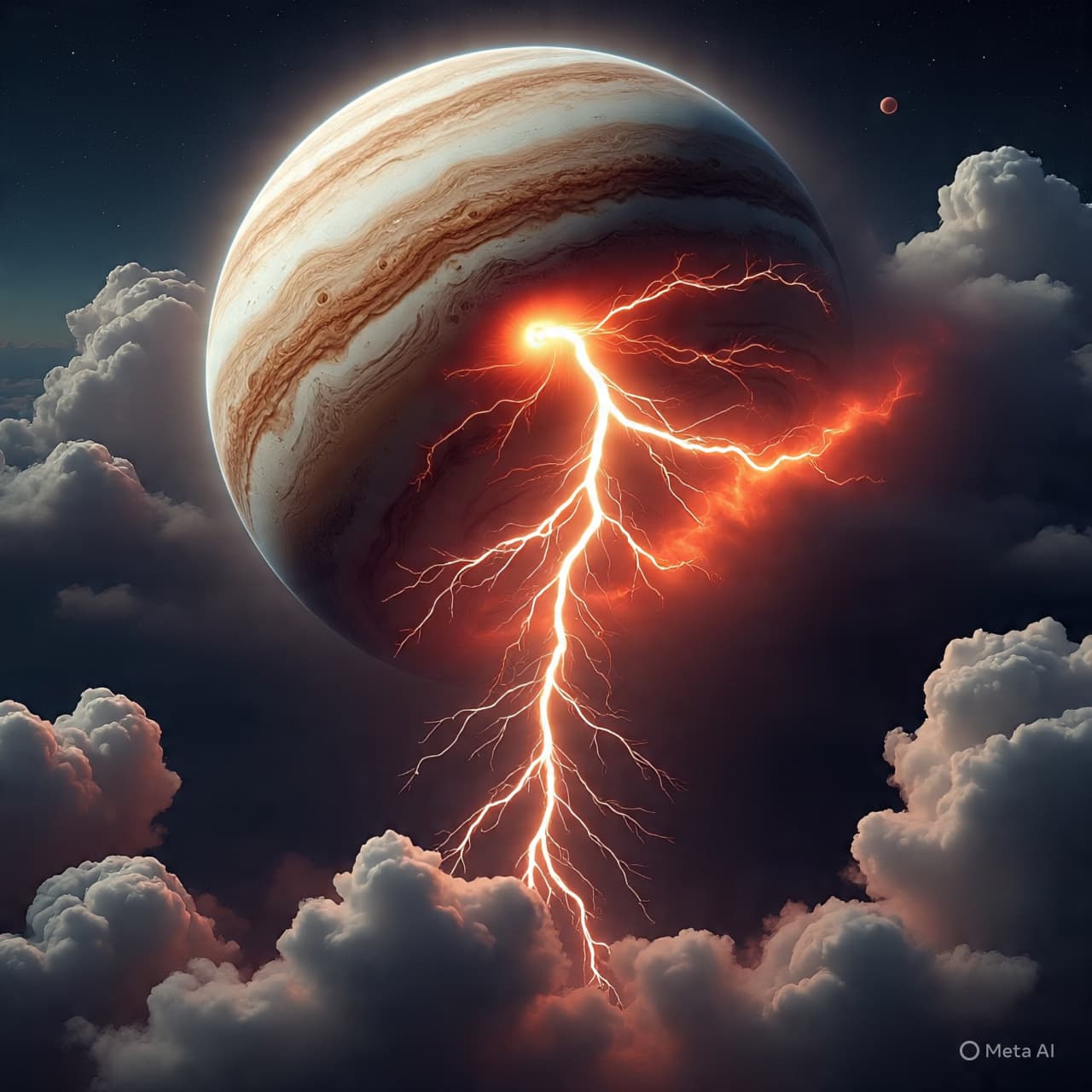
This is not the familiar crack of a summer tempest back home. The Juno spacecraft, in its long, looping vigil around Jupiter since 2016, has been listening for these electric murmurs — not with the naked eye but through microwaves that slip through thick Jovian clouds. Over episodes when isolated “stealth superstorms” quietly dominated regions of the planet’s North Equatorial Belt, scientists could finally match the storm’s location in light and follow its radio pulse back to its source. From those remote calculations emerged a remarkable truth: some of those bolts carry more than a hundred times the electrical power of the fiercest flashes seen in Earth’s skies.
Here, in an atmosphere ruled by hydrogen and helium in vast abundance, energy seems to take on a different life. On Earth, a storm builds and releases in hours, drawn by the pull of warm air and cooling breezes. On Jupiter, storm towers might climb tens of kilometers deeper into the cloudscape, driven by forces that resist and release with a languor only possible on a world where weight and pressure wear a different meaning. Observations of these giant storms suggest that the mechanisms behind their electrical discharges, though shaped by familiar physics, operate on scales and through pathways that continue to surprise those who study them.
Yet there is a calmness to this distant thunder. It comes without the human stakes that electrify our own weather forecasts. There is only knowledge — the slow, gentle illumination of a phenomenon that binds worlds across a solar system. These bolts, many times stronger than our own, become bridges of comprehension that allow scientists to reflect on atmospheric electricity in all its cosmic forms.
In this way, each flash on Jupiter becomes an echo back to us — a reminder that while our storms are spoken in thunder and rain, the language of lightning is universal, written in electric arcs that span across gas and sky alike. In the quiet aftermath of each discovery, the fact remains: lightning on Jupiter is measured with precision and curiosity, reaching at least a hundred times the power of terrestrial flashes, offering a new horizon in our understanding of planetary meteorology.
AI Image Disclaimer: Visuals are AI-generated and serve as conceptual representations.
Sources: Berkeley News, Popular Science, Ars Technica, Phys.org.
Published by Banx Network. This article is part of the Banx decentralized media programme, powered by the BXE token on the XRP Ledger.