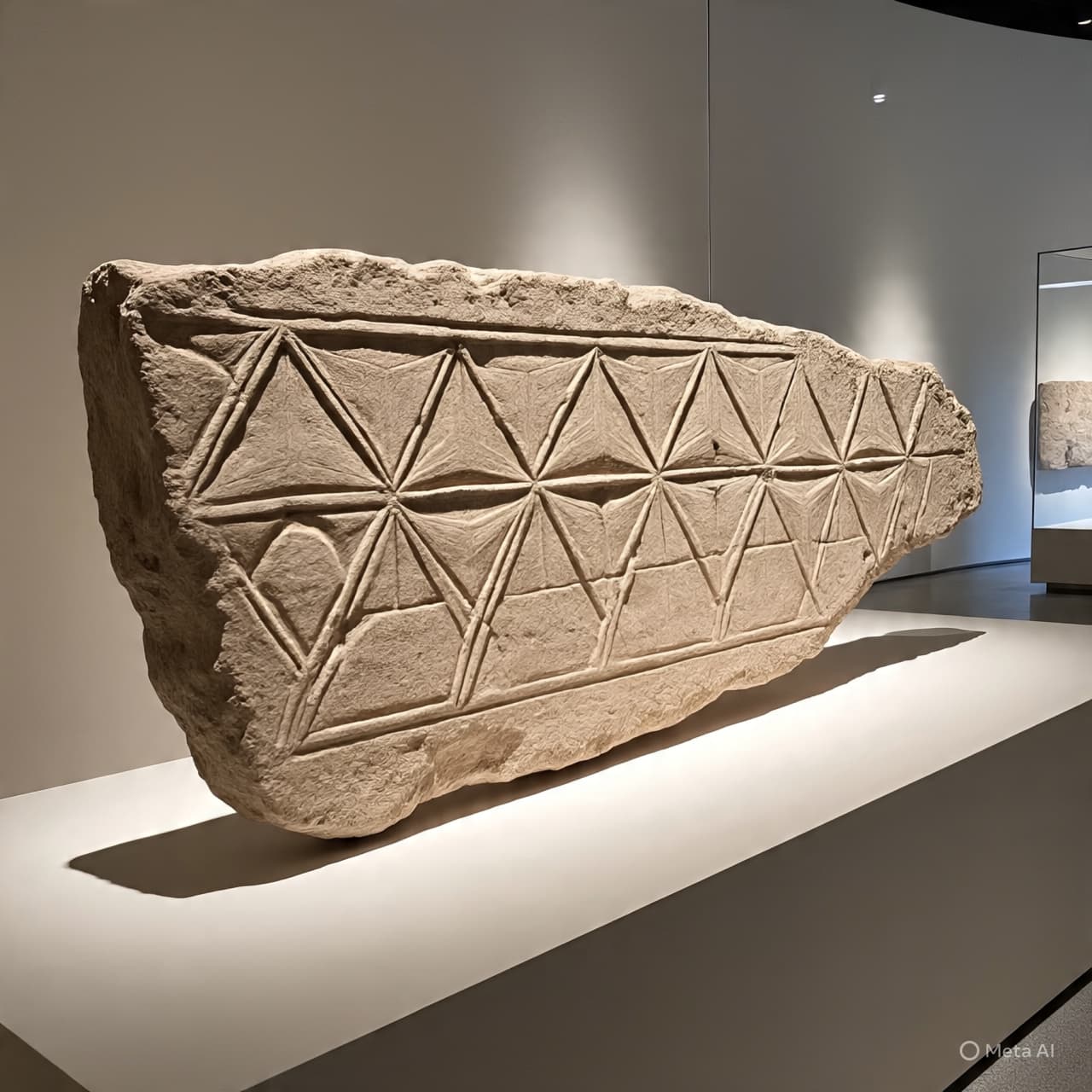
There are moments when history does not shout but waits. It rests quietly in stone, in dust, in objects once handled with familiarity and then forgotten by time. In a museum in the Netherlands, a modest Roman-era limestone slab lay still for centuries, its carved lines seeming decorative at first glance. Yet like faint footprints across an old courtyard, the grooves suggested motion, repetition, intention. And in an age defined by algorithms rather than emperors, it was artificial intelligence that finally paused long enough to listen.
The artifact, dating back roughly 1,500 to 1,700 years, bears a geometric pattern of intersecting lines. Archaeologists long suspected it might be more than ornamentation. Subtle wear marks traced along certain paths hinted that small objects had once moved repeatedly across its surface. The stone, it seemed, had hosted a game—though its rules had long vanished.
To approach this silent puzzle, researchers turned to an AI system trained to analyze and simulate historical board games. By feeding the carved layout into the program, scholars allowed the system to generate and test possible rule sets. The AI ran thousands of simulations, comparing movement logic with the wear patterns preserved in the stone. Slowly, patterns began to align.
What emerged was the likelihood of a “blocking game,” a strategic contest in which players attempt to restrict their opponent’s movement. Such mechanics are familiar in later medieval games, but rarely documented so clearly in the Roman period. If accurate, the finding suggests that structured strategic play may have been more sophisticated—and perhaps more widespread—than previously assumed.
Yet the researchers remain measured. Artificial intelligence can propose possibilities, but it cannot confirm lived experience. The reconstructed rules are plausible, not definitive. Still, the convergence between simulated outcomes and physical wear offers a compelling bridge between technology and antiquity.
In this quiet collaboration between archaeology and machine learning, the past is not rewritten but gently reexamined. A simple slab of stone becomes something more than an artifact. It becomes evidence of leisure, rivalry, and thoughtful play—reminding us that even across millennia, human curiosity remains a constant companion.
Researchers from Leiden University and Maastricht University detailed their findings in the journal Antiquity, noting that while the AI-generated reconstruction aligns with physical evidence, further comparative discoveries would strengthen the case. For now, the Roman stone stands not only as a relic of play, but as a testament to how modern tools can illuminate ancient lives.
AI Image Disclaimer Visuals are created with AI tools and are not real photographs.
Source Check Credible mainstream and niche media coverage found:
CBS News Scientific American Gizmodo Semafor Dutch News
Published by Banx Network. This article is part of the Banx decentralized media programme, powered by the BXE token on the XRP Ledger.