
Key Highlights
- Artifact Age:The limestone slab dates back 1,500 to 1,700 years.
- AI Analysis:Researchers utilized AI to simulate historical board games.
- Game Discovery:Findings suggest the slab may have hosted a strategic blocking game.
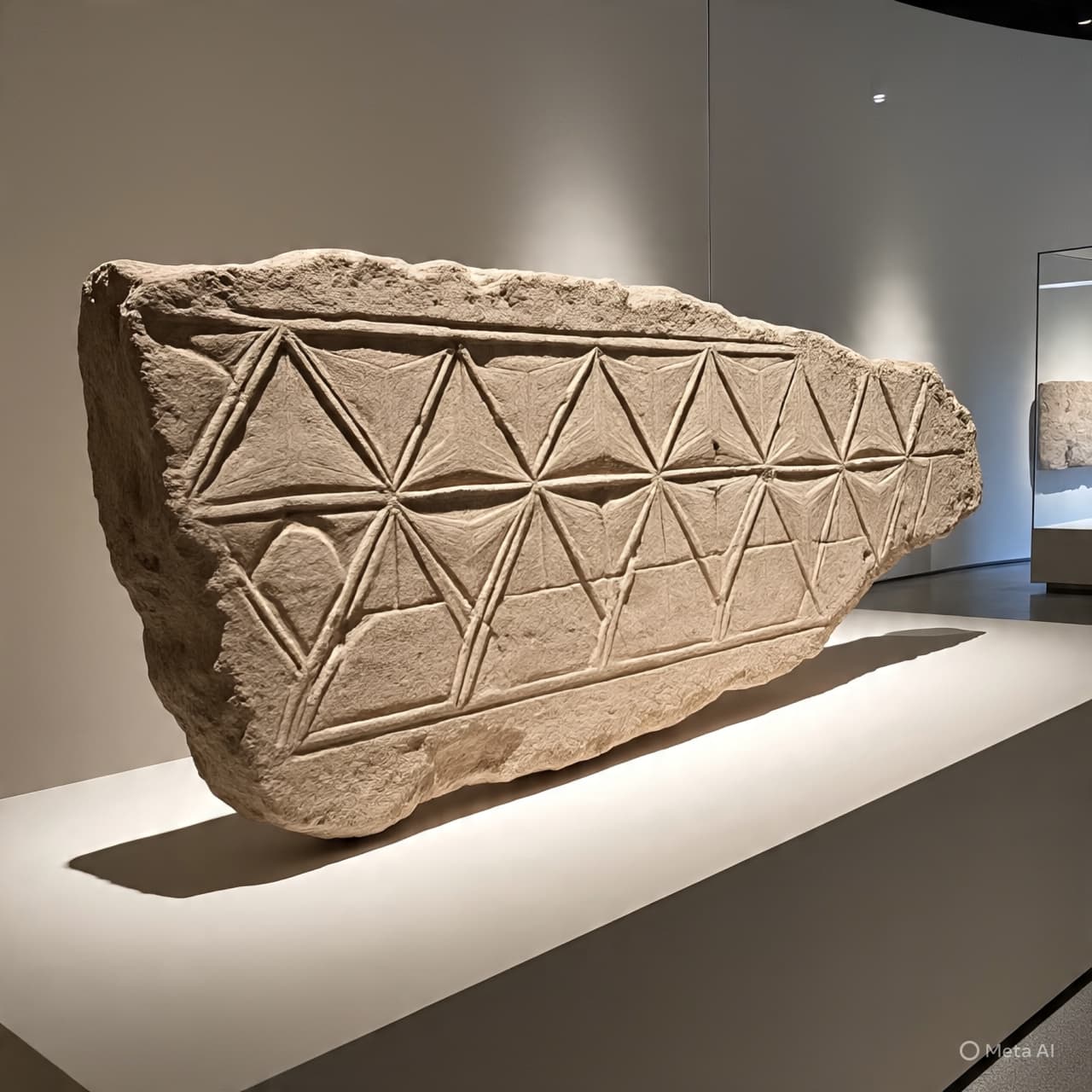
In a quiet museum in the Netherlands, a seemingly ordinary Roman-era limestone slab has become the focus of groundbreaking research. This artifact, which has remained undisturbed for centuries, features a geometric pattern of intersecting lines that initially appeared decorative. However, archaeologists suspected that these grooves might indicate something more significant—evidence of a game played long ago.
The limestone slab, estimated to be between 1,500 and 1,700 years old, shows subtle wear marks along certain paths. These marks suggest that small objects were moved repeatedly across its surface, hinting at the existence of a game whose rules have been lost to time. To investigate this possibility, researchers from Leiden University and Maastricht University turned to artificial intelligence, a modern tool that has begun to bridge the gap between ancient history and contemporary technology.
By inputting the carved layout into an AI system designed to analyze historical board games, the researchers were able to generate and test various rule sets. The AI conducted thousands of simulations, comparing the movement logic with the wear patterns observed on the stone. Over time, the simulations began to reveal a coherent picture, suggesting that the slab may have been used for a “blocking game.” This type of strategic contest involves players attempting to limit their opponent's movements, a concept familiar in later medieval games but rarely documented in the Roman era.
While the findings are promising, the researchers caution against drawing definitive conclusions. The AI-generated rules are plausible but not confirmed. The intersection of simulated outcomes and physical evidence provides a compelling narrative, yet it remains a hypothesis that requires further exploration. The researchers emphasize that while AI can propose possibilities, it cannot replace the lived experiences of those who once played on this slab.
This collaboration between archaeology and machine learning represents a significant step forward in understanding ancient leisure activities. The limestone slab transforms from a mere artifact into a window into the past, revealing insights into human behavior and social interaction. It serves as a reminder that curiosity and the desire for play have been constants throughout human history, transcending the barriers of time.
The findings were published in the journal Antiquity, where the researchers noted that additional comparative discoveries would bolster their case. For now, this Roman stone stands as a testament to the potential of modern technology to illuminate the lives of those who came before us, offering a glimpse into a world where leisure and competition were as vital as they are today.
AI Image Disclaimer Visuals are created with AI tools and are not real photographs.
Published by Banx Network. This article is part of the Banx decentralized media programme, powered by the BXE token on the XRP Ledger.



