Opening Some journeys begin with footsteps, others with questions whispered into the wind. In the thin, rust-colored air of Mars, a different kind of whisper now stirs — not from human lips, but from circuits and algorithms. As the first light of a Martian morning brushes the jagged horizon, a six-wheeled explorer has followed instructions not drawn by hand, but woven by artificial intelligence. In this quiet revolution on a distant world, we find ourselves pondering not just where we’re going, but how we choose to get there. Here, on the rim of Jezero Crater, human curiosity and machine ingenuity meet in gentle harmony.
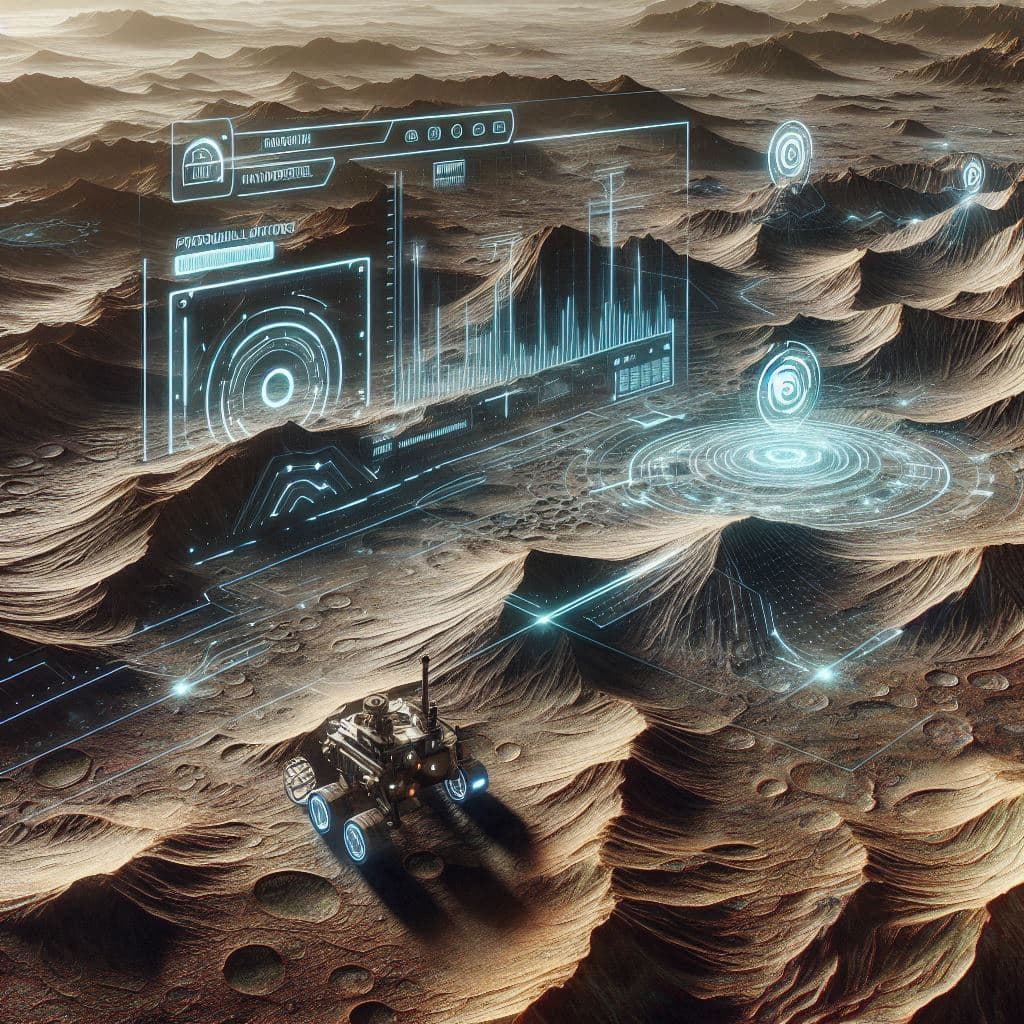
Body In early December 2025, on the 1,707th and 1,709th Martian sols of its mission, NASA’s Perseverance rover executed something previously reserved for science fiction: autonomous drives planned by generative artificial intelligence rather than carefully plotted by human teams on Earth. Instead of meticulously sketching waypoints and sending them across millions of miles, engineers at NASA’s Jet Propulsion Laboratory asked AI to do the heavy thinking. The result was two smooth traverses — one of about 210 meters and another of roughly 246 meters — across rocky terrain that had challenged many minds before.
The AI used in this demonstration wasn’t a remote controller, but a vision-capable model trained to interpret images and terrain data the same way human planners do. It analyzed high-resolution snapshots of Martian surface features from orbit, identified hazards like boulders and sand ripples, and created a continuous path for Perseverance to follow. These AI-generated waypoints — fixed roadmarks for the rover — were then checked against a “digital twin” of the rover, a virtual simulation ensuring every command would be safe and compatible with its onboard systems before the actual transmission.
Generative AI doesn’t tire, and it doesn’t await answers from Earth. Signals to and from Mars take many minutes to make the round trip, making real-time remote control impossible. For decades, human rover planners have had to anticipate every turn, but this new approach promises a future where Mars rovers can make smart decisions more independently, allowing them to cover greater distances and gather more science in the same span of time.
While this demonstration is still carefully overseen by engineers, it points toward a horizon where AI and robotics work hand in hand to tackle the challenges of space exploration. In gentle steps — a few meters at a time — rovers like Perseverance are showing that far from Earth, trust can grow between human intent and machine execution.
Closing On that distant, dusty plain, the rover’s quiet progress reminds us that the future of exploration isn’t only about distance, but about adaptation and collaboration. With each AI-planned drive, we learn not only about the Red Planet’s rugged beauty but also about how tools born of human imagination may carry that imagination ever further. As data continues to arrive back on Earth and scientists reflect on this milestone, one truth stands gently radiant: the march toward Mars evolves not in sudden leaps, but in thoughtful steps forward.
AI Image Disclaimer (Rotated)
Graphics are AI-generated and intended for representation, not reality.
---
Sources
1. NASA Jet Propulsion Laboratory (JPL) news release 2. NASA official article 3. WutsHot visualization recap 4. Mirage News summary 5. Anthropic “Claude on Mars” description
Published by Banx Network. This article is part of the Banx decentralized media programme, powered by the BXE token on the XRP Ledger.