
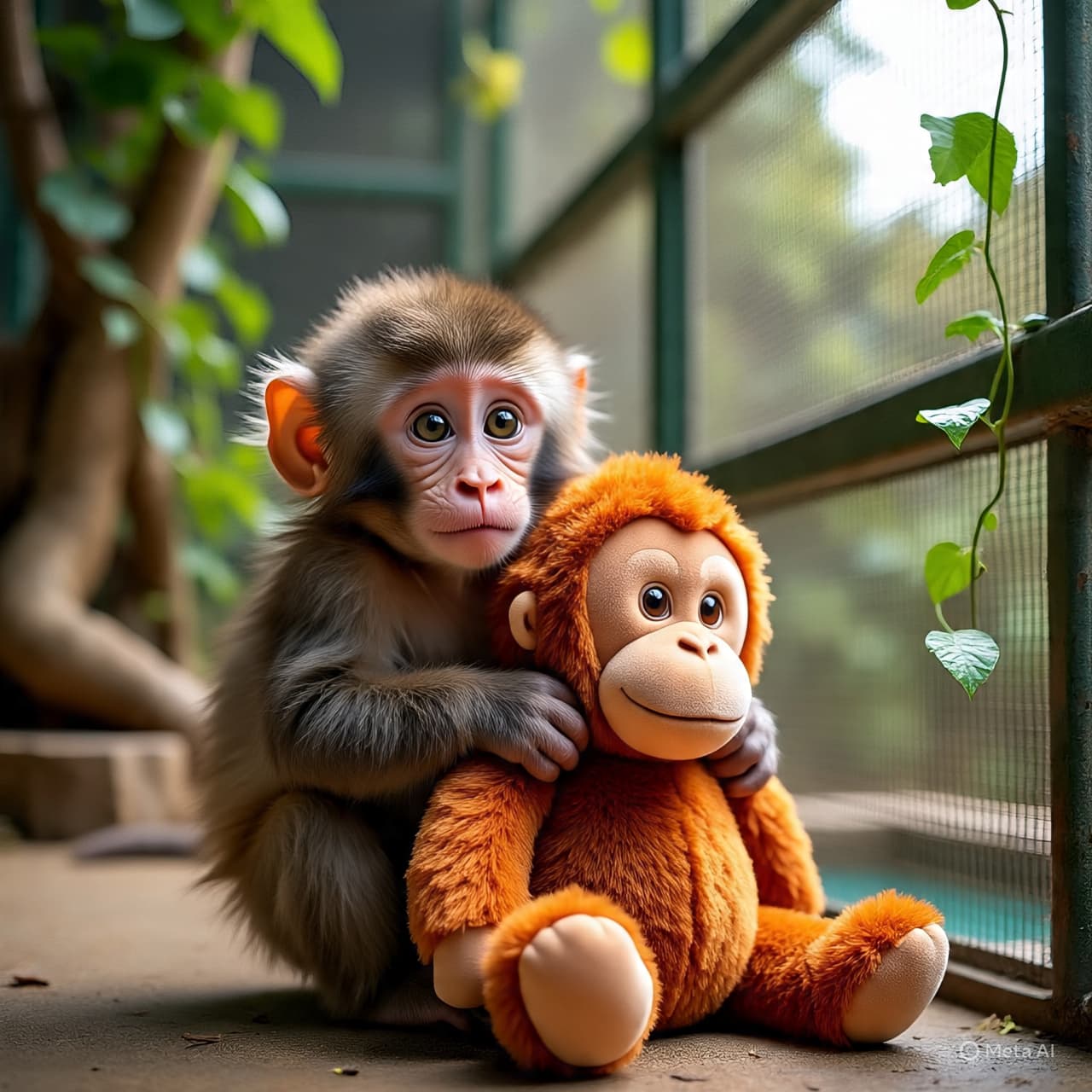
A crisp morning sun broke over the monkey enclosure at a modest zoo outside Tokyo, where a tiny, fur-clad figure made his way through a world much larger than himself. There was a kind of quiet poetry in the way he walked — tentative, but unafraid — with a plush orangutan toy tucked close, like a secret friend against the uncertain cold. In the gentle cadence of the wind through bamboo and cedar, visitors began to see not just an animal, but a small, living emblem of vulnerability and resilience.
His name is Punch — a six- or seven-month-old Japanese macaque who arrived into life without the warm clasp of a mother’s arms. Rejected by his birth mother soon after he was born, Punch was taken in by zookeepers who provided food, shelter, and, in time, this stuffed orangutan whose soft, long hair seemed to offer some echo of the comfort he had never known. With his toy under one arm, Punch explored his enclosure with a mixture of curiosity and caution, like a child carrying both a balloon and a question in his heart.
The world beyond the zoo fences took notice. Video clips and photos of Punch clutching his plush companion spread across social media and captured people’s attention around the globe. In each frame, there was an interplay of innocence and adaptation — a small primate navigating a social world without the cradle of family, leaning on an object of his own making for reassurance. For many, this was more than a viral image; it was a gentle mirror of our own search for connection.
In the early days of his reintroduction to other macaques, Punch sometimes met with indifference or rebuff. Other monkeys, uncertain of his presence, watched as he peeked from behind his plush orangutan or crept forward with tentative steps. Some moments were awkward; a larger macaque might guide him away, reminding him of group boundaries. In those scenes, the plush toy became both shield and comfort — a mum made of fabric in a space where real arms were slow to reach.
But life’s rhythms, especially among primates, are subtle and quiet in their unfolding. Over time, Punch began leaving the toy behind more often, curious about the calls of other members of his troop. Caretakers and observers have noted shy grooming exchanges and the first tentative touches between Punch and his companions. In recent videos shared by visitors, an adult macaque named Onsing pulled the young monkey close in a moment that felt, for many, like a small dawn after a long night.
What began as a story of loneliness became, for many, a tale of possibility — a reminder that even the smallest among us can, in time, find a place in the greater whole. And in the quiet midst of this journey, Punch continues to embody both fragility and courage: a monkey with a soft toy who taught the world something about the gentle work of belonging.
In the days since Punch became known beyond the zoo, visitors come not only for the spectacle but to witness a living story of adaptation. Officials at the zoo express gratitude for the attention and have urged audiences to watch how Punch, with patience and support, continues his path toward fuller social life among his kind.
Even as crowds gather and cameras click, the essence of Punch’s story remains unadorned: life is a series of small steps taken toward warmth — sometimes toward another’s embrace, sometimes toward the shade of a familiar friend in soft fur.
AI Image Disclaimer Illustrations were produced with AI and serve as conceptual depictions.
Sources Reuters, Washington Post, Los Angeles Times, Yahoo News, People.com
نُشر بواسطة Banx Network. هذا المقال جزء من برنامج الوسائط اللامركزية من Banx، مدعومًا برمز BXE على شبكة XRP Ledger.


