

Key Highlights
- Discovery:Astronomers have identified a warm gas ring surrounding a newborn star.
- Implications:This finding challenges existing theories about stellar birth and planetary formation.
- Future Research:Scientists are investigating whether this phenomenon is common among young stars.
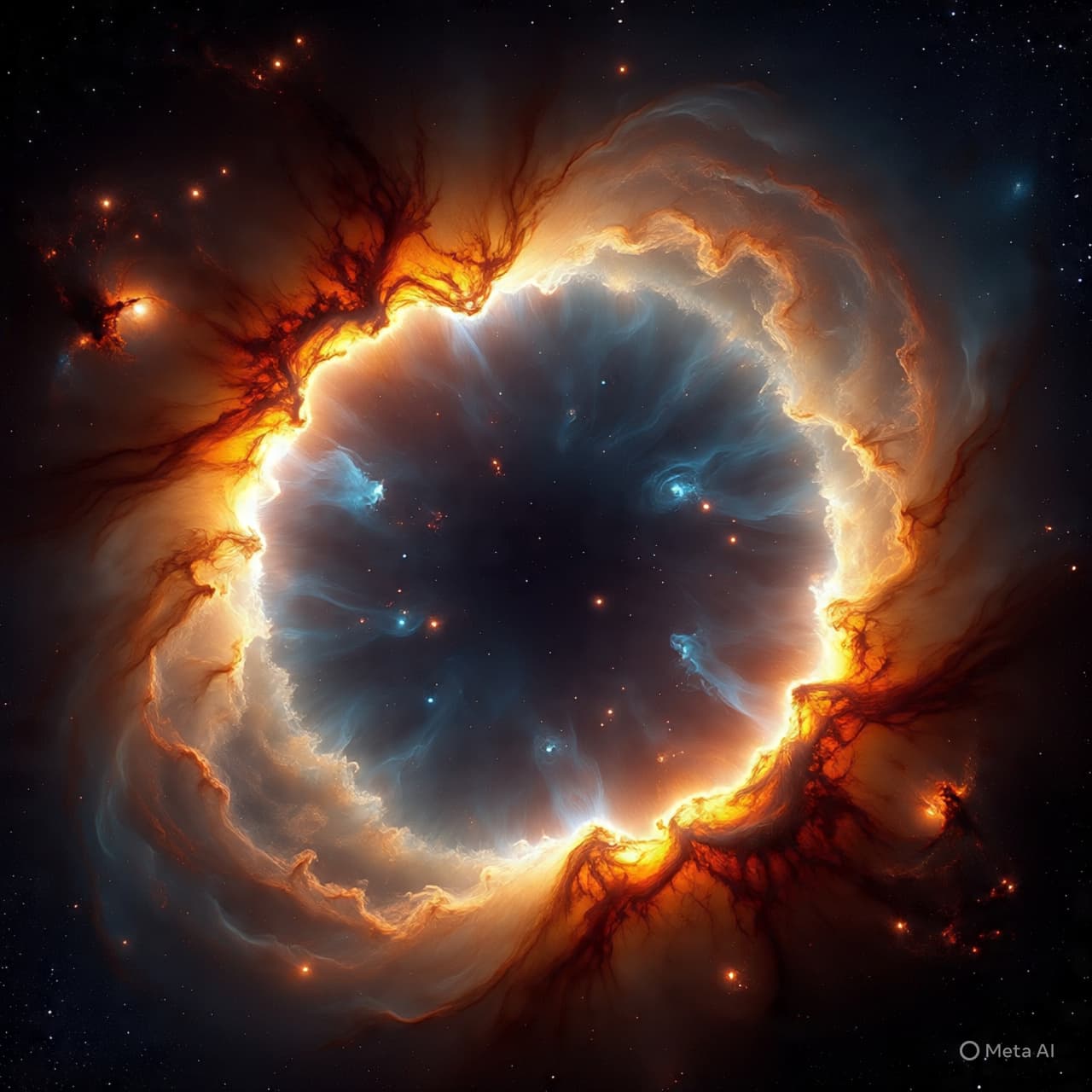
In the quiet nursery of the cosmos, where stars are born in clouds of dust and time seems to move in whispers, astronomers have uncovered something unexpected—a warm ring of gas encircling a newborn star. This discovery, made using advanced telescopes, feels almost poetic, akin to discovering a pulse where only stillness was expected.
For decades, scientists have studied stellar birth as a process shaped by gravity and cold molecular clouds. Young stars are typically surrounded by protoplanetary disks—vast, flattened structures of dust and gas that may eventually form planets. These environments are often thought to be relatively cold, especially at greater distances from the star. Yet this newly observed ring challenges that assumption, suggesting a more dynamic and complex environment than previously believed.
Using advanced telescopes capable of detecting subtle emissions from gas molecules, researchers identified a distinct, warm structure surrounding the infant star. The gas was not evenly distributed but instead formed a ring-like shape, indicating a dynamic process at play. Its temperature, higher than expected for such a region, hints at unseen forces shaping the system. One possibility is that shock waves—generated by material falling inward toward the star—are heating the gas as they collide. Another theory points to chemical reactions occurring within the disk, releasing energy and altering the local temperature. These mechanisms, while known, have rarely been observed so clearly in such a young system.
The discovery also raises questions about the timeline of planetary formation. If warm gas rings exist earlier than previously believed, they could influence how and where planets begin to take shape. Temperature variations can affect the condensation of materials, potentially altering the composition of emerging worlds. This insight could reshape our understanding of how planets form and evolve in the early stages of a star's life.
Moreover, the ring’s presence may indicate that protoplanetary disks are more structured from the outset than scientists assumed. Rather than forming gradually over time, certain features may emerge rapidly, guided by complex interactions between gravity, radiation, and motion. This could lead to a reevaluation of existing models of star and planet formation, prompting further investigation into the processes that govern these cosmic phenomena.
Researchers are now turning their attention to similar young stars, searching for patterns that might confirm whether this is a rare phenomenon or a common stage in stellar evolution. Each new observation adds a piece to the puzzle, revealing a universe that is less predictable and more intricate than models once suggested. The implications of this discovery extend beyond the immediate findings, potentially influencing future research directions in astrophysics.
In the broader context of astronomy, findings like this remind us that even well-studied processes can still hold surprises. The birth of a star, long considered a familiar story, continues to evolve with each new discovery. As scientists continue to observe and analyze these distant systems, the warm gas ring stands as a quiet testament to the complexity of cosmic beginnings—an unexpected detail in a story that is still being written.
Published by Banx Network. This article is part of the Banx decentralized media programme, powered by the BXE token on the XRP Ledger.




