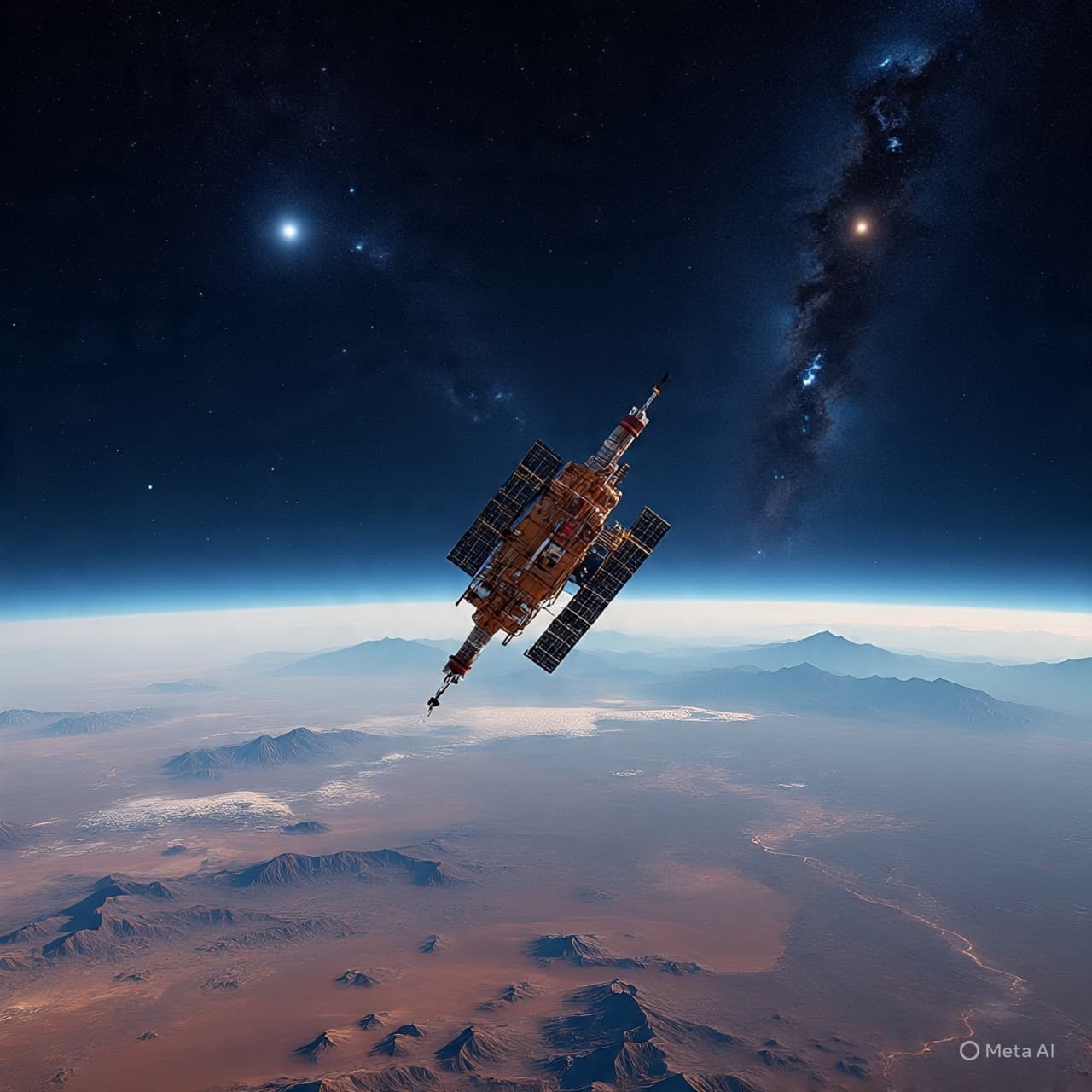
There is a particular kind of quiet in space — a silence that does not drift or echo, but simply exists. For ten years, NASA’s MAVEN spacecraft cut through that quiet above Mars, capturing the planet’s thin atmosphere, its ancient storms, and the subtle traces of its past. And then, without warning, the silence deepened. NASA confirmed it has lost contact with MAVEN, a spacecraft that had become one of the most reliable narrators of the Martian sky.
The moment stands out because MAVEN was never a headline-seeking mission. It worked steadily, gathering data that helped scientists understand how Mars transformed from a warm, water-bearing world to a barren, windswept landscape. Its instruments mapped the escape of atmospheric particles into space and provided insights into a long-vanished climate. Its contribution was slow, steady, and precise — the kind of science whose significance becomes clearer only with time.
NASA’s engineers are now attempting to reestablish communications, running through fault-protection scenarios and safe-mode possibilities. Spacecraft lose contact for all kinds of reasons: a glitch in the pointing system, a memory fault, a misalignment with Earth, an unexpected reboot. But at millions of miles away, even a simple issue can feel like a chasm. Commands travel slowly, and each attempt to revive a spacecraft becomes an exercise in patience and hope.
For scientists who have followed MAVEN’s journey since 2014, the interruption is more than a technical problem. The spacecraft served as a bridge between generations of Mars exploration — arriving after Curiosity, working alongside orbiters old and new, and feeding data into a decade of climate modeling that reshaped our understanding of the planet’s evolution. Losing contact, even temporarily, feels like losing a familiar voice in a distant world.
Yet missions like MAVEN are built with endurance in mind. NASA has restored communication with silent spacecraft before — some gone quiet for days, others for months. The process is slow, methodical, and grounded in the knowledge that space is unforgiving but not always final.
As teams continue their efforts, the hope is that Mars will speak again, even faintly, through the instruments of a spacecraft that has already given far more than expected. In the vastness of the Red Planet’s orbit, silence may be temporary — and MAVEN’s story may still have chapters left to write.
Published by Banx Network. This article is part of the Banx decentralized media programme, powered by the BXE token on the XRP Ledger.