
Key Highlights
- MAVEN spacecraft has lost contact with NASA after ten years in orbit.
- The mission has significantly contributed to understanding Mars' atmospheric evolution.
- NASA engineers are working to restore communication with the spacecraft.
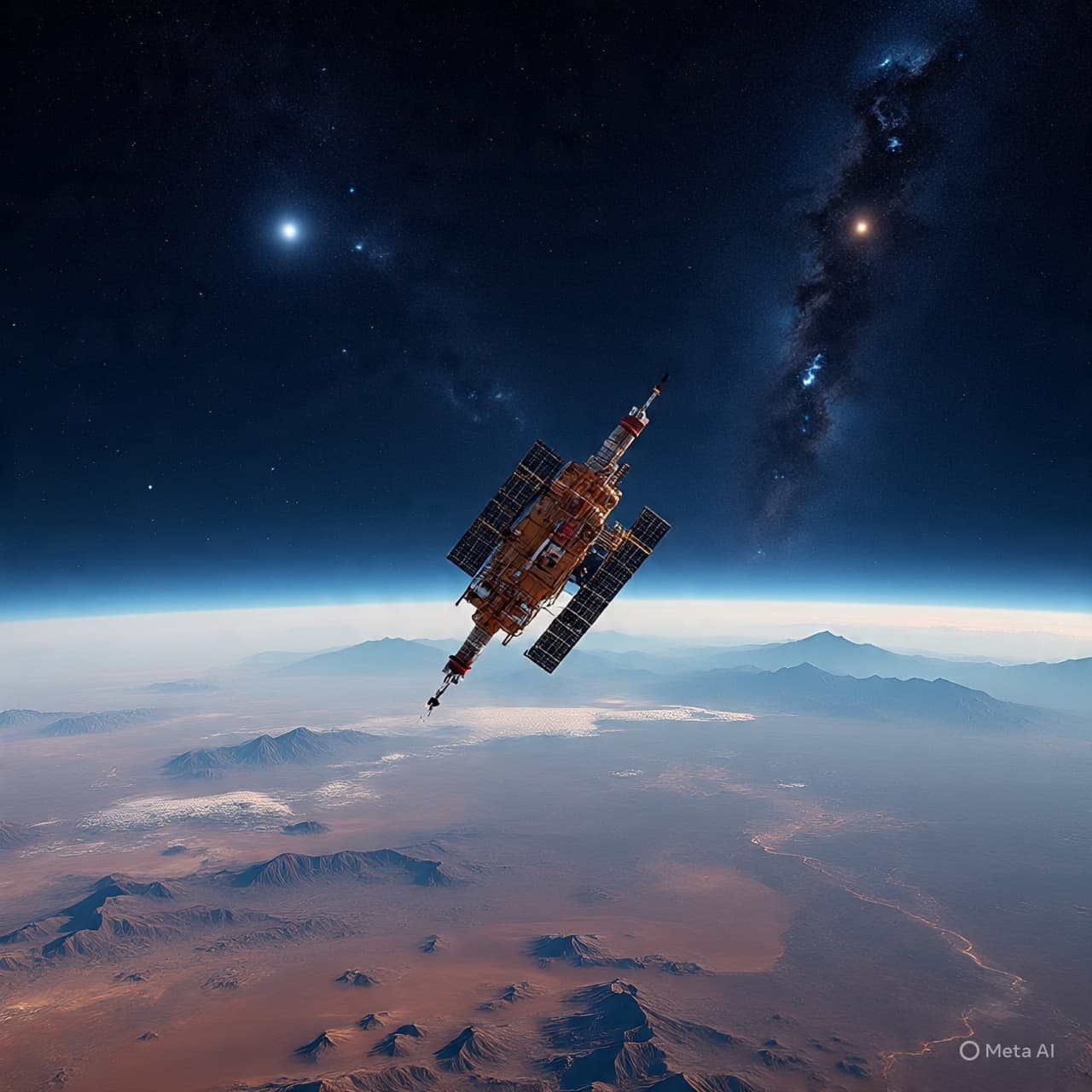
NASA's MAVEN (Mars Atmosphere and Volatile EvolutioN) spacecraft has been a silent observer of the Martian atmosphere for a decade, but recently, the agency confirmed that it has lost contact with the spacecraft. This loss marks a significant moment in the ongoing exploration of Mars, as MAVEN has played a crucial role in unraveling the mysteries of the planet's climate and atmospheric changes over time.
Launched in November 2013, MAVEN arrived at Mars in September 2014, becoming the first mission dedicated to studying the Martian atmosphere. Over the years, it has provided invaluable data on how Mars transitioned from a warm, wet planet to the cold, arid world we see today. Its instruments have meticulously mapped the escape of atmospheric particles into space, offering insights into the planet's ancient climate and the processes that led to its current state.
The recent communication loss is not uncommon in space missions, where various factors can lead to a temporary disconnection. NASA engineers are currently exploring multiple scenarios to reestablish contact, including checking for potential glitches in the spacecraft's systems or misalignments with Earth. Given the vast distance of millions of miles, even minor issues can complicate communication efforts, making each attempt to reconnect a test of patience and perseverance.
For scientists and engineers who have closely monitored MAVEN's progress, this interruption is more than just a technical glitch. It represents a disruption in the ongoing narrative of Mars exploration, as MAVEN has served as a vital link between past and future missions. Its data has influenced a decade of climate modeling and has been instrumental in shaping our understanding of Mars' evolution.
Despite the current silence, MAVEN was designed with resilience in mind. NASA has successfully reestablished communication with other spacecraft that have gone quiet in the past, some for extended periods. The agency's approach to troubleshooting is methodical, grounded in the understanding that while space can be unforgiving, it does not always spell the end for a mission.
As efforts to regain contact continue, there remains hope that MAVEN will once again transmit data from the Martian orbit. The spacecraft has already exceeded expectations in its contributions to planetary science, and its story may not be finished yet. In the vast expanse of space, silence can often be a temporary state, and the potential for MAVEN to resume its vital work remains a possibility.
In conclusion, the loss of contact with MAVEN serves as a reminder of the challenges faced in space exploration. However, the mission's legacy and the knowledge it has provided about Mars will continue to resonate, regardless of the current silence. As NASA works diligently to restore communication, the scientific community remains hopeful for MAVEN's return to the Martian narrative.
Published by Banx Network. This article is part of the Banx decentralized media programme, powered by the BXE token on the XRP Ledger.



