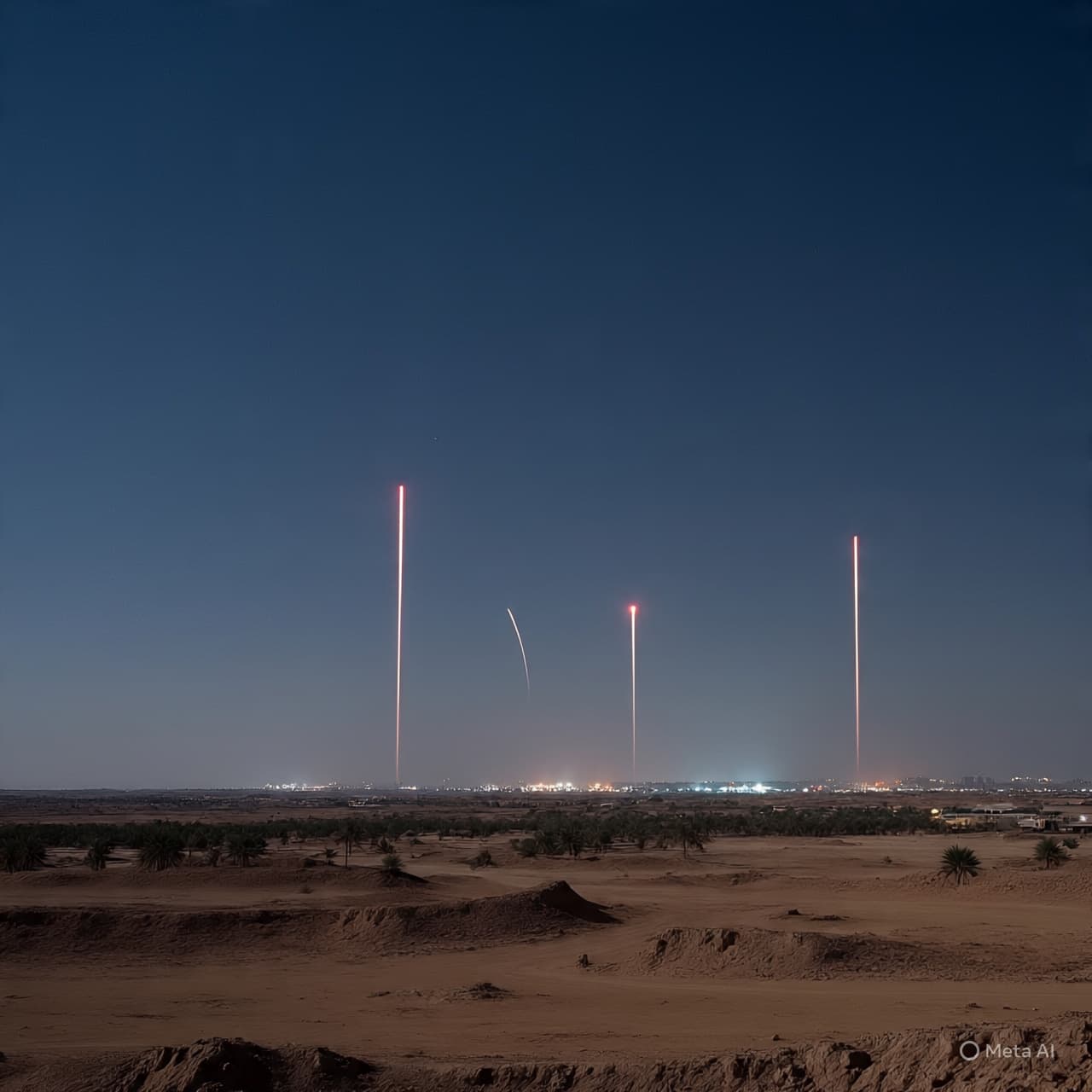
There are moments when messages are not written in words, but traced across the sky—fleeting arcs that carry meaning far beyond their brief presence. In the Middle East, where history often unfolds in layers of memory and motion, such signals are rarely simple. The recent reports of Iran launching volleys of missiles across the region arrive as one of those moments, where action becomes language, and intent is read as much as it is seen.
At the center of this development is Iran, a nation whose regional posture has long been shaped by a blend of deterrence, signaling, and strategic positioning. The reported missile activity, described as a display of resilience, suggests an effort to communicate strength amid ongoing pressures. Whether directed at immediate adversaries or broader audiences, such actions often serve multiple purposes—military, political, and symbolic.
The geography of the Middle East adds further depth to the situation. Countries across the region, including Israel and others within range, are attentive to developments that may affect their security environment. Missile launches, particularly when conducted in volleys, tend to be interpreted not only in terms of capability but also intent. Defense systems are placed on alert, and governments move quickly to assess both immediate risks and longer-term implications.
Beyond the technical dimension lies a narrative of resilience—one that Iran appears to be emphasizing. In geopolitical terms, resilience can signal continuity under pressure, an assertion that existing challenges have not diminished capacity or resolve. This messaging, while directed outward, also resonates internally, reinforcing perceptions of stability and control within a complex regional landscape.
Yet, as with many developments of this kind, the implications extend beyond the initiating country. The Middle East remains a network of interconnected relationships, where actions in one area can influence perceptions and responses elsewhere. Regional actors, along with global stakeholders, are likely to view the situation through multiple lenses—security, diplomacy, and the broader balance of power.
International responses often follow a familiar pattern. Calls for restraint, reaffirmations of stability, and behind-the-scenes diplomatic engagement become part of the unfolding story. While public statements may emphasize caution, quieter channels frequently work toward preventing escalation, seeking to ensure that signaling does not evolve into sustained confrontation.
There is also an underlying technological narrative at play. Modern missile systems, with their range and precision, have transformed how states communicate power. They allow for demonstrations that are both visible and calibrated, capable of conveying intent without necessarily leading to immediate conflict. At the same time, their use carries inherent risks, as interpretation can vary among observers.
For communities within the region, the experience is more immediate. The sound of alerts, the movement toward shelters, and the heightened awareness of uncertainty become part of daily life, even if only temporarily. These human elements, often quieter in international reporting, remain central to the reality on the ground.
As events continue to develop, the situation appears to be framed within a broader pattern of signaling and response. Iran’s actions, described as a demonstration of resilience, are being met with vigilance and measured reactions from others in the region. The trajectory from here will likely depend on how these signals are interpreted and whether they prompt further action or a gradual return to a more subdued state of tension.
In the steady rhythm of international relations, such moments rarely stand alone. They become part of an ongoing dialogue—one that unfolds not only through visible actions, but also through the quieter efforts to maintain balance. For now, the skies have carried their message, and the region listens, attentive to what may follow.
AI Image Disclaimer Images in this article are AI-generated illustrations, meant for concept only.
Source Check (Credible Media Outlets):
Reuters BBC News Al Jazeera Associated Press (AP News) The New York Times
Published by Banx Network. This article is part of the Banx decentralized media programme, powered by the BXE token on the XRP Ledger.