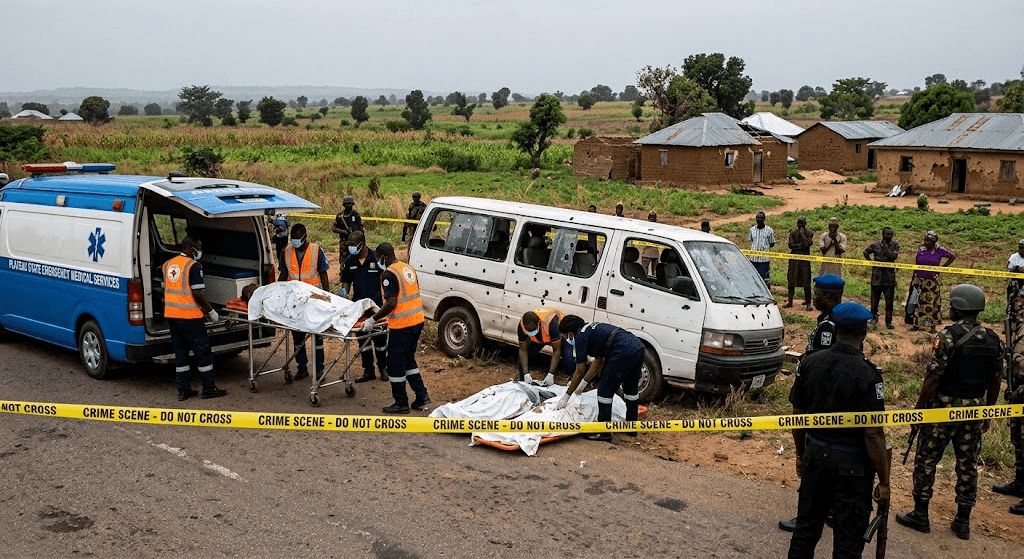
The morning sun crept over the horizon, casting long, wavering shadows against the pavement where a routine commute once held the promise of an ordinary day. In the quiet intersection, a vehicle pulled to the curb, its lights flashing with a sterile, official rhythm that spoke of duty and compliance. Yet, as the figures emerged, clad in the familiar dark fabric of those sworn to protect, the air grew thick with an unspoken, chilling dissonance. The city, usually bustling with the early hum of industry, seemed to hold its breath, unaware that the authority it perceived was merely a mask worn by those who profit from the ending of things.
This moment of intrusion was not merely an act of violence, but a profound rupture in the social fabric that binds a community together. When the symbols of state protection—the badge, the uniform, the structured authority—are co-opted by the very forces they are designed to oppose, the foundation of public safety begins to erode. For the local businessman who had spent years building a livelihood, the encounter was a final, tragic navigation of a landscape where the lines between order and lawlessness have become dangerously porous. His disappearance into the gray light of the morning left behind a void that no police report or official statement could adequately fill.
As the authorities scrambled to piece together the sequence of events, they found themselves confronting a sophisticated evolution in criminal methodology. It is a reality where the tools of the state are turned into instruments of abduction, rendering the citizenry vulnerable in the very places they expect security. This incident serves as a haunting reminder of how organized criminal networks have adapted, moving away from simple confrontation toward methods that exploit the psychological trust individuals place in uniforms. The tragedy is compounded by the silence of witnesses who, fearing retribution, retreat into the safety of anonymity.
The investigation that followed uncovered a calculated operation, a sequence of events planned with a precision that chilled investigators to the core. By assuming the guise of law enforcement, these individuals not only executed their crime but also successfully dismantled the psychological barrier that usually keeps the public safe. The businessman had no reason to doubt the authority presented to him until the moment the illusion shattered. In the aftermath, the local community remains paralyzed, grappling with the realization that the guardians they look to for safety may no longer be who they seem.
Throughout the city, small businesses have begun to adopt their own, often insufficient, measures of protection. The psychological toll is palpable; a pervasive sense of unease has settled over the streets, turning routine interactions into moments of calculation and suspicion. For many, the incident is not an isolated event but a stark symptom of the deeper, systemic fragility that permeates the region. The loss of a single life is felt not just by family and friends but as a collective tremor in the security of the entire district.
Questions regarding the oversight of uniforms and the verification of police identification have dominated local discourse. Yet, the answers remain elusive, obscured by layers of bureaucracy and the rapid, shifting nature of these criminal syndicates. Law enforcement officials have issued warnings, advising caution in interactions with individuals claiming official status, yet these recommendations feel hollow in the face of such calculated deception. The disparity between the reality of the street and the rhetoric of the office has never been wider.
In the days following the event, the family of the victim sought answers that remain buried in the machinery of an overburdened legal system. Their grief, intimate and profound, stands in stark contrast to the clinical nature of the official investigation. It is a reminder that behind every headline and statistical report lies a human story, a life interrupted, and a future abruptly cut short by forces that operate in the dark corners of societal transition.
The situation has prompted a reevaluation of security protocols at the highest levels, with calls for a more rigorous verification process for law enforcement personnel. Yet, the struggle to balance the necessity of active policing with the need for public trust remains a complex, ongoing challenge. As the sun sets on the city each day, the memory of the businessman serves as a silent, grim sentinel, watching over a community that is still learning how to navigate a reality where shadows are increasingly indistinguishable from the light.
In a recent development, the local prosecutor’s office announced the identification of several persons of interest connected to the investigation. Enhanced surveillance measures have been deployed across major commercial corridors, and the police department has launched a campaign to verify the legitimacy of patrol units, urging citizens to confirm identification numbers during traffic stops. Official reports confirm that the investigation remains active as authorities work to dismantle the criminal cell responsible for this impersonation scheme.
Published by Banx Network. This article is part of the Banx decentralized media programme, powered by the BXE token on the XRP Ledger.