There are ways of seeing that do not depend on light as we know it. Beyond the familiar glow of reflection and color, the universe offers quieter signals—heat, motion, and wavelengths that pass unnoticed through human vision. To look in infrared is to step slightly outside our own senses, to witness not what shines, but what endures in warmth and shadow.
It is through this subtle perspective that the James Webb Space Telescope, developed in partnership with NASA and ESA, has turned its gaze toward Saturn. Known for its elegant rings and pale golden hue in visible light, Saturn appears transformed when observed in the infrared spectrum—less a symbol of brightness, and more a landscape of temperature and atmosphere.
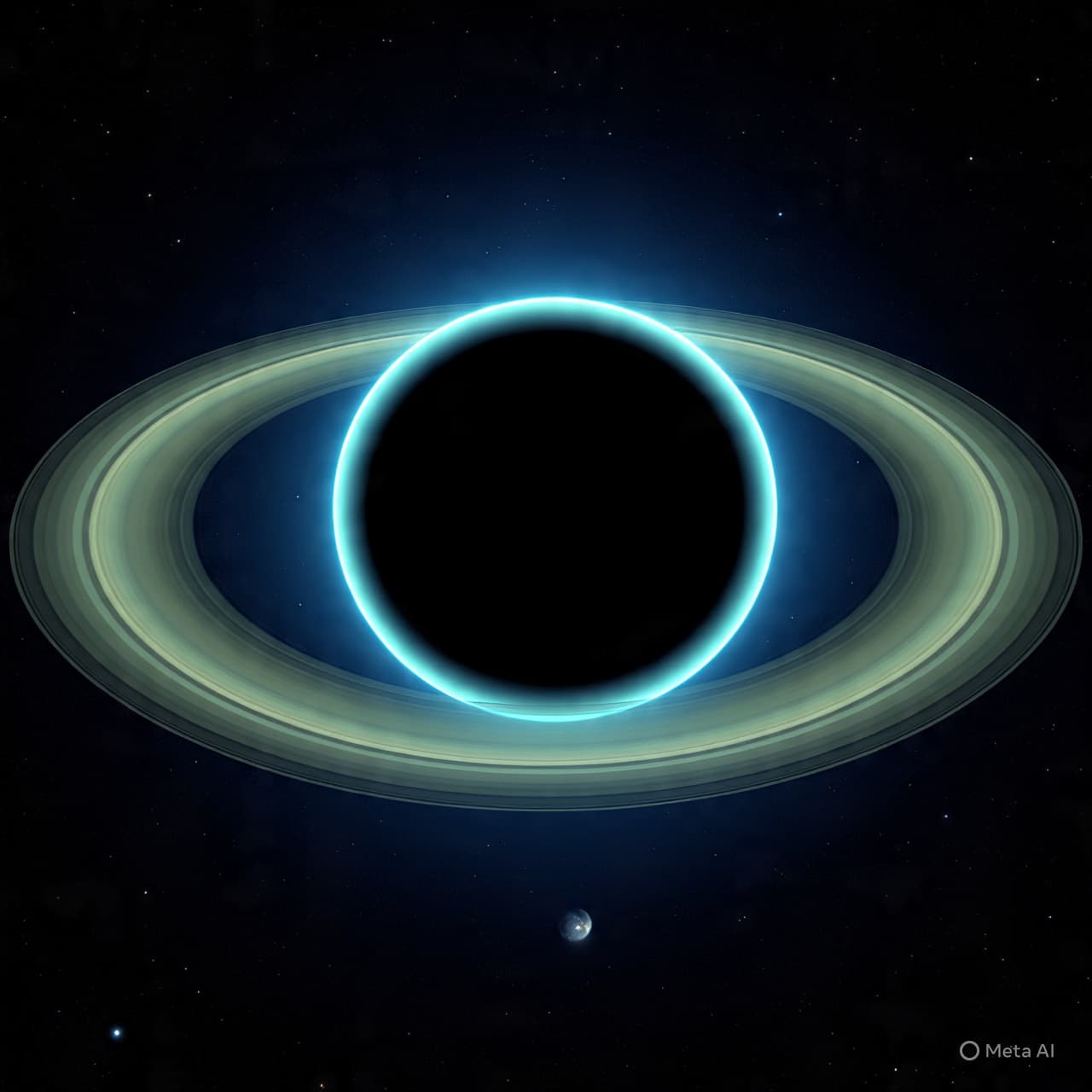
In the images captured by Webb, the planet’s familiar features soften into new forms. The rings, so prominent in visible light, become darker and more subdued, while the atmosphere reveals layers of structure shaped by heat and chemical composition. Methane in Saturn’s upper atmosphere absorbs much of the infrared light, giving the planet a deeper, more shadowed appearance, while higher-altitude clouds emerge as faint, luminous patterns.
Perhaps most striking is the presence of Saturn’s moons, which appear as small points of light surrounding the planet. In infrared, these distant companions can stand out more clearly against the darker backdrop, offering a different sense of scale and relationship within the Saturnian system. The image becomes less about a single object and more about a quiet constellation of bodies, each holding its place in orbit.
What Webb provides is not merely a new picture, but a new layer of understanding. Infrared observations allow scientists to study atmospheric composition, temperature variations, and seasonal changes with greater precision. Subtle shifts in brightness can indicate movement within the atmosphere—winds, storms, and circulation patterns that are otherwise difficult to detect.
In this way, the familiar becomes unfamiliar again. Saturn, long observed and admired, reveals aspects of itself that were always present but rarely seen. The planet’s calm exterior gives way to a more dynamic interior, where energy moves in patterns shaped by both chemistry and motion.
The observation also reflects the broader purpose of Webb itself: to expand the boundaries of perception. Whether looking at distant galaxies or nearby planets, the telescope offers a way to see beyond the limits of visible light, uncovering details that deepen rather than disrupt our understanding.
As analysis of the infrared data continues, scientists are expected to refine models of Saturn’s atmosphere and better understand the interactions within its ring system and surrounding moons. The images will contribute to ongoing studies of planetary science, adding new information to a body of knowledge built over decades.
For now, the capture stands as a measured reminder that even the most familiar worlds can appear new when seen through a different lens—quietly inviting us to look again, and perhaps to see more than we expected.
AI Image Disclaimer Graphics are AI-generated and intended for representation, not reality.
Source Check (Credible Media Outlets):
NASA ESA Space.com BBC Science The New York Times
Published by Banx Network. This article is part of the Banx decentralized media programme, powered by the BXE token on the XRP Ledger.