
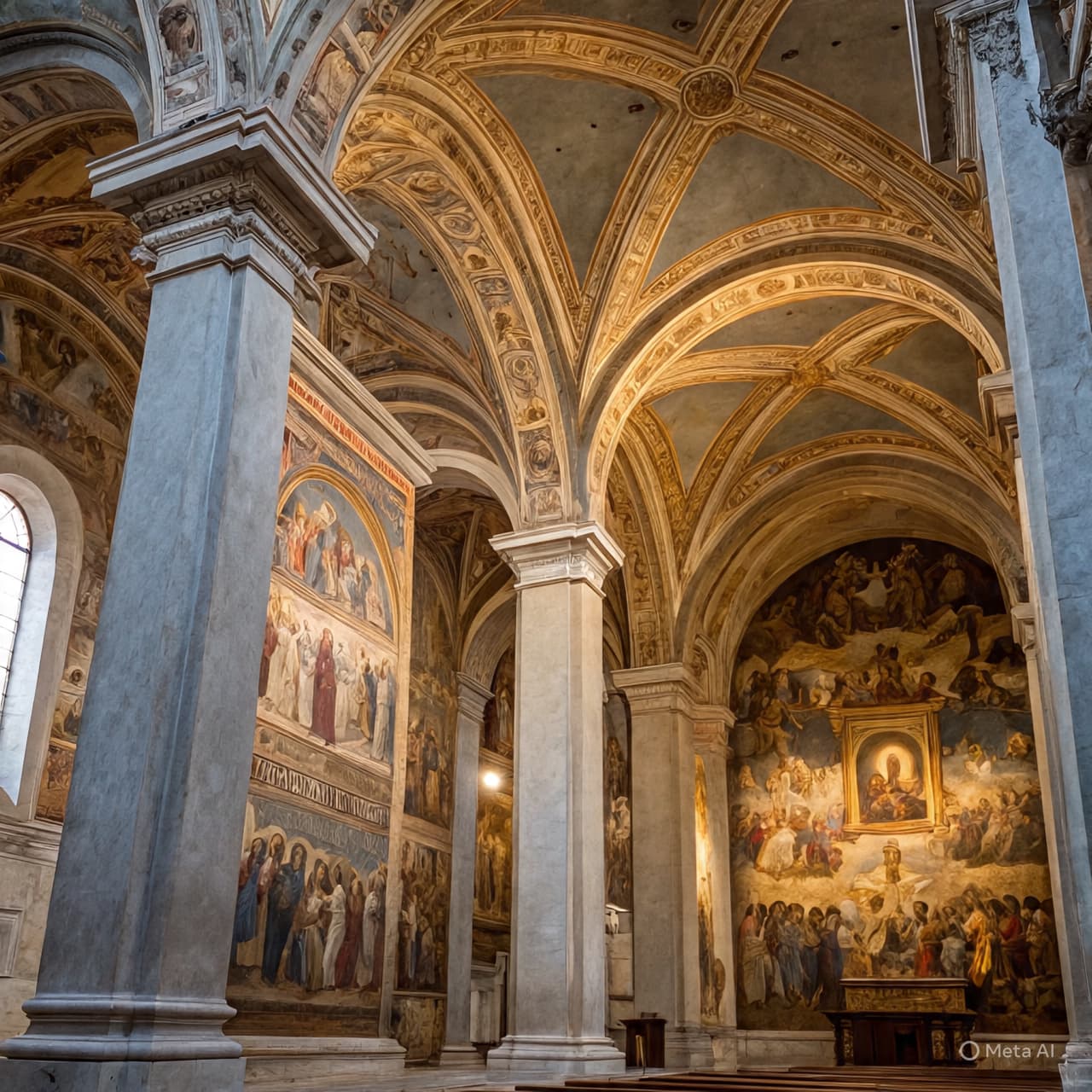
In a Roman chapel where centuries press lightly against the hush of afternoon light, the walls hold more than echoes of prayer and whispered devotion; they carry the layered patina of faith and history. The Basilica of San Lorenzo in Lucina, one of the city’s oldest houses of worship, opens onto a quiet square just a stone’s throw from the flow of modern life. In that space where past and present seem to breathe together, a controversy unfolded over imagery that blurred the lines between sacred art and contemporary perception.
The painting in question was an angel, a cherub once restored to its place among other figures that have watched over worshippers for years. But when the fresco emerged from restoration with features that many observers felt bore an unmistakable resemblance to Italy’s sitting prime minister, Giorgia Meloni — the first woman to hold that office — the chapel’s serene interior suddenly drew crowds not for Mass but for photographs and speculation. Church authorities and Italy’s Culture Ministry were stirred into action, mindful that the imagery of a political figure resting on wings and halo in a sacred setting could unsettle both liturgical life and public expectation.
For days, the image became a point of curiosity and conversation. Some parishioners, drawn by the unexpected sight, paused not in prayer but in contemplation of the figure, their cameras capturing the cherub’s face alongside the marble busts of historical figures nearby. Local residents and visitors alike gathered near the fresco, their presence quietly shifting the still rhythm of worship into something resembling a pilgrimage of a different sort. Critics from political circles and clerical voices alike spoke of the impropriety of interweaving political likeness with sacred depiction, prompting the diocesan authorities to consider how art and devotion intersect in a place built for reflection and reverence.
In the end, the face was painted over — a patch of plain surface replacing the features that had sparked fascination and debate. The cherub now remains without its detailed countenance, a blank winged presence in the chapel that once held a face many believed they recognized. Those who walk beneath the fresco today experience it not as a novelty but as a quiet reminder of how fragile the harmony between art, place, and perception can be. Discussions between the diocese, the Culture Ministry, and other custodians of the basilica’s heritage now guide how future restorations will proceed, underscoring that the preservation of sacred spaces carries responsibilities extending beyond brushstrokes.
There was no uproar in the traditional sense of clamor or clashing voices; rather, this was a moment of recalibration, where the measure of public interest and ecclesiastical calm met and, for a brief interval, intertwined. The Italian premier herself brought a touch of lightness to the stir, noting with humor that she did not see an angelic reflection in the painted visage. In straightforward terms, a restored fresco of an angel in a Rome basilica that appeared to resemble Prime Minister Giorgia Meloni drew widespread attention, leading church authorities to paint over the face amid concerns about the appropriateness of political likeness in sacred art.
Visuals are AI-generated and serve as conceptual representations.
Sources (Media Names Only)
Associated Press Reuters The Independent South China Morning Post La Repubblica
Published by Banx Network. This article is part of the Banx decentralized media programme, powered by the BXE token on the XRP Ledger.
.jpg&w=3840&q=75 "Romania Passes Controversial Integrity Law for Officials to Access EU Funds")

