
Key Highlights
- Event:Palm Sunday services at the Church of the Holy Sepulchre faced access restrictions.
- Restrictions:Israeli police set up barriers, limiting entry for clergy and worshippers.
- Context:Ongoing regional tensions prompted security measures during the religious observance.
On Palm Sunday, a day of profound significance for Christians worldwide, the streets of Jerusalem's Old City were filled with both reverence and frustration. Traditionally, this day marks the beginning of Holy Week, commemorating Jesus' triumphant entry into Jerusalem. However, this year, the atmosphere was marred by restrictions imposed by Israeli police, who cited security concerns as the rationale for limiting access to the Church of the Holy Sepulchre.
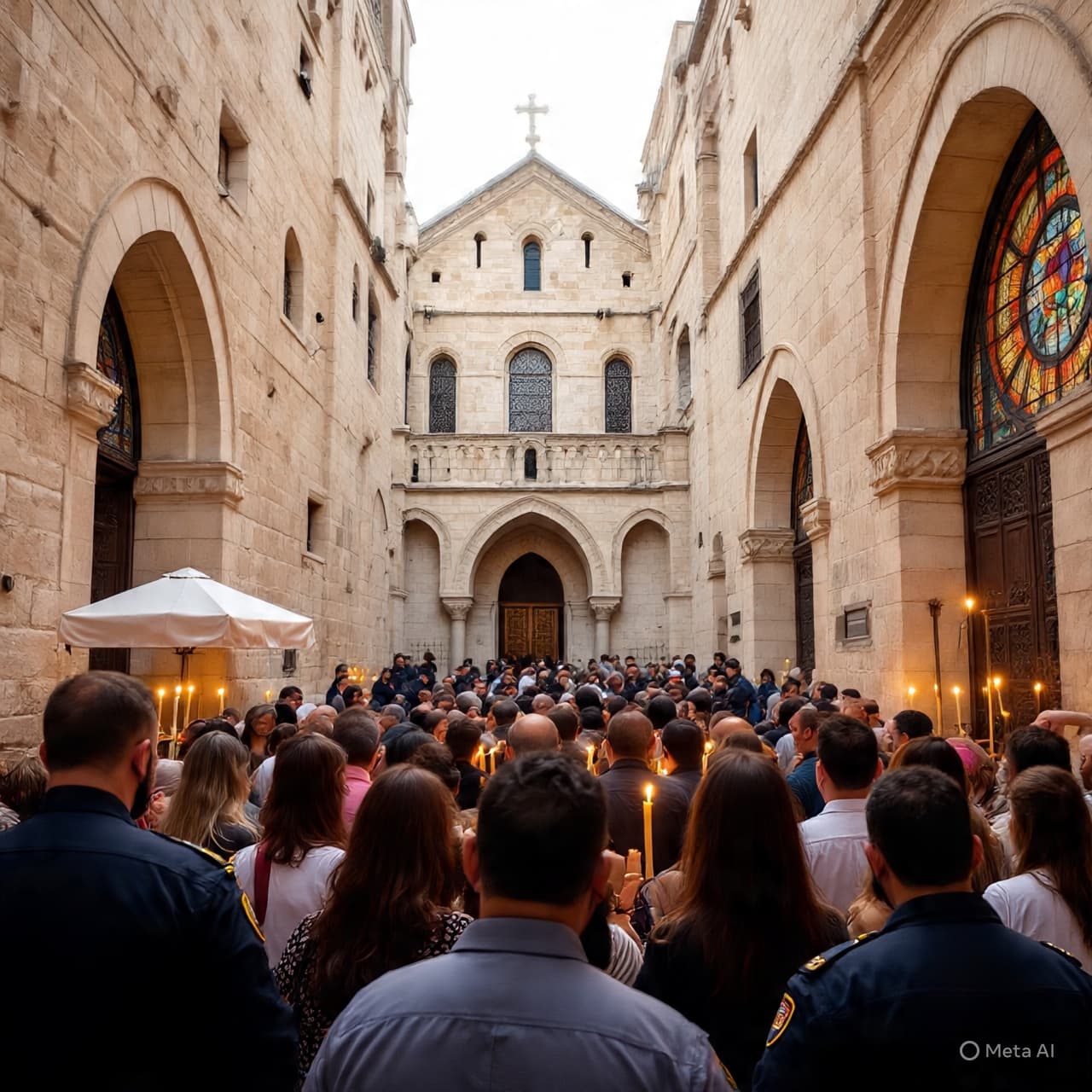
Worshippers, including clergy from various denominations, gathered outside the church, a site revered as the location of Jesus' crucifixion, burial, and resurrection. The church typically serves as a focal point for Palm Sunday processions, drawing pilgrims from around the globe. Yet, as Israeli authorities established checkpoints and barriers, many found themselves unable to participate in the sacred rituals, leading to scenes of confusion and disappointment.
Reports indicate that only a limited number of worshippers were permitted entry at designated times, with some clergy members turned away entirely. This situation created a stark contrast between the solemnity of the services inside the church and the chaos outside, where many were left to observe from a distance. The restrictions felt particularly poignant given the day’s significance, as Palm Sunday is not merely a religious observance but a celebration of unity among diverse Christian communities.
Israeli officials defended the measures, emphasizing the need for crowd control amid ongoing tensions in the region. With the backdrop of conflict and security risks, authorities have increasingly implemented such restrictions during major religious events. They argue that these precautions are necessary to prevent overcrowding and potential incidents in the narrow streets of the Old City, which can become volatile during times of unrest.
The events of Palm Sunday highlight the complex interplay between faith and politics in Jerusalem, a city where sacred spaces are often at the center of broader geopolitical issues. Access to holy sites has long been a contentious topic, reflecting the delicate balance between security policies and the rights of individuals to practice their faith freely. Each restriction, even when framed as a precautionary measure, resonates deeply within the communities affected, raising questions about identity, access, and coexistence.
For those who gathered on Palm Sunday, the experience was a mix of devotion and disruption. While some were able to attend the services, others remained outside, grappling with the reality of their exclusion from a moment that should have been one of collective celebration. The juxtaposition of the sacred rituals occurring within the church and the controlled access outside underscored the ongoing challenges faced by worshippers in a city steeped in history and conflict.
As Jerusalem continues to navigate these complexities, the events of Palm Sunday serve as a reminder of the fragile nature of religious observance in a city where faith and politics are inextricably linked. The situation not only reflects the immediate challenges of access to sacred spaces but also speaks to the broader implications for religious freedom and coexistence in a region marked by tension.
Published by Banx Network. This article is part of the Banx decentralized media programme, powered by the BXE token on the XRP Ledger.



