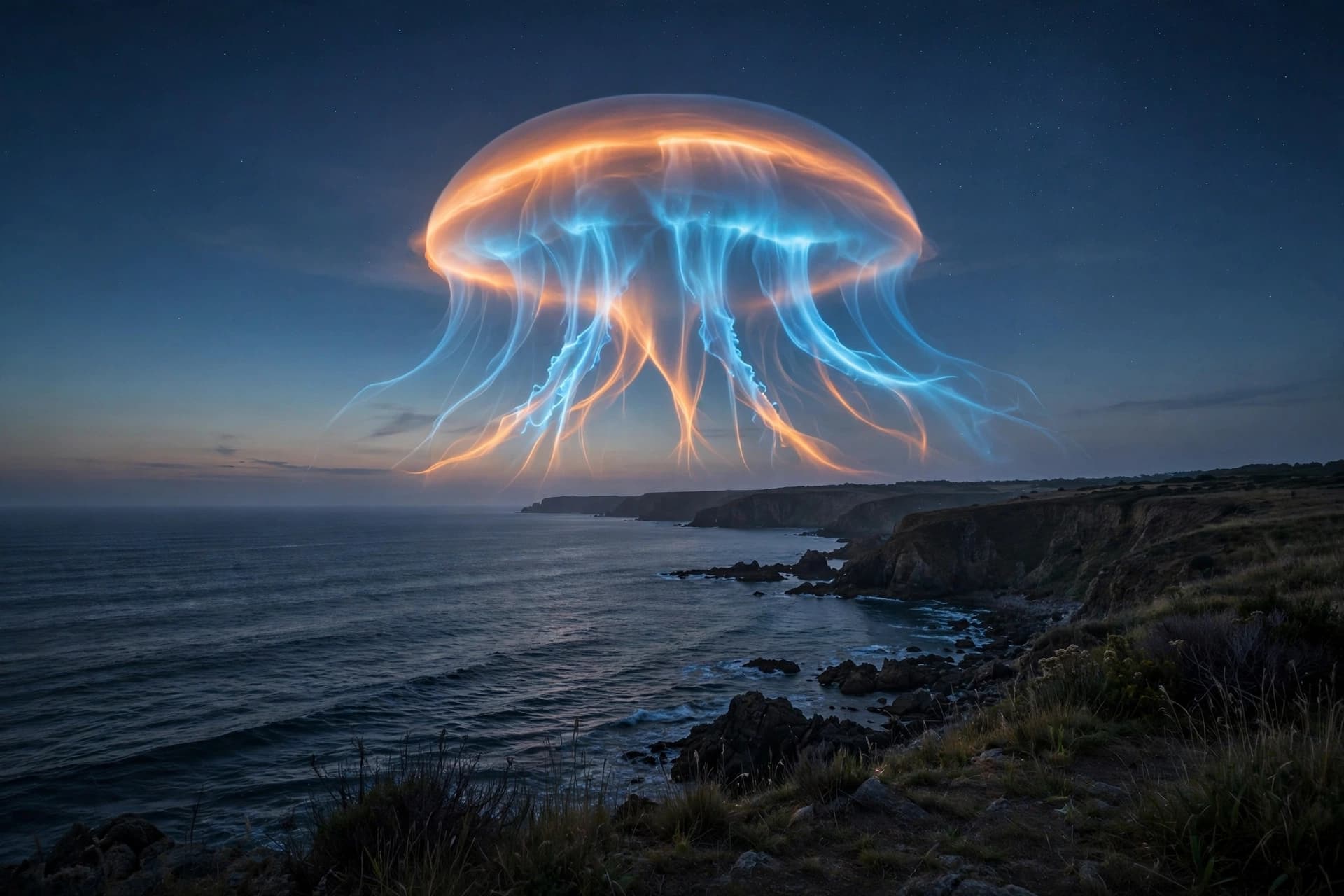
There are mornings when the sky seems to stretch and yawn before the sun has risen, holding its breath between night and day. In those quiet hours along Florida’s coast, residents often glance eastward, expecting little more than fading stars and the first pale hint of dawn. Yet on this particular morning, the darkness unfurled something unexpected: a luminous shape drifting upward, glowing softly, its tendrils trailing like something alive. It resembled a jellyfish suspended not in water, but in air.
The source of this celestial apparition was a predawn launch by , carrying another batch of satellites for its expanding Starlink network. The rocket lifted off from Florida’s Space Coast, near , rising through layers of atmosphere while most of the region still slept. But as it climbed higher, something remarkable occurred.
The so-called “jellyfish effect” is not uncommon during twilight launches, though it never fails to stir wonder. As the rocket ascends into thinner atmosphere, it releases exhaust that expands dramatically in the near-vacuum of high altitude. When the sun is still below the horizon for observers on the ground, its rays can nonetheless strike that expanding plume far above. The result is a glowing cloud illuminated against a dark sky—a radiant dome with streaming arcs that evoke the bell and tentacles of a deep-sea creature.
From beaches and neighborhoods across central Florida, onlookers paused. Phones tilted upward. Social media filled with images of a pale, translucent bloom spreading silently across the predawn canvas. For a moment, speculation fluttered—meteor? anomaly?—before recognition settled in. It was, once again, the choreography of physics and perspective.
The rocket’s trajectory added to the visual drama. As it staged and continued its climb, the separation and engine burns created layered plumes, each catching sunlight at slightly different angles. The effect was not explosive but graceful. It expanded slowly, almost delicately, as though the sky itself had exhaled light.
Beyond its aesthetic presence, the mission itself was routine in its purpose. The Starlink satellites aim to strengthen global broadband coverage, particularly in remote or underserved areas. With each launch, the constellation grows, forming an intricate lattice of connectivity encircling Earth. While debates continue regarding orbital traffic and night-sky visibility, the technical cadence of launches has become a familiar rhythm along Florida’s coast.
Yet routine does not always mean ordinary. The jellyfish-like plume serves as a reminder that even established technology can create moments of shared astonishment. It is an intersection where engineering meets atmosphere, where orbital mechanics briefly paints the sky with something almost mythic.
The phenomenon also underscores a subtle truth about spaceflight in the modern era: launches are no longer rare spectacles reserved for historic milestones. They occur with increasing frequency, often carrying commercial payloads rather than singular national ambitions. And still, when conditions align—when timing, sunlight, and altitude converge—they can transform into impromptu works of art.
In closing, the predawn launch successfully deployed its Starlink satellites as planned, according to mission updates. No anomalies were reported, and the booster completed its flight sequence as expected. For residents across Florida, however, the memory may linger less as a technical accomplishment and more as a fleeting vision—a luminous jellyfish drifting upward, briefly reminding Earthbound observers that even the most engineered endeavors can appear, for a moment, like magic.
AI Image Disclaimer Visuals are created with AI tools and are not real photographs.
Sources Space.com Florida Today CNN The Associated Press NASA
Published by Banx Network. This article is part of the Banx decentralized media programme, powered by the BXE token on the XRP Ledger.