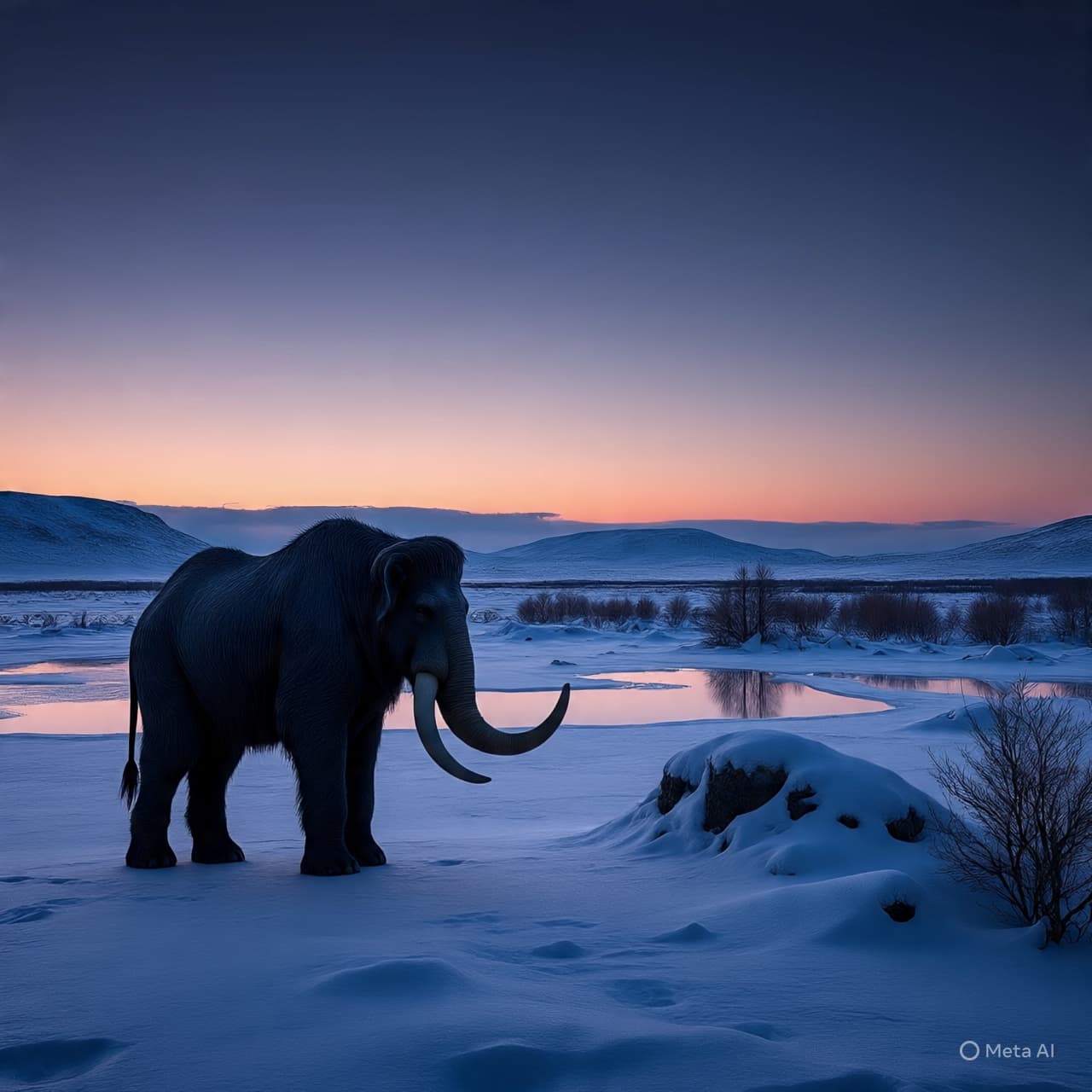
There is a softness in the way ancient life resurfaces — not as bones crashing into museums but as molecules, fragile and unassuming, carrying stories older than civilization itself. The recent sequencing of the oldest RNA ever recovered has opened a quiet window into the final hours of a woolly mammoth that walked the Ice Age plains some 40,000 years ago. It is a discovery that feels less like scientific triumph and more like an intimate whisper from prehistory.
Unlike DNA, which serves as a durable archive of genetic identity, RNA speaks in urgent, fleeting tones. It reveals which genes were active, which tissues were under stress, and what biological processes were unfolding at the very end. To find RNA preserved in permafrost at all borders on improbable; to sequence it with clarity is a rare stroke of scientific luck paired with modern precision.
The mammoth in question, recovered from Siberian ground frozen since its fall, showed patterns of RNA consistent with a body shutting down. Cellular signals suggested damage in muscle tissues, metabolic imbalance, and a physiological response that hinted at environmental strain — perhaps cold shock, exhaustion, or injury. These are not definitive answers but biological clues, the kind that transform a prehistoric silhouette into a living being caught in its final struggle against a harsh and unrelenting world.
Researchers describe the achievement as more than a technical milestone. It marks a shift in how ancient organisms can be studied — not merely as remains but as systems whose internal states can be partially reconstructed. It offers a glimpse into Ice Age ecology, the stresses animals faced, and the biological rhythms that shaped species long before humans mapped their evolution.
For scientists, this success also hints at the future of ancient biomolecular research. If RNA can survive 40,000 years under the right conditions, then new frontiers await: extinct predators, vanished ecosystems, and perhaps even snapshots of disease from ages long before recorded history.
But beyond the scientific implications, there is a quiet human reaction as well. Standing before data that survived an epoch feels like listening to the last breath of a world that has disappeared. The mammoth is gone, yet a fragment of its final moments has slipped through time, offering a brief, profound connection across the gulf of millennia.
Published by Banx Network. This article is part of the Banx decentralized media programme, powered by the BXE token on the XRP Ledger.