
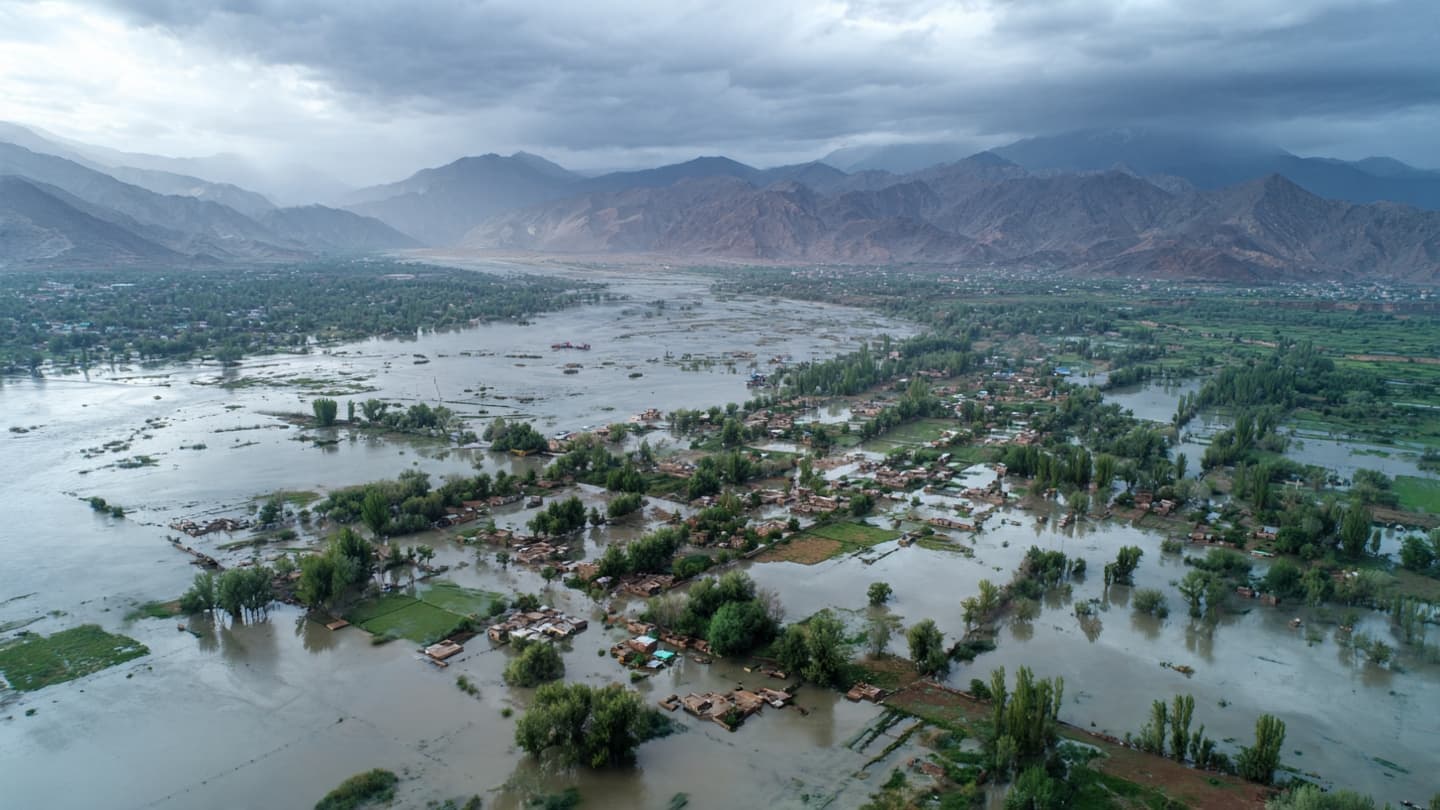
There are mornings when the mountains of Afghanistan seem to cradle the clouds with quiet certainty. Valleys awaken beneath pale light, rivers trace familiar paths through villages, and fields wait patiently for another season to unfold. Yet nature has its own memory, and sometimes the waters that nourish the land return with a force that reshapes both landscape and life.
In recent days, torrential rainfall swept across parts of Afghanistan, sending powerful floods through rural communities where rivers and seasonal streams quickly overflowed their banks. Homes built close to waterways were overtaken within hours, roads disappeared beneath rushing currents, and farmland that had promised a harvest became submerged beneath muddy water. Families found themselves moving toward higher ground with little time to gather belongings.
Authorities reported that at least 20 people lost their lives, while more than 100 others were believed to be missing as rescue operations continued across several affected provinces. Emergency workers, local volunteers, and community leaders searched damaged villages, hoping to locate survivors despite difficult terrain and limited equipment. Every passing hour carried both urgency and uncertainty.
Floodwaters also swept away bridges, damaged irrigation canals, and disrupted electricity and communications in several districts. Entire communities became temporarily isolated as transportation routes were cut off, complicating efforts to deliver emergency assistance. Helicopters and rescue teams faced additional challenges from unstable weather and debris carried by fast-moving currents.
For many Afghan families, the disaster arrived against a backdrop of existing hardship. Years of economic difficulties, recurring droughts, and limited infrastructure have left numerous communities vulnerable to extreme weather events. In many rural areas, homes are constructed from materials that offer little protection against rapidly rising floodwaters, making seasonal storms increasingly destructive.
Humanitarian organizations have begun assessing the scale of the damage while coordinating emergency relief. Temporary shelters, food supplies, clean drinking water, and medical assistance remain among the most immediate priorities. Aid agencies have also warned that displaced families could face heightened risks of disease if access to sanitation and healthcare remains limited in the coming weeks.
Meteorologists note that Afghanistan has experienced increasingly erratic weather patterns in recent years. Periods of prolonged drought have often been followed by sudden, intense rainfall, creating conditions where dry ground struggles to absorb large volumes of water. The resulting flash floods can develop rapidly, leaving little opportunity for communities to prepare or evacuate.
Beyond the visible destruction lies the quieter challenge of rebuilding everyday life. Farmers must assess damaged fields, parents search for missing relatives, and children return to villages transformed by water. Recovery extends beyond repairing roads and homes; it also involves restoring routines that help communities regain a sense of stability after disaster.
As rescue teams continue their work and families wait for news of loved ones, Afghanistan's flooded valleys remain suspended between loss and resilience. The rivers will eventually return to calmer courses, and the mud will slowly dry beneath the sun. Yet the memory of these waters will endure, reminding both those who live beside them and those watching from afar that nature's power is measured not only by what it takes away, but also by the quiet determination it asks of those who remain.
AI Image Disclaimer The accompanying illustrations are AI-generated visual interpretations and do not depict actual photographs of the event.
Sources Reuters Associated Press United Nations Office for the Coordination of Humanitarian Affairs (OCHA) International Federation of Red Cross and Red Crescent Societies (IFRC) BBC News
Published by Banx Network. This article is part of the Banx decentralized media programme, powered by the BXE token on the XRP Ledger.


.jpg&w=3840&q=75 "Intelligence Agencies Suspect Russia Is Developing Anti-Satellite Weapon to Target Starlink")
