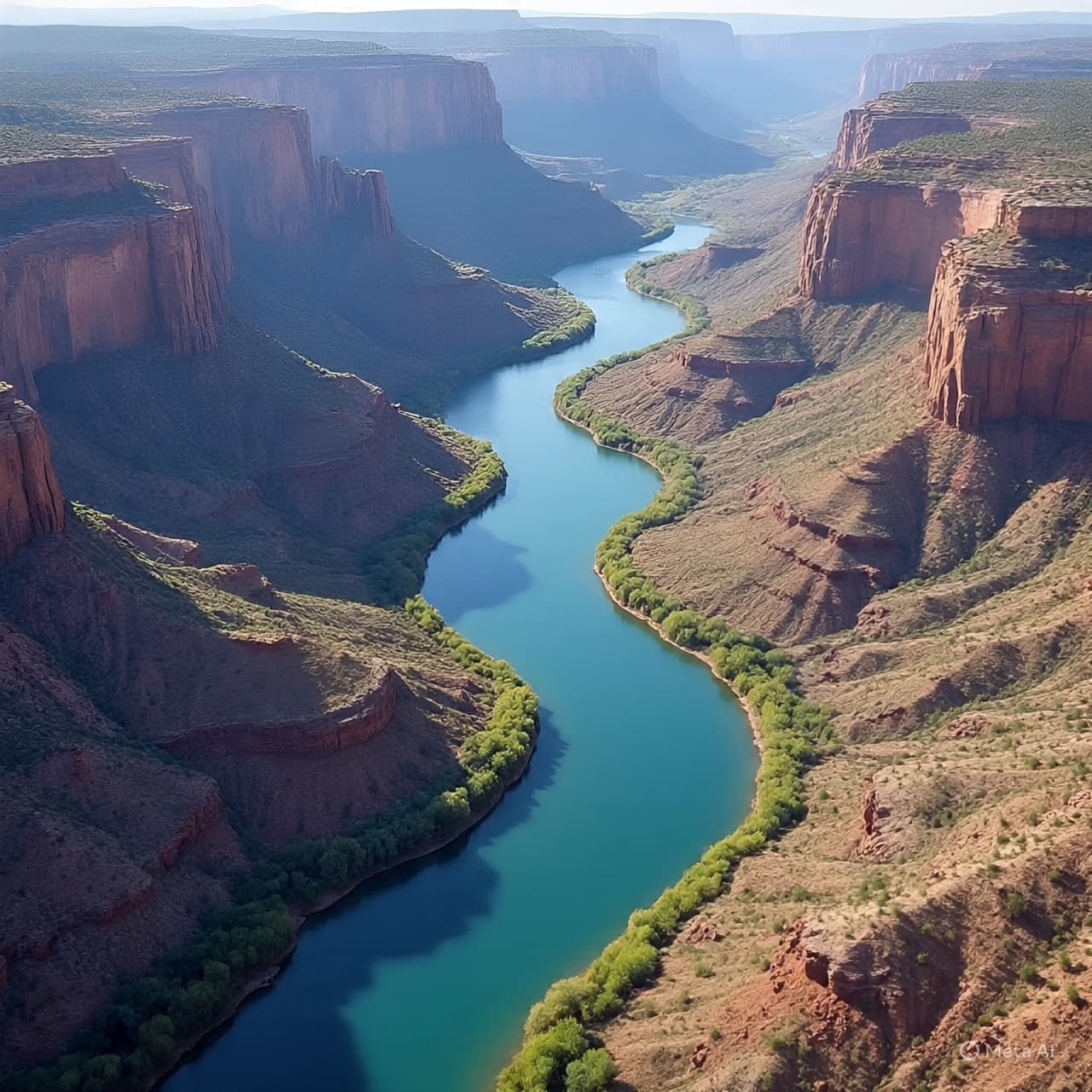
Across the rugged landscapes of the American Southwest, the Colorado River weaves its familiar path through canyons and plains. Yet one of its largest tributaries has long puzzled geologists: for more than a hundred miles, it appears to flow ‘uphill,’ defying the logic of gravity and expectation. Recent studies, however, suggest that the river’s strange behavior may be explained by subtle geological forces, reshaping our understanding of landscapes carved over millennia.
Researchers point to variations in rock density, hidden subsurface faults, and ancient tectonic shifts that create local pressure gradients capable of guiding water in unexpected directions. While the notion of an uphill river may seem like a paradox, it is a reminder that Earth’s surface is rarely as simple as it appears; the visible flow of water is the product of deep, imperceptible forces.
There is a poetry in this revelation. Water, the quiet sculptor of valleys, sometimes chooses a path that challenges perception, a fluid storyteller tracing histories encoded in stone. Observing this tributary, scientists glimpse the interplay of time, pressure, and erosion—forces that have shaped landscapes far before humans arrived to measure or marvel.
In understanding the river’s upward journey, we are reminded of the hidden dimensions of our world. Even phenomena that seem impossible at first glance can reveal profound truths about Earth’s processes, patience, and resilience. The tributary flows not just against elevation, but also as a testament to the complexity and wonder of the natural world.
AI Image Disclaimer Visuals are AI-generated and serve as conceptual representations.
Sources Geological Society of America Science Daily Nature Geoscience US Geological Survey National Geographic
Published by Banx Network. This article is part of the Banx decentralized media programme, powered by the BXE token on the XRP Ledger.