On clear nights, when darkness settles gently and the stars seem suspended like lanterns in a quiet hall, astronomers have long sought to measure the subtle drift of those distant lights. That drift, finely tied to the expansion of the cosmos itself, is captured in a number known fondly and formally as the Hubble constant. It is a number that tells a story of the universe’s growth, whispering of time and distance on a cosmic scale.
For decades, two main routes have been used to measure this expansion: observing flickering stars and exploding supernovae, and reading the ancient patterns of relic radiation left over from the Big Bang. Yet those methods have yielded slightly different answers, a discrepancy scientists affectionately call the “Hubble tension.” It is a persistent puzzle that suggests there may be more to learn about the universe’s history.
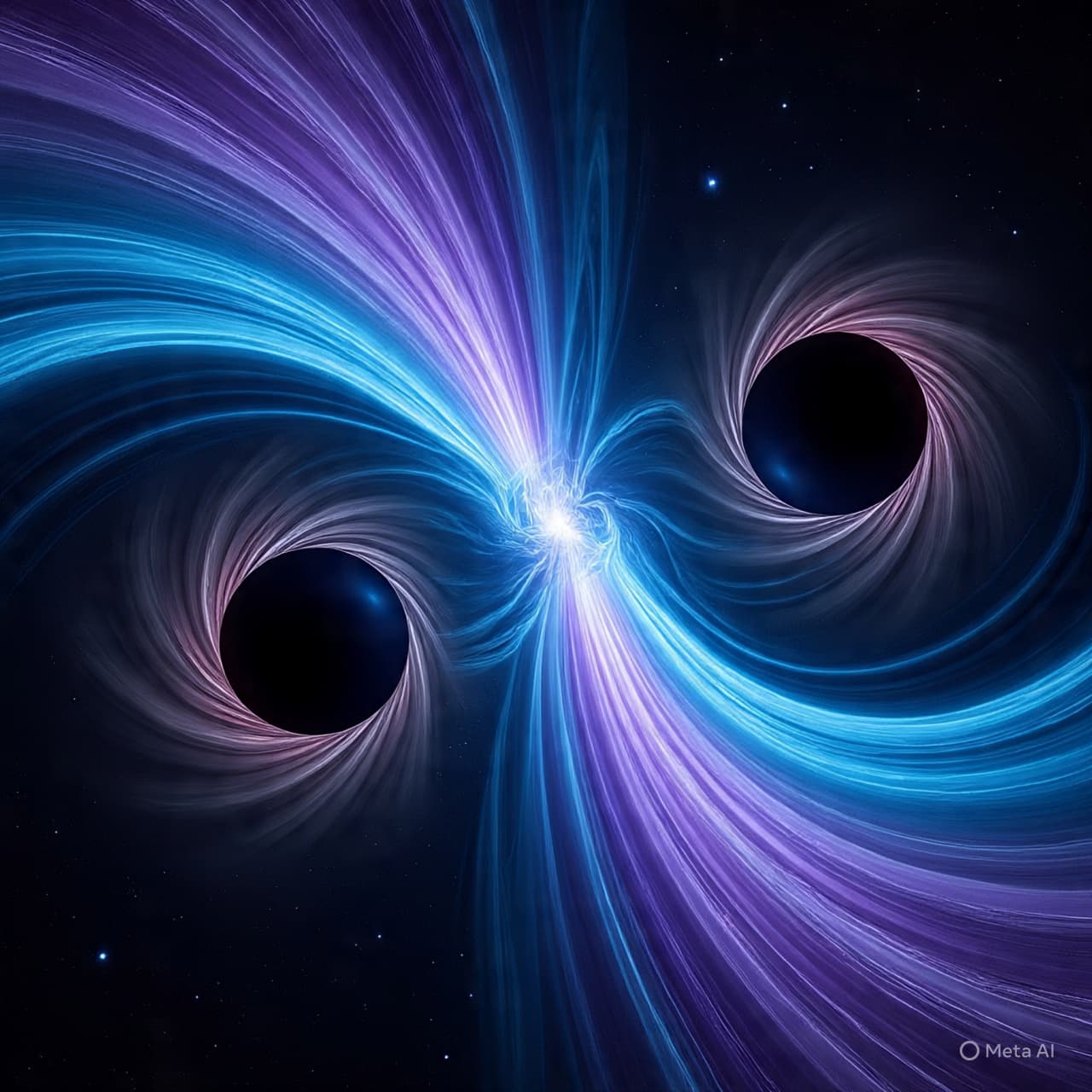
Now, a team of astrophysicists has proposed a novel way to add a new thread to this tapestry of measurement. Drawing on the faint, ambient “hum” of gravitational waves — ripples in spacetime produced by countless colliding black holes across the universe — researchers from the University of Illinois and the University of Chicago describe what they call the stochastic siren method. Rather than relying solely on visible light or individual gravitational wave events, this method listens to the collective background created by innumerable, distant mergers.
Imagine sitting by a river and hearing not only the splash of a single stone, but the distant, constant murmur of water over pebbles too small to see. In this analogy, the river’s steady murmur carries information about the flow itself. In the astrophysicists’ approach, the gravitational‑wave background plays that role: its statistical strength and pattern reflect how many collisions occur across vast distances, which in turn are shaped by how rapidly space expands.
The beauty of this framework lies in its independence from traditional methods. It does not depend on measuring light from individual stars or galaxies, nor on detailed cosmic microwave background maps. Instead, it treats gravitational waves — the subtle tremors left by deep cosmic violence — as a universal messenger. As detectors become more sensitive in the coming years, scientists hope this background hum will be detected in earnest, allowing them to sharpen measurements of the universe’s expansion rate.
Leading researchers emphasize that this approach complements, rather than replaces, existing techniques. Early work suggests that even without a direct detection of the gravitational‑wave background, upper limits on that signal can help rule out certain values of the Hubble constant. By combining information from both individual gravitational wave events and the background hum, scientists can refine estimates in a way that draws on the full orchestra of cosmic signals.
If successful, the stochastic siren method could help bridge the gap between differing measurements of the Hubble constant. It offers a promising new perspective at a time when resolving the Hubble tension is one of cosmology’s central goals. Like all scientific advances, this approach will grow in clarity as instruments improve and data accumulate.
For now, astrophysicists continue developing the theory and awaiting the next generation of gravitational‑wave observatories, which may soon hear the universe’s faint chorus in greater detail than ever before. These gentle ripples, stretching across spacetime, hold the promise of unveiling deeper truths about the universe we inhabit.
AI Image Disclaimer Visuals are created with AI tools and are not real photographs.
SOURCE CHECK Credible mainstream and niche news sources covering this development include:
Reuters BBC News Sci.News Phys.org Newswise
Published by Banx Network. This article is part of the Banx decentralized media programme, powered by the BXE token on the XRP Ledger.