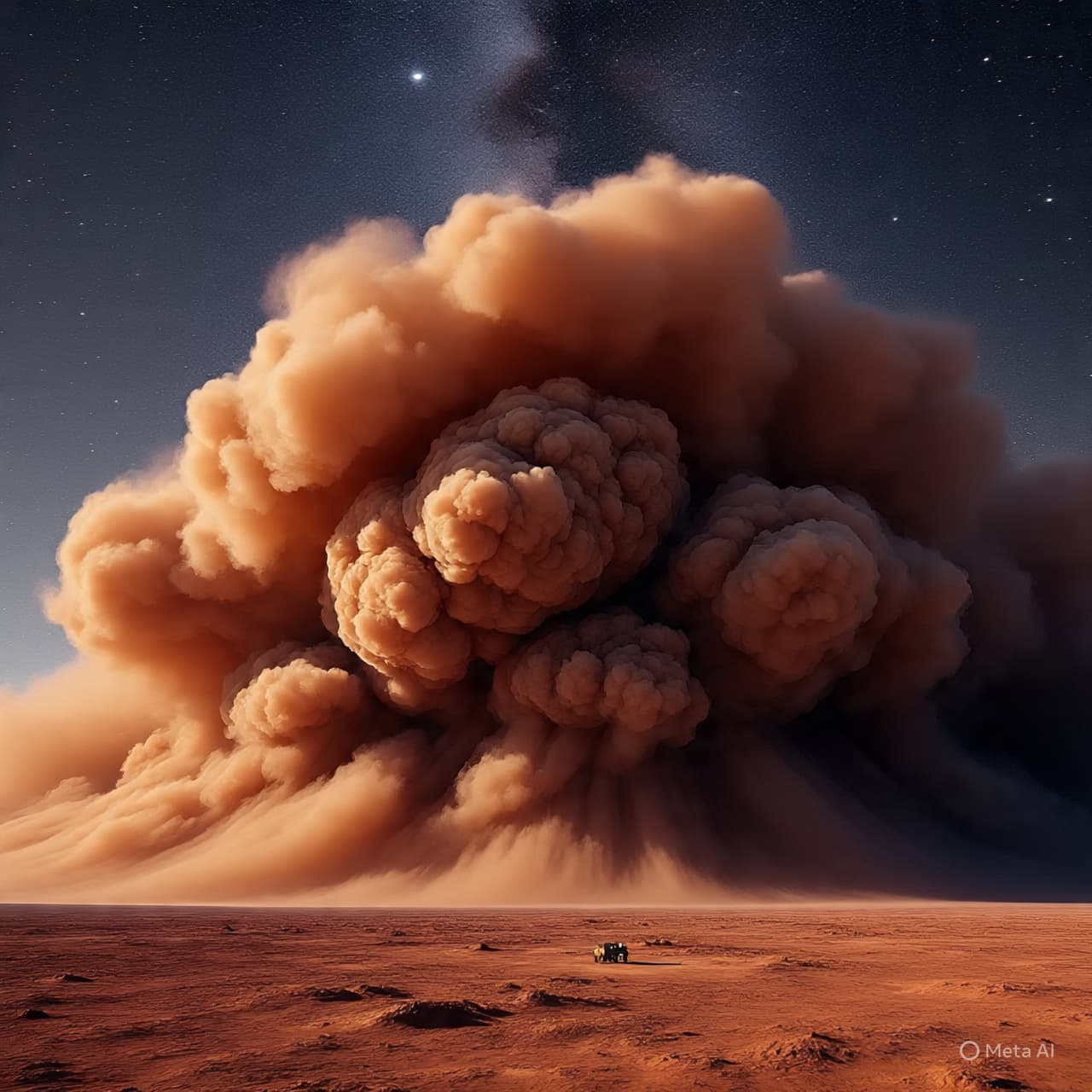
There are storms that pass and are forgotten, and others that seem to linger, not in memory alone but in the very fabric of a place. On Mars, storms do not arrive with rain or thunder. They rise instead as vast curtains of dust, lifting from the planet’s surface and spreading outward, sometimes until they obscure entire regions in a muted, ochre haze.
For a long time, these storms were understood as surface events—dramatic in scale, yet largely confined to the lower reaches of the atmosphere. But recent observations have begun to suggest something more far-reaching, as if the storms themselves were reaching upward, carrying with them traces of the planet’s past.
Scientists analyzing data from orbiting spacecraft have found that powerful Martian dust storms can propel water vapor to unexpectedly high altitudes. Once lifted into these upper layers, the water is exposed to conditions that allow it to break apart, with hydrogen atoms escaping into space. It is a process both gradual and profound, one that speaks to how Mars, over immense stretches of time, has been losing what water it once held.
The discovery has surprised researchers not because water loss on Mars is new, but because of the mechanism’s intensity. Dust storms, already known for reshaping the planet’s atmosphere, appear to act as vertical conveyors, drawing moisture upward far more efficiently than previously thought. During particularly large storms, this transport can extend to the very edge of the atmosphere, where the boundary between planet and space begins to thin.
These findings have been supported by instruments aboard missions such as those led by NASA and international partners, which monitor atmospheric composition and movement. By tracking the distribution of water vapor during storm events, scientists have observed clear spikes in altitude—moments when water is no longer held close to the surface, but carried into regions where escape becomes possible.
Mars has long been a world defined by absence. Dry riverbeds and mineral traces hint at a wetter past, suggesting that water once moved more freely across its surface. Understanding how that water disappeared is central to unraveling the planet’s history, and by extension, the conditions that shape planetary habitability.
The role of dust storms adds a new layer to that story. It suggests that loss is not only a slow seep into space, but also something episodic—intensified during periods when the planet’s atmosphere is stirred into motion. In this way, each storm becomes part of a larger pattern, contributing in small increments to a transformation that has unfolded over billions of years.
There is a certain quiet persistence in this process. No single storm empties the planet of its water, just as no single moment defines its history. Instead, it is the accumulation of events, each lifting a fraction higher, each allowing a little more to drift beyond reach.
Researchers report that Martian dust storms can carry water vapor to high altitudes where it is more likely to escape into space. Observations from orbiting missions continue to refine understanding of how these processes contribute to the long-term loss of water on Mars.
AI Image Disclaimer
Illustrations were created using AI tools and are not real photographs.
Source Check (verified coverage exists): BBC News, Reuters, The Guardian, Nature, NASA
Published by Banx Network. This article is part of the Banx decentralized media programme, powered by the BXE token on the XRP Ledger.